Landsbankinn
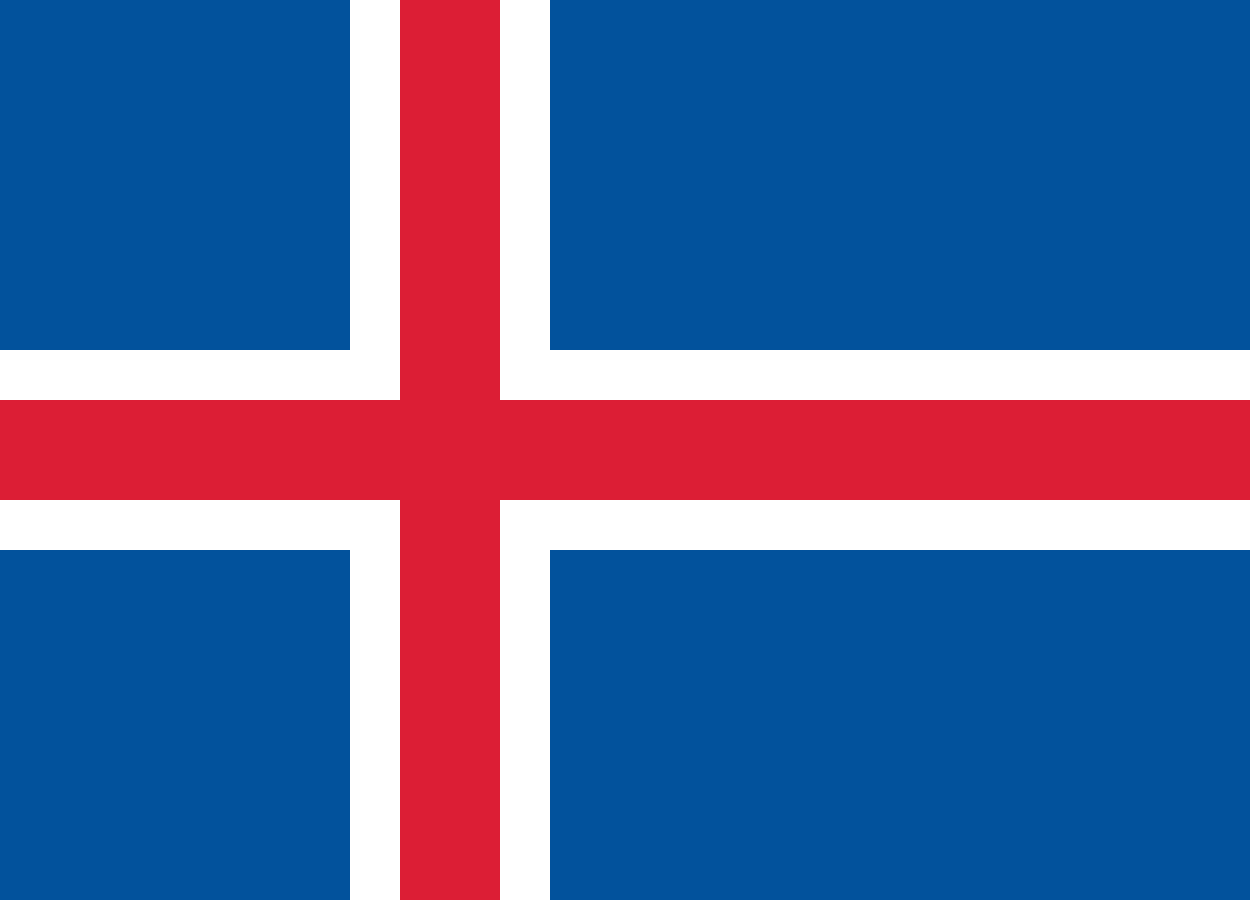
Landsbankinn is one of the three pillars of Icelandic banking, alongside Arion Bank and Íslandsbanki. It serves individuals and businesses, provides mortgages and corporate loans, handles payments, savings and investments, and offers asset management services. Following its acquisition of the insurance company TM tryggingar in 2025, it also operates in the insurance market. It has a user-friendly mobile app.

The bank’s name is familiar to generations of Icelanders, as the original Landsbanki Íslands began operating on July 1, 1886, and became the institution around which the country’s entire economy developed. However, it is not quite the same bank. Today’s Landsbankinn hf. is a separate legal entity, established on October 7, 2008, following the financial crisis, the Icesave affair and the closure of the old bank. In addition to retaining the historic name, the new company took over its domestic operations and customer services in Iceland.
Landsbankinn is one of Iceland’s largest banks. At the end of 2025, it held a 40.2% share of the retail banking market and accounted for approximately 40% of all loans issued to businesses by Iceland’s banking system. Its market share in the fishing and construction industries is around 50% or higher.
In the first half of 2026, Landsbankinn reported a net profit of ISK 22.1 billion. As of June 30, the group’s assets totaled ISK 2.417 trillion, loans to customers amounted to ISK 1.934 trillion, and deposits stood at ISK 1.331 trillion.
Full name | Landsbankinn hf. |
|---|---|
Historical origins | Landsbanki Íslands — 1886 |
Current bank | Established on October 7, 2008 |
Headquarters | |
Type | Commercial bank, hlutafélag (hf.) |
Status | Systemically important financial institution in Iceland |
Main activities | Retail and corporate banking, loans, payments, savings, investments, asset management |
Address | Reykjastræti 6, 101 Reykjavík |
Major shareholder | Icelandic State Treasury — 98.2% |
Official website |
History of the Bank’s Founding
The idea of establishing a national bank in Iceland emerged while the country was still under Danish rule and local businesses had limited access to capital. In the early 19th century, Iceland was a predominantly rural society, with a population scattered across the island, few urban settlements and an economy based on livestock farming.
Background and Context
Following Denmark’s trade reform, links with foreign markets expanded, widespread urbanization began, and infrastructure developed. At the time, Iceland had neither an established community of local bankers nor an extensive network of trading companies capable of pooling savings and turning them into loans. Many economic transactions had long taken place without sophisticated financial infrastructure. Money in circulation was scarce, and individuals and businesses seeking long-term capital had very few sources available to them.
Several community and state funds provided loans, and savings institutions began to emerge. The first attempts to organize savings-based lending date back to the 1850s, while the first permanent savings bank, Sparisjóður Múlasýslna, was founded in 1868. Before Landsbanki appeared, these small institutions effectively formed the backbone of the deposit-taking and lending sector.
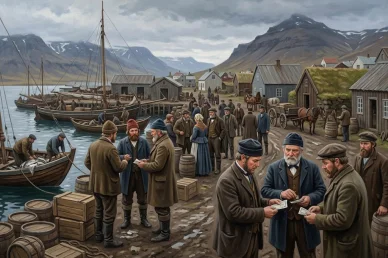
A historical reconstruction of Reykjavík's harbor in the 19th century: fishermen, merchants, and locals engage in lively trade beside wooden boats against the backdrop of Icelandic mountains
Economic changes coincided with political developments. Alþingi, Iceland’s historic parliament, was abolished by the Danish authorities in 1800, but in 1843 the king agreed to restore it as an advisory assembly. The restored Alþingi held its first session in Reykjavík in 1845. In 1874, the Constitution granted Alþingi legislative powers over Iceland’s internal affairs. A separate Icelandic National Treasury, known as landssjóður, gained authority over taxation and the allocation of public funds.
Against this background, the need for a bank became increasingly clear. During the second half of the 19th century, trade grew, the volume of monetary transactions increased, and fishing businesses expanded. Small savings institutions could no longer provide enough funding to purchase vessels, equipment or property, or to develop farms. Studies of Iceland’s financial history describe the period before 1886 as one of an underdeveloped financial market: monetary transactions were limited, credit institutions were almost nonexistent, and the country lacked an established currency issuance system of its own. Toward the end of the century, demand for loans rose rapidly, trade expanded, and new businesses emerged.
In 1881 and 1883, Alþingi considered bills to establish a bank, but both attempts failed. Members of parliament disagreed less about whether Iceland needed a bank than about what kind of bank it should have. One side argued for a conventional commercial institution that would handle money, deposits and short-term loans. The other wanted a mortgage bank capable of providing long-term loans secured by land and property, which were particularly important in an agricultural country. A compromise was reached in 1885: the future Landsbanki would combine both functions.

Althing deputies debating the establishment of Iceland's first national bank (Landsbanki), 1880s
The Establishment and Development of Landsbanki Íslands
In 1885, Alþingi finally passed the law establishing Landsbanki Íslands. The legislation defined the institution’s purpose as facilitating monetary transactions in Iceland and supporting the development of its economic sectors. Landsbanki was established as a state institution owned by Iceland’s landssjóður.
The Icelandic Treasury did not have 500,000 krónur readily available to contribute as the new bank’s initial capital. Instead, special Icelandic Treasury banknotes worth 500,000 krónur were issued, with landssjóður guaranteeing their parity with the Danish krone. The establishment of Iceland’s first bank effectively coincided with the introduction of the country’s first paper currency of this kind.
On July 1, 1886, Landsbanki Íslands opened its doors in Reykjavík. Its beginnings were modest: the bank occupied just a few rooms in a small building near Bakarabrekka, opened to customers for only a few hours two days a week, and employed a handful of people.
The bank emerged as Iceland was moving away from centuries of agricultural self-sufficiency, expanding foreign trade, growing its fishing industry, developing towns and gradually taking control of its own finances. Landsbanki became one of the instruments of this transformation, three decades before Iceland gained sovereignty in 1918.
In the early 20th century, Landsbanki expanded beyond the capital. One of its first regional branches opened in Akureyri in 1902, followed by another in Ísafjörður in 1904.
For a time, Landsbanki performed functions that now belong to the Central Bank of Iceland. In the 1920s, it gained the right to issue banknotes, and following a reorganization in 1927, it combined commercial banking with central banking functions. These two areas were separated within the institution in 1957. In 1961, a separate institution, Seðlabanki Íslands, the Central Bank of Iceland, was established. Landsbanki continued operating as a commercial bank.
Landsbanki remained state-owned until the late 20th century. The transition toward private ownership began in 1997, when it was converted into a public limited company, Landsbanki Íslands hf. The new company took over the bank’s operations, assets and liabilities on January 1, 1998. Later that year, a 15% stake consisting of newly issued shares was offered to the market, and the bank was listed on the Iceland Stock Exchange.

How Iceland Went BANKRUPT Overnight | The $85 Billion Collapse
In 1999, the state sold another 15% of the bank’s shares. In 2001, Alþingi authorized the government to sell its entire remaining stake. In 2002, another 20% was offered for public sale, while Samson eignarhaldsfélag ehf. acquired a 45.8% stake. The final 2.5% of state-owned shares was sold on February 25, 2003, formally completing Landsbanki’s privatization.
After privatization, Landsbanki expanded rapidly outside Iceland: it acquired financial companies, operated in the United Kingdom and Luxembourg, and grew its deposit-taking and lending business across Europe. The same international expansion that had appeared to signal the success of Icelandic banks in the early 2000s became a serious problem during the global credit crisis.
The 2008 Financial Crisis and Icesave
In the early 2000s, Iceland’s banking system grew much faster than the country’s domestic economy and relied on foreign markets.
The collapse of Icelandic banks in the fall of 2008 was part of a much larger global financial crisis rooted in the US housing market. Banks on both sides of the Atlantic were losing access to funding, investors were trying to shed risky assets, and institutions that had easily borrowed vast sums on international markets for years suddenly found it almost impossible to refinance existing debt.
What happened? In the early 2000s, the US housing market expanded rapidly. Banks issued increasing numbers of mortgages, including loans to borrowers with poor creditworthiness, known as subprime mortgages. Rising property prices created the impression that the risks were low: if a borrower stopped making payments, the house could supposedly always be sold for a higher price. Mortgages were pooled together and converted into financial instruments called mortgage-backed securities, or MBS. Banks, investment funds, insurance companies and other investors around the world bought these securities. Risk that had initially been tied specifically to US mortgages spread throughout the international financial system.
As long as house prices kept rising, the model appeared stable. When the US property market weakened, however, the number of troubled loans increased, and the securities linked to them lost value. The most serious problem was not necessarily the size of the losses, but the uncertainty: banks could not always determine how many risky assets their counterparties held or how much they might lose. As a result, interbank and short-term lending became more expensive and, at times, virtually stopped. This shift was dangerous for banks that financed long-term assets by continually raising new short-term funding.
In the spring of 2008, the US investment bank Bear Stearns avoided a disorderly bankruptcy only through its sale to JPMorgan Chase with support from the Federal Reserve. On September 15, 2008, Lehman Brothers filed for bankruptcy. It was one of the largest US investment banks, with extensive ties to financial institutions around the world.
After Lehman Brothers’ bankruptcy, distrust between banks escalated into a global liquidity crisis. Investors moved their money into safer assets, banks cut back on lending, and the short-term funding markets on which many large institutions depended virtually froze. Even US money market funds experienced heavy outflows: following losses at the Reserve Primary Fund, investors withdrew hundreds of billions of dollars from prime money market funds (MMFs) within a short period.
What did this have to do with Iceland? In the preceding years, Icelandic banks had built a successful system that could function properly only with continuous access to international funding.
After the privatization of the banking sector was completed in 2003, Landsbanki, Kaupthing and Glitnir began expanding extraordinarily quickly. They acquired companies and banks abroad, lent to international businesses, engaged in investment activities, and increased their presence in the United Kingdom and other Northern European countries. The combined assets of Iceland’s three largest banks rose from approximately 100% of the country’s GDP in 2004 to 923% at the end of 2007. Almost half of these assets were held abroad.
The three banks in Iceland, a country with just over 300,000 people, had combined balance sheets equivalent to almost nine times the annual output of the entire Icelandic economy. The domestic market was too small to provide the deposits and capital they needed, so they increasingly borrowed abroad.
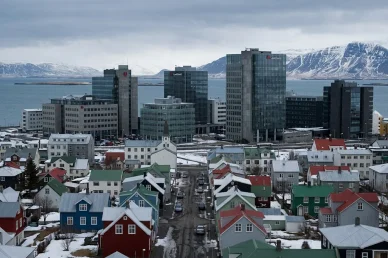
The urban contrast visually highlights the scale of the financial system, whose assets on the eve of 2008 exceeded the GDP of the small island nation ninefold
By the end of 2007, approximately 75% of borrowing came from large loans on international financial markets, bond issues and other sources that required regular refinancing. As long as international investors were willing to lend to Icelandic banks, the system worked perfectly. Then the global crisis struck.
In a crisis, a major US, British or German bank could rely on the central bank of a country with substantial foreign exchange reserves and a large economy. The Central Bank of Iceland, however, had to support institutions whose combined balance sheets were many times larger than the country’s GDP. The banking system had grown so large that it effectively exceeded the Icelandic state’s financial capacity to act as its lender of last resort.
After the global credit crisis began in the summer of 2007, investors sharply increased the cost of protection against default through credit default swaps (CDS). By September 2008, the Icelandic króna had lost more than 40% of its value compared with earlier levels, while CDS spreads for the largest banks were approaching 1,000 basis points.
Landsbanki and the other banks tried to reduce their dependence on large international lenders by attracting retail deposits abroad. This was the context in which Landsbanki developed Icesave, an online platform offering competitive interest rates to savers in the United Kingdom and, from 2008, in the Netherlands. For a time, these deposits provided the bank with a new source of funding. However, they also created a situation that became an international dispute after Landsbanki’s bankruptcy: billions of euros and pounds belonged not to large professional investors, but to hundreds of thousands of ordinary British and Dutch depositors.
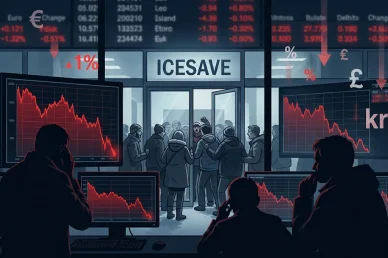
Panic among foreign Icesave depositors and the collapse of financial markets during the banking system crash
By mid-2008, Icelandic banks had largely exhausted their available funding options. Glitnir was the first to buckle. On September 25, the bank asked the Central Bank of Iceland for €600 million in emergency liquidity: several large obligations were due in October, and it could no longer obtain the foreign currency it needed on the market. The central bank rejected the proposed loan arrangement. On September 29, the government announced plans to acquire a 75% stake in Glitnir for €600 million.
Depositors began withdrawing funds from Landsbanki and Kaupthing. Landsbanki’s position was particularly difficult. According to the parliamentary investigative commission, approximately £318 million was withdrawn from British Icesave accounts over the weekend before October 6 alone. The British regulator required the bank to provide additional liquidity for its UK operations. Landsbanki requested €500 million from the Central Bank of Iceland but was unable to secure the funds.
By early October 2008, the question was no longer how to rescue an individual Icelandic bank, but how to prevent the entire domestic payment system from shutting down.
On October 6, 2008, Alþingi passed Emergency Act No. 125/2008, granting the Financial Supervisory Authority exceptional powers to intervene in banks’ operations. It also allowed the system to be restructured, prioritizing the protection of domestic deposits and essential banking services in Iceland.
The following day, the regulator took control of Landsbanki. The other two major banks collapsed soon afterward. Within days, virtually the entire core of Iceland’s banking system had ceased to exist, despite having recently managed assets worth almost nine times the country’s GDP.
The Icelandic króna fell sharply. Its decline on the offshore foreign exchange market exceeded 70%, while Iceland’s stock market lost approximately 80% of its value. The depreciation hit individuals and businesses with foreign currency-linked loans particularly hard. Rising prices following the króna’s collapse also increased the burden of inflation-indexed loans.
The government sought international assistance. On November 19, 2008, the IMF approved a two-year, $2.1 billion Stand-By Arrangement for Iceland, supplemented by funding from other countries. The main objectives were to stabilize the króna, rebuild the banking system and regain control of public finances.
The financial shock was followed by a recession. Iceland’s real GDP contracted by approximately 6.8% in 2009, private consumption fell by almost 15%, and domestic demand declined by more than 20%.
Bankruptcies, household debt, the króna’s collapse and questions about the responsibility of the government and bankers sparked scandals and large-scale protests known as the “Pots and Pans Revolution,” or Búsáhaldabyltingin. Protesters gathered outside Alþingi, banging kitchen utensils and demanding accountability for the collapse of the financial system.
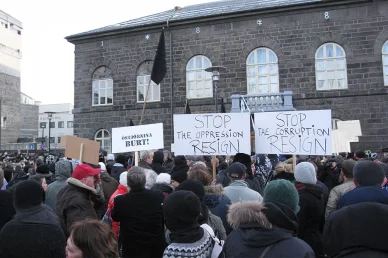
The "Kitchenware Revolution" (Búsáhaldabyltingin) outside the Althing building in Reykjavík following the financial collapse (November 15 2008)
The Icesave affair forced Iceland to confront the question of who should pay for the consequences of a private bank’s international expansion when its liabilities exceeded the resources of the country in which it was registered. The dispute with the United Kingdom and the Netherlands continued for several years after Landsbanki Íslands had ceased operating.
Nýi Landsbanki Íslands hf. — “New Landsbanki”
On October 7, 2008, the financial regulator FME took control of Landsbanki Íslands hf. That same day, the Ministry of Finance established a new legal entity, initially named Nýi Landsbanki Íslands hf., or “New Landsbanki.” The new bank effectively began operating on October 9, taking over most of the old Landsbanki’s domestic assets, its loans and all its deposits in Iceland. Overseas operations and the associated debts remained with the old company.
On October 21, 2008, the new bank’s legal name was changed to NBI hf., although it operated under the Landsbankinn brand for customers. Landsbankinn hf. also became its official legal name following a shareholders’ resolution on April 28, 2011.
The separation of domestic and foreign liabilities became a central issue in the subsequent Icesave dispute. Icesave was the old Landsbanki’s online deposit service for foreign savers. It launched in the United Kingdom in October 2006 and in the Netherlands in May 2008.
Icesave offered competitive interest rates and quickly attracted substantial deposits. According to the IMF, when Landsbanki collapsed, Icesave had more than 300,000 customers in the United Kingdom, with deposits exceeding £4 billion. In the Netherlands, it attracted more than 125,000 customers and €1.7 billion in just five months. Total Icesave deposits were equivalent to approximately 60% of Iceland’s GDP in 2008.
When Landsbanki ceased operating, British and Dutch depositors lost access to their accounts. Deposits within Iceland had already been transferred to the newly established bank, so the different treatment of domestic and foreign depositors quickly turned a banking problem into an international conflict. The United Kingdom decided to compensate Icesave’s retail depositors and subsequently sought reimbursement for the portion of those payments it believed should have been covered by Iceland’s deposit guarantee scheme.
On October 8, 2008, the UK Treasury issued the Landsbanki Freezing Order, freezing Landsbanki’s assets in the United Kingdom. It used powers granted under the Anti-terrorism, Crime and Security Act 2001. The law’s name prompted persistent claims that the British government had “used anti-terrorism legislation against Iceland.” Over the following years, the governments of Iceland, the United Kingdom and the Netherlands tried to agree on repayment arrangements.

The Iceland Banking Collapse Explained Like You're 5
Iceland held its first referendum on the issue on March 6, 2010, but voters rejected the proposed arrangement. It was the first nationwide referendum since the Republic of Iceland was established in 1944. After a second referendum, which also failed to resolve the issue, the dispute moved to the courts. The EFTA Surveillance Authority brought a case before the EFTA Court, arguing that Iceland had failed to meet its obligations under the European directive on deposit guarantee schemes and had discriminated against foreign depositors.
On January 28, 2013, the EFTA Court dismissed the case against Iceland. The court did not find the alleged breach of the directive in the circumstances of a systemic banking crisis of this magnitude.
The United Kingdom and the Netherlands did not write off the money paid to depositors. A substantial portion was recovered from the old Landsbanki’s assets during its liquidation. On January 15, 2016, the UK Treasury announced that it had received a final payment of £740 million. In total, the United Kingdom recovered £4.6 billion from the Landsbanki estate.
However, Icesave is more accurately described as a case involving the old Landsbanki Íslands hf., rather than a debt owed by today’s Landsbankinn. The current institution was established as part of the rescue of Iceland’s domestic banking infrastructure.
Landsbankinn Today: Services and Innovation
After 2008, the changes extended beyond the bank’s legal structure. Iceland’s banking system became subject to much stricter regulation: Landsbankinn, Arion Bank and Íslandsbanki are designated as systemically important institutions and must maintain an additional 3% O-SII capital buffer. Based on the results of its 2026 stress test, the Central Bank of Iceland considers these three major banks sufficiently resilient to continue lending even in the event of a severe economic shock.

Landsbankinn Iceland: Where stone facades unite nature and urban life
In the first half of 2026, Landsbankinn increased lending to customers by ISK 49.4 billion and deposits by ISK 81.3 billion compared with the end of 2025. Its liquidity coverage ratio (LCR) stood at 244% at the end of June. Loans more than 90 days overdue remained low, accounting for 1.2% of the loan portfolio.
As of October 2026, the Icelandic State Treasury, Ríkissjóður Íslands, owns 98.2% of Landsbankinn’s shares. The bank has approximately 800 shareholders in total, but private and other holdings together represent only a small proportion of its capital. The Ministry of Finance and Economic Affairs manages the state’s stake.
When the new bank was established in 2008, it was initially wholly state-owned. Following a valuation of the assets transferred from the old Landsbanki, the state, the new bank and Landsbanki Íslands hf. signed a financial agreement in December 2009. After some claims were converted into equity, the ownership structure changed: the state held 81.33%, while the old Landsbanki owned 18.67% through Landskil ehf.
In 2013, following the final valuation of the transferred assets, LBI hf. relinquished its stake in the new bank. The state received approximately 98%, while around 2% went to Landsbankinn itself for the subsequent distribution of some shares to employees. The state’s stake later settled at its current level of 98.2% and remains unchanged in 2026.
Services for Individuals and Businesses
Today, Landsbankinn operates as a full-service bank for retail customers. Customers can open current and savings accounts, obtain debit or credit cards, take out mortgages, use foreign currency accounts, make international payments, invest in funds and securities, and manage their pension savings.
International transfers are available through SEPA and SWIFT. Customers can open a foreign currency account themselves and view their accounts’ IBANs directly through digital banking. Landsbankinn’s SWIFT code is NBIIISRE.
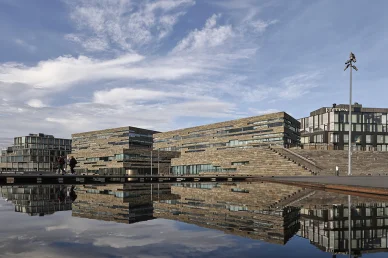
Landsbankinn operates as a full-service bank for retail customers
Following the acquisition of TM tryggingar hf. in February 2025, insurance services are also being gradually integrated into the bank’s services. Customers can view their TM insurance policies in the Landsbankinn app.
According to 2025 figures, Landsbankinn accounted for approximately 40% of all bank lending to businesses in Iceland. Its lending extends beyond large corporations: the bank also serves small and medium-sized businesses, tourism companies, trade and construction businesses, the maritime sector, and technology and healthcare companies. In 2025, Landsbankinn also launched a new version of its corporate online banking service.
The Landsbankinn mobile app is becoming increasingly popular. By the end of 2025, 88% of retail customers used it regularly, with approximately 70% primarily using the app rather than browser-based online banking. During the year, users opened the app 52.2 million times, a 25% increase compared with 2024.
The app provides access to accounts and transaction histories, payments and transfers, card management, savings, loans, mortgages, pension products, securities and selected TM insurance services.
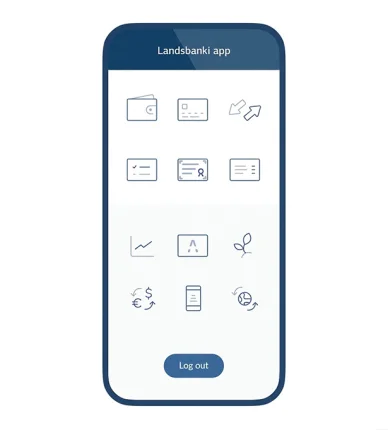
The Landsbankinn mobile app is becoming increasingly popular
Open banking also allows customers to view accounts held with other Icelandic banks: Arion Bank, Íslandsbanki and Kvika/Auður. Landsbankinn subsequently added the ability to make transfers from accounts at other banks through its app.
Customers can log in using electronic IDs (rafræn skilríki), the Auðkenni app or biometric authentication through Face ID or a fingerprint. Auðkenni works over the internet and does not require an Icelandic phone number, making it convenient for people living abroad or using a foreign SIM card.
However, upgraded digital services have not led Landsbankinn to abandon its physical network. At the end of 2025, the bank had 34 branches and service points across Iceland, the largest such network among the country’s financial institutions. It also operated 84 ATMs across 43 locations.
Sustainability and Social Responsibility
For Landsbankinn, environmental impact is measured by more than the electricity its offices consume or the fuel its vehicles use. The companies and projects the bank finances have a much greater impact.
More than 99% of Landsbankinn’s calculated emissions are financed emissions: emissions from businesses and assets associated with the bank’s loans and investments. Landsbankinn does not produce these emissions directly but accounts for a share of the climate footprint of the businesses it finances. The bank uses the Partnership for Carbon Accounting Financials (PCAF) methodology for these calculations. It allows financial institutions to estimate the proportion of companies’ emissions attributable to their loans and investments.

Explained | The Partnership for Carbon Accounting Financials (PCAF) for Financed Emissions
The largest contributors to the climate footprint of Landsbankinn’s loan portfolio are industries that play a significant role in Iceland’s economy: tourism, fishing and seafood processing, as well as services, information technology and telecommunications. Together, these sectors account for approximately 60% of the loan portfolio’s estimated emissions.
The bank also sets separate targets for its own operations. By 2030, Landsbankinn plans to reduce its direct emissions and emissions associated with purchased energy by 95% compared with 2019. These are known as Scope 1 and Scope 2 under the international emissions accounting system. The much larger Scope 3 category covers indirect emissions, including those associated with lending and investment. According to the bank’s 2025 report, its Scope 3 emissions were approximately 27% below the 2019 baseline.

Sustainable Finance Framework - a set of rules for determining which assets qualify for green or social financing
Another area of focus is financing projects that meet environmental or social criteria. To support this work, Landsbankinn developed its Sustainable Finance Framework, a set of rules for determining which assets qualify for green or social financing. Examples include projects in renewable energy, energy efficiency, green construction and other areas that meet the established criteria. In developing the framework, the bank drew on the international Green Bond Principles and Social Bond Principles, as well as the EU Taxonomy for sustainable activities.
One example of Landsbankinn’s environmental approach is its new headquarters at Reykjastræti 6 in the Austurhöfn area of central Reykjavík. Before the move, head office employees were spread across several buildings in the city center. The new complex brought most departments together in one location and reduced the amount of floor space the bank used for its operations. The building was designed to meet requirements for energy efficiency, resource use, indoor environmental quality and environmental impact. In June 2026, Reykjastræti 6 received its final BREEAM Excellent certification. Excellent is the second-highest rating in the BREEAM system. Reykjastræti 6 became the first building in Iceland to receive final certification at this level under the BREEAM 2016 standard.
Landsbankinn’s social responsibility extends beyond environmental issues. The bank funds community, cultural, educational and charitable initiatives through its own grants and partnership programs. In 2026, Landsbankinn is distributing ISK 20 million through its Community Fund. Eligible recipients include humanitarian and charitable organizations, cultural and arts projects, educational and scientific initiatives, youth programs, and projects focused on nature conservation and sustainability.

Landsbankinn supported the Skólahreysti school sports competitions
Another area of focus is sports and youth engagement. Over the years, Landsbankinn has supported the Skólahreysti school sports competition, partnered with the Football Association of Iceland (KSÍ), and funded sports programs for children and young people.
The bank also supports cultural events and community initiatives, including Reykjavík Pride, arts projects and festivals. Part of Landsbankinn’s community work focuses on financial literacy: bank employees teach classes for upper secondary school students, while its website offers resources on personal finance, savings, loans and other everyday banking topics.
Social Media and Contact Information


Address | Landsbankinn hf., Reykjastræti 6, 101 Reykjavík |
|---|---|
ID | 471008-0280 |
SWIFT/BIC | NBIIISRE |
Phone | +354 410 4000 |
Website | https://www.landsbankinn.is/ |
Customer support is available on weekdays from 9:00 a.m. to 4:00 p.m.
The chat also features a virtual assistant, Ellí. Available around the clock, she answers common questions and transfers inquiries to a customer service representative when needed.
FAQ
❓What is Landsbankinn?
Landsbankinn is an Icelandic commercial bank and one of the country’s three systemically important credit institutions. It serves individuals and businesses, provides loans and mortgages, and offers payment, savings, investment and asset management services.
❓Who currently owns Landsbankinn?
The Icelandic State Treasury owns 98.2% of the bank’s shares. The Ministry of Finance and Economic Affairs manages the state’s stake, while the remaining shares are held by the bank itself and several hundred minority shareholders.
❓When was Landsbankinn founded?
The original Landsbanki Íslands opened on July 1, 1886. Today’s Landsbankinn hf. was established on October 7, 2008, following the collapse of the former legal entity. The new bank began handling the domestic operations transferred to it on October 9, 2008.
❓What services does Landsbankinn offer individuals?
The bank offers current and savings accounts, debit and credit cards, mortgages and other loans, SEPA and SWIFT transfers, and pension and investment products. Most everyday transactions can be completed through the app or online banking.
❓What happened to Landsbanki during the 2008 crisis?
On October 7, 2008, FME took control of Landsbanki Íslands hf. Two days later, domestic deposits and core Icelandic operations were transferred to a new state-owned bank. Foreign assets and liabilities remained with the old Landsbanki, which subsequently entered liquidation.
❓What was the Icesave dispute?
Icesave was the old Landsbanki’s online deposit service in the United Kingdom and the Netherlands. After the bank collapsed, the governments of both countries compensated depositors, leading to a dispute lasting several years over how much Iceland should guarantee. Two referendums were held, in 2010 and 2011, and voters rejected the proposed agreements both times. In 2013, the EFTA Court dismissed the case against Iceland. A substantial portion of the compensation was later recovered from the old Landsbanki’s assets; the United Kingdom completed the recovery of its costs in 2016.
❓Where is Landsbankinn’s head office?
It is located at Reykjastræti 6, 101 Reykjavík, in the Austurhöfn area.
❓How can a foreign national open an account with Landsbankinn?
An Icelandic kennitala, or personal identification number, is required first. After obtaining a kennitala, the easiest option is to set up electronic identification and register through the Landsbankinn app. Anyone without electronic identification can book an appointment at a branch. The bank requires a valid identity document and carries out standard customer checks under anti-money laundering rules. Foreign citizenship does not prevent someone from opening an account.
❓Is the Landsbankinn mobile app easy to use?
The app handles most transactions that would otherwise require a branch visit. Customers can manage accounts and cards, pay bills, transfer money, open savings accounts, apply for mortgages, and monitor pension savings and investments. At the end of 2025, 88% of Landsbankinn’s retail customers used the app regularly, with 52.2 million logins recorded during the year.
❓What environmental initiatives does Landsbankinn support?
Landsbankinn measures emissions from its own operations and loan portfolio, uses the PCAF methodology, has climate targets validated by SBTi, and finances projects through its Sustainable Finance Framework. In 2026, the bank’s new headquarters at Reykjastræti 6 received final BREEAM Excellent certification.