Icelandic króna
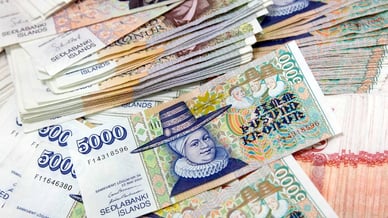
The Icelandic króna (currency code: ISK, symbol: kr) is the national currency of Iceland. One króna was historically divided into 100 aurar, although this subdivision is now purely nominal. The eyrir was withdrawn from circulation in 1995, and since 2003 the króna has no longer been divided into smaller units.
The króna is issued by the Central Bank of Iceland, while Icelandic banknotes are produced by the British security printing company De La Rue.
Historical background
Iceland’s recorded history begins relatively late, in the late 9th century, with the arrival of Norse settlers. The island was initially settled by Norwegian Vikings and later became part of the Kingdom of Norway. After the Kalmar Union, sovereignty eventually passed to the Danish Crown. Iceland gained full independence only in 1944, when the Althingi—one of the world’s oldest parliaments—voted to dissolve the union with Denmark.

Icelandic króna
Until 1771, all currency in circulation in Iceland was of Norwegian or Danish origin. Between 1771 and 1774, the first coins bearing the name of Iceland were minted. This limited issue consisted of 543 silver trading dollars (piastres) with a fineness of 902.
Over the following century, a growing independence movement led to Iceland being granted limited autonomy within the Kingdom of Denmark. In 1885, the National Bank of Iceland was established, and in 1886 it issued its first banknotes in denominations of 5, 10, and 50 krónur. At the same time, currencies from other Scandinavian countries—Denmark, Norway, and Sweden—continued to circulate alongside the Icelandic króna.
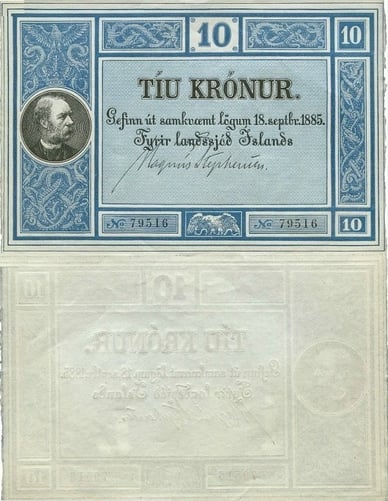
10 Icelandic krona from 1885
In 1918, Iceland became a sovereign kingdom in personal union with Denmark. Although this marked an important step toward independence, the country remained under the Danish monarch Christian X, whose portrait appeared on Icelandic banknotes of the period.
In May 1944, Iceland declared full independence and adopted a republican system of government, ending the monarchy. Two years later, the country introduced a new series of banknotes and coins that no longer featured royal symbols.
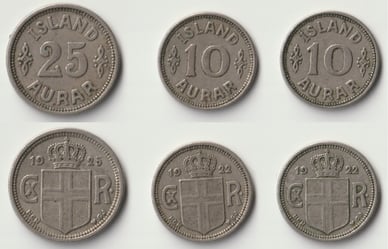
Coins of 10 and 25 aurar, issued in 1922
Soon after, the Icelandic króna began to experience significant depreciation due to economic challenges. This eventually led to a currency redenomination in 1981, when old krónur were exchanged for new ones at a rate of 100:1.
Over time, smaller-denomination banknotes and coins were withdrawn from circulation and replaced with higher values. Today, the smallest banknote in circulation is 500 kr, while the largest is 10,000 kr, with current designs issued between 2001 and 2019.
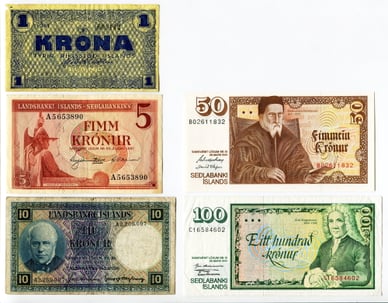
Icelandic krona of various issues
The global financial crisis of 2008 caused a sharp collapse in the value of the Icelandic króna, which lost more than half of its value. Although discussions emerged about adopting the euro and joining the European Union, no formal decision was made to abandon the national currency.
In 2010, Iceland began negotiations to join the European Union, but these talks were suspended in 2013 amid public opposition. In 2015, the application was formally withdrawn, and the króna remains Iceland’s national currency.
Appearance of the Icelandic króna
There are currently five banknote denominations in circulation in Iceland. They are protected by a range of modern security features, including security threads, ultraviolet elements, microprinting, and other anti-counterfeiting measures. All banknotes feature a watermark portrait of Jón Sigurðsson, a key figure in Iceland’s independence movement.
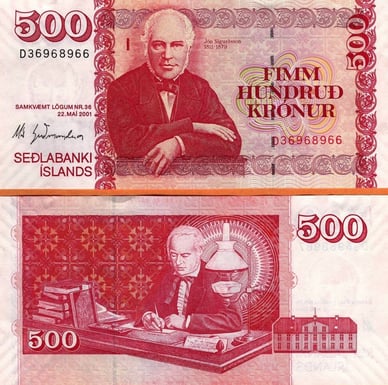
500 krónur — a red banknote measuring 145 × 70 mm. The obverse features Jón Sigurðsson, while the reverse depicts a tapestry illustrating a gymnasium in Reykjavík, alongside a repeat portrait motif;

Currency of 500 Icelandic krona denomination
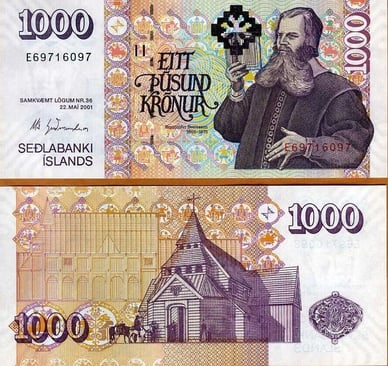
Wikipedia 1,000 krónur — a purple and orange banknote measuring 150 × 70 mm. The obverse shows poet and philologist Brynjólfur Sveinsson, and the reverse features Skálholt Cathedral;

Currency denomination of 1000 Icelandic krona
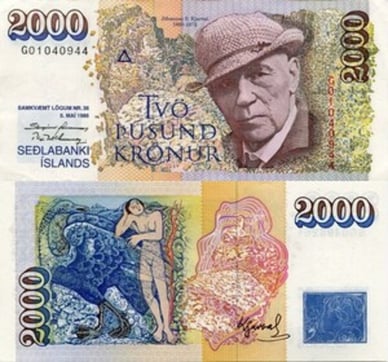
Wikipedia 2,000 krónur — a banknote in blue and brown tones, measuring 150 × 70 mm. The obverse bears a portrait of Icelandic artist Jóhannes S. Kjarval, while the reverse displays two of his paintings;

Currency of 2000 Icelandic krona
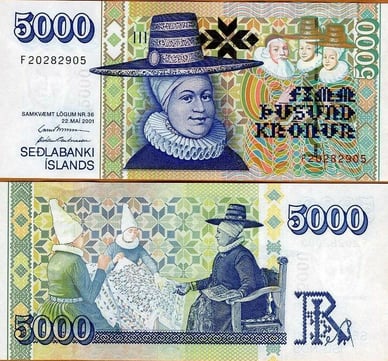
Wikipedia 5,000 krónur — a blue-green banknote measuring 155 × 70 mm. The obverse features Ragnheiður Jónsdóttir, a seamstress and social activist, and the reverse shows a scene of her embroidering a tapestry with two students;

Currency of 5000 Icelandic krona
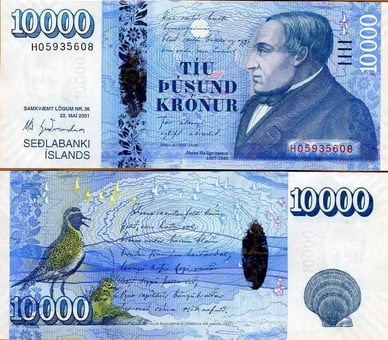
Wikipedia 10,000 krónur — a banknote in light and dark blue tones, measuring 160 × 70 mm. The obverse depicts Jóhann Sigurjónsson, one of Iceland’s most renowned poets and playwrights. The reverse features a stanza from one of his poems, set against an image of a golden plover with its chick.

Currency denomination of 10,000 Icelandic krona
Wikipedia
Coins
There are currently five denominations of coins in circulation in Iceland, all denominated in krónur. Coins in aurar were fully withdrawn from circulation in 2003.
Icelandic coins are notable for their distinctive designs, which traditionally feature the four guardian spirits of Iceland (landvættir) on one side and marine-themed motifs on the other.
- 1 króna — a nickel-plated steel coin. One side features a guardian spirit, while the reverse displays a marine motif;
- 5 krónur — a nickel-plated steel coin. The obverse depicts a dragon, one of Iceland’s landvættir, with a marine design on the reverse;
- 10 krónur — a nickel-plated steel coin featuring a griffin on one side and a marine-themed design on the other;
- 50 krónur — a nickel-plated brass coin. The obverse shows a bull, another of the guardian spirits, while the reverse depicts a coastal marine motif;
- 100 krónur — a nickel-plated brass coin. The obverse features a giant, and the reverse carries a marine design inspired by Iceland’s maritime heritage.
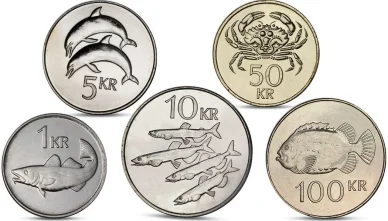
Icelandic krona coins
The Icelandic króna in the world
Iceland’s national currency circulates exclusively within the country and is neither a reserve currency nor fully convertible on international markets. The Icelandic króna operates under a floating exchange rate regime.
The króna is known for its high volatility, largely due to Iceland’s economic dependence on exports such as fish, aluminium, and tourism. The global financial crisis of 2008 severely weakened the currency, although it has shown periods of recovery in recent years, supported by economic growth.
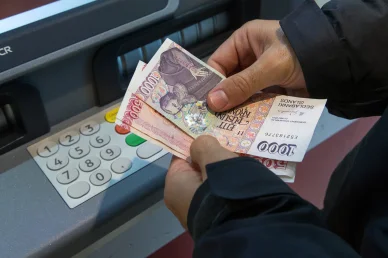
Icelandic krona
Some economists have suggested that Iceland could eventually adopt the euro or another more stable currency. However, the Icelandic government continues to pursue an independent monetary policy, with the króna remaining at the centre of the country’s financial system.
Icelandic krona exchange rate against other currencies
As of 6 March 2025, the official exchange rate of the Icelandic króna (ISK) against major currencies is as follows:
Currency | ISK exchange rate per 1 currency unit |
|---|---|
US dollar (USD) | 136,99 |
Euro (EUR) | 146,50 |
Pound sterling (GBP) | 175,45 |
Polish zloty (PLN) | 35,301 |
Ukrainian hryvnia (UAH) | 4,566 |