Euro
The euro (€, EUR) is the second most widely held reserve currency in the world, after the US dollar. It is the world’s youngest major currency: it has been used for non-cash transactions since 1999, while euro banknotes and coins entered circulation in 2002.
The euro is the official currency of 20 member states of the European Union, which together form the eurozone, as well as several non-EU countries and territories that use it either through formal agreements or unilaterally. Croatia adopted the euro in 2023, while Bulgaria joined the eurozone on January 1, 2026.

History
The introduction of the euro followed the creation of the European Union under the Maastricht Treaty, signed in 1992. The treaty established the legal and economic framework for the creation of a single European currency for participating member states. The name euro was officially adopted in 1995 following approval by the European Council.
The Maastricht Treaty also set out a series of convergence criteria that countries must meet in order to adopt the euro, including requirements related to inflation, public finances, exchange rate stability, and long-term interest rates.

The introduction of the euro followed the establishment of the European Union with the Maastricht Treaty, which was signed in 1992
Not all EU member states supported the transition to the new currency. The United Kingdom and Denmark negotiated formal opt-outs, allowing them to remain outside the eurozone. Sweden chose not to adopt the euro following a national referendum, in which voters decided to retain the Swedish krona.
The Baltic states initially postponed adopting the euro due to difficulties in meeting the Maastricht criteria. Estonia was the first of the three to join the eurozone, introducing the euro in 2011, followed by Latvia in 2014 and Lithuania in 2015.

History of the Euro Currency and the Eurozone
Several EU member states continue to use their national currencies and currently have no fixed timetable for adopting the euro.
A number of non-EU countries have officially adopted the euro for everyday use through monetary agreements with the EU. These include Vatican City, Andorra, Monaco, and San Marino. In addition, the euro is used as legal tender in certain EU territories, such as Saint Pierre and Miquelon, which is an overseas collectivity of France.
In several other regions, the euro is widely used but not officially recognised as legal tender. These include the French overseas communities of Saint Martin and Saint Barthélemy, the British Sovereign Base Areas of Akrotiri and Dhekelia in Cyprus, as well as the Balkan states of Montenegro and Kosovo, which have adopted the euro unilaterally.
Appearance
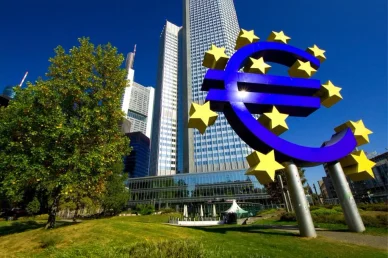
The euro is issued by the European Central Bank (ECB)
The euro is issued by the European Central Bank (ECB). Together with the national central banks of EU member states, it forms the Eurosystem, which is responsible for the issuance, circulation, and overall monetary policy of the euro area.
Banknotes
Euro banknotes are issued in two series. The first series, introduced in 2002, was designed by Austrian banknote designer Robert Kalina. The second series, known as the Europa series, was released gradually between 2013 and 2019 and designed by German artist Reinhold Gerstetter.
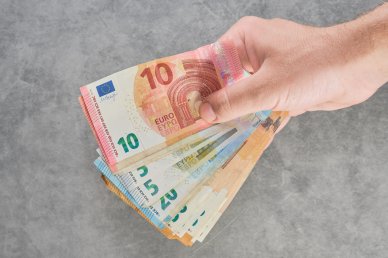
Euro banknotes
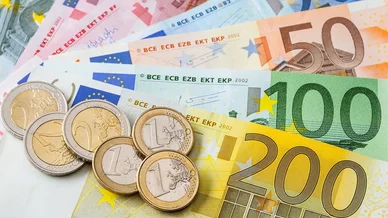
The banknotes are issued in denominations of €5, €10, €20, €50, €100, and €200. The €500 banknote, although still legal tender, is no longer issued and is not in general circulation, as its production was discontinued in 2019.
Both series share a common design concept. Windows and gateways appear on the front of the banknotes, symbolising openness and cooperation, while bridges on the reverse represent connection and unity across Europe. The EU flag is displayed on each banknote, featuring 12 stars, which symbolise unity and harmony rather than the number of member states. The name of the currency appears in Latin (EURO) and Greek (ΕΥΡΩ) scripts.
The Europa series introduced enhanced security features, including security threads, holographic elements, watermarks, and raised print, making the banknotes easier to authenticate and more resistant to counterfeiting. In this series, the name of the currency also appears in Cyrillic (ЕВРО), reflecting Bulgaria’s accession to the European Union.
Each euro banknote carries a serial number beginning with a Latin letter that indicates the country of issuance. This letter does not always correspond directly to the country’s name—for example, Austria is denoted by “N”, Spain by “V”, and Germany by “X”.
Banknote designs by denomination:
- €5 — grey, Classical style; dimensions 62 × 120 mm;
- €10 — red, Romanesque style; dimensions 67 × 127 mm;
- €20 — blue, Gothic style; dimensions 72 × 133 mm;
- €50 — orange, Renaissance style; dimensions 77 × 140 mm;
- €100 — green, Baroque and Rococo style; dimensions 82 × 147 mm;
- €200 — yellow, Modern style (steel and glass); dimensions 82 × 153 mm;
- €500 — purple, Modern / Art Nouveau–inspired style; dimensions 82 × 160 mm (no longer issued).

Euro banknotes old new
Coins
Euro coins are issued in denominations ranging from 1 cent to 2 euros. The practical use of small-denomination coins varies by country and depends largely on pricing practices. In countries where prices are commonly rounded to the nearest five cents, higher-value coins—such as 50 cents, €1, and €2—are used more frequently. In other countries, 1- and 2-cent coins remain in regular circulation.
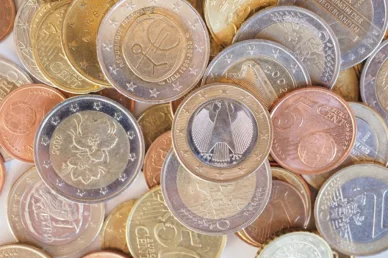
Euro coins are issued in denominations ranging from 1 cent to 2 euros
The design of euro coins differs from country to country. Each coin has a common European side, identical throughout the eurozone, which features a map of Europe. The national side varies by issuing country and typically displays symbols reflecting national history, culture, or notable figures.
The euro in the world
The total value of euro banknotes and coins in circulation is estimated at around €950 billion, placing the euro second worldwide after the US dollar in terms of cash circulation.
Within Europe, the euro is one of the most widely used currencies for both everyday transactions and online payments, reflecting its central role in the region’s financial and digital economy.