US dollar
The US dollar ($, USD) is the national currency of the United States and one of the most important currencies in global trade and finance. It is widely used in international transactions, serving as a key medium of exchange, a unit of account, and a store of value in the global economy.
History

The history of the US Dollar
The origins of the term dollar can be traced back to the early European colonisation of North America. Among the first settlers were the Dutch, who brought with them thalers—silver coins widely used in European trade at the time. Over time, the name was adapted across different languages and dialects, eventually evolving into the word “dollar”, which later became the name of the United States’ national currency.
On 2 April 1792, the dollar was formally established as the national currency of the United States through the Coinage Act, passed by the US Congress. For much of the 19th century, American legal tender consisted primarily of metal coinage, including gold and silver coins. Gold dollar coins, containing roughly 90% gold, were minted between 1849 and 1889. The United States operated under a form of the gold standard until 1933, when domestic convertibility of the dollar into gold was suspended during the Great Depression.
Although private citizens could no longer exchange dollars for gold after 1933, limited international convertibility remained in place under the Bretton Woods system until 1971, when the United States ended the direct link between the dollar and gold. This marked the transition to the modern system of floating exchange rates, which gradually became the dominant global standard.
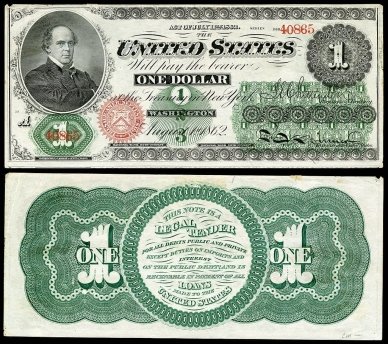
A historic US one-dollar bill from 1862
Paper money first entered circulation in the United States in August 1862, during the American Civil War. The conflict created an urgent need for government financing, accelerating the development of a national banking and monetary system. The earliest paper notes, known as Demand Notes, were soon followed by United States Notes, issued between 1862 and 1865. These notes became popularly known as greenbacks due to their distinctive green reverse and remained in circulation for many decades.
During the Civil War era, a large number of private banks were authorised to issue their own banknotes. At its peak, around 1,600 banks produced notes with unique designs, resulting in tens of thousands of different banknote types. These notes typically circulated only within the states where they were issued and were collectively known as State Bank Notes. The lack of uniformity made the monetary system difficult to regulate, leading to the introduction of National Bank Notes in 1866, which helped standardise US paper currency.
Today, the US dollar is not only the most widely used currency in the world but also the most influential. It serves as a global benchmark for exchange rates, international trade contracts, and financial markets, and is widely accepted for transactions well beyond the borders of the United States.
Appearance
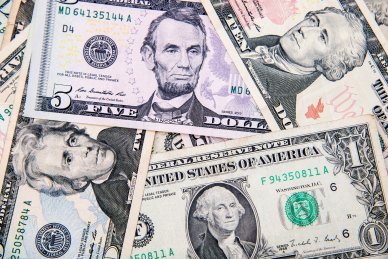
The US dollar ($, USD) is the national currency of the United States
US dollar banknotes are issued in several denominations, most of which feature portraits of prominent figures from American history, primarily presidents and statesmen:
- $1 — features George Washington on the obverse. The reverse displays both sides of the Great Seal of the United States, the national emblem. In everyday speech, Americans often refer to it as a “one” or “single”;
- $5 — bears a portrait of Abraham Lincoln. The reverse shows the Lincoln Memorial, dedicated to the 16th President of the United States. Colloquial terms include “five” or “fiver”;
- $10 — features Alexander Hamilton, the first US Secretary of the Treasury. The reverse depicts the US Department of the Treasury building. Informal names include “ten” or “tenner”; “sawbuck” is a historical slang term derived from the Roman numeral X;
- $20 — displays Andrew Jackson on the obverse, with the White House on the reverse. It is commonly referred to simply as a “twenty”;
- $50 — features Ulysses S. Grant, the 18th President of the United States, on the obverse and the US Capitol on the reverse. Common informal terms include “fifty”;
- $100 — depicts Benjamin Franklin, one of the Founding Fathers, on the obverse. The reverse shows Independence Hall in Philadelphia, where the Declaration of Independence and the US Constitution were debated and adopted. The note is widely known as a “Benjamin” or a “C-note”.
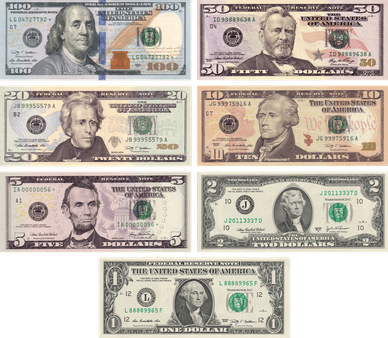
US dollar banknotes: $1, $2, $5, $10, $20, $50, $100
A $2 banknote is also issued, featuring Thomas Jefferson on the obverse and a depiction of the signing of the Declaration of Independence on the reverse. Although it remains legal tender, it is printed infrequently and is relatively uncommon in everyday circulation.
Higher-denomination banknotes—$500, $1,000, $5,000, and $10,000—were issued in the past but are no longer produced and are not used in everyday transactions. They are now primarily found in private collections or held for historical interest.
Rare banknotes
Many historic US banknotes issued in the early and mid-20th century are now held in private collections. For example, the 1918 $500 note features a portrait of John Marshall, former Chief Justice of the US Supreme Court, while the 1934 $500 note depicts William McKinley, the 25th President of the United States. The $5,000 banknote bears the portrait of James Madison, who served as president after Thomas Jefferson.
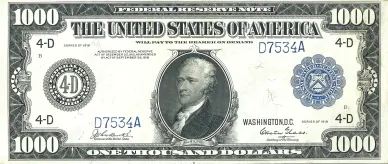
US $1000 bill with Alexander Hamilton's portrait
All US paper currency, regardless of denomination, is produced in a uniform size, measuring 156 × 66 mm. Importantly, there are no “obsolete” US banknotes: notes issued in any year remain legal tender and must be accepted for payments, deposits, and currency exchange.
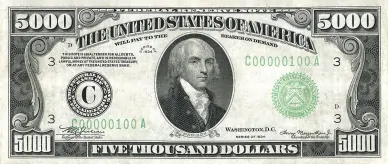
US $5000 bill with the portrait of James Madison
Coins
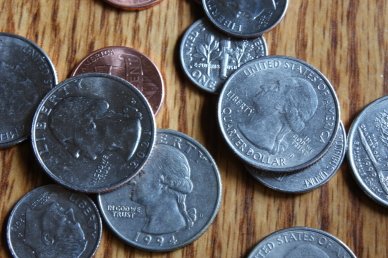
The US dollar coins
One US dollar ($1) is divided into 100 cents. Coins in circulation are issued in denominations of 1, 5, 10, 25, and 50 cents, as well as a one-dollar coin.
Protection
As one of the world’s most important currencies, the US dollar incorporates a wide range of security features designed to prevent counterfeiting. US banknotes are printed on a distinctive paper composed of approximately 75% cotton and 25% linen, which gives them greater durability than ordinary paper. No synthetic fibres are used in the paper itself. The exact manufacturing process is confidential and known only to the US Bureau of Engraving and Printing (BEP).
US banknotes are produced at BEP facilities in Washington, D.C., and Fort Worth, Texas.

How the $100 Bill Prevents Counterfeiting, And How It’s Counterfeited Anyway | Tales From the Bottle
Dollar banknotes are highly wear-resistant. According to official estimates, a banknote can withstand thousands of folds before showing significant signs of wear.
The characteristic green and black inks used in US currency have specialised formulations that are difficult to replicate precisely. To enhance security, modern US banknotes incorporate advanced features such as microprinting, fine-line engraving, security threads, watermarks, and colour-shifting inks.
Certain design elements, including portraits and numerals, are printed using intaglio engraving, creating a distinctive raised texture that can be felt by touch. These tactile features, along with numerous subtle design details, make US banknotes particularly difficult to counterfeit.
Global usage

How Global Trade Runs on U.S. Dollars | WSJ
The total value of US dollar banknotes and coins in circulation worldwide is estimated at over USD 1 trillion, with a significant portion held outside the United States. This reflects the dollar’s unique role as a global means of payment, store of value, and reserve currency.
In addition to physical cash, the broader supply of dollar-denominated financial assets—including bank deposits, government securities, and other dollar-based instruments—forms the backbone of the global financial system. These aggregates far exceed the value of cash in circulation and underline the dollar’s central position in international finance.
The US dollar accounts for more than half of global foreign exchange reserves, making it the world’s dominant reserve currency. This status provides the United States with several important advantages, including high international liquidity, lower borrowing costs, and strong global demand for dollar-denominated assets.
Although the euro represents the most significant alternative reserve currency, it has not displaced the dollar’s leading role. The US dollar continues to serve as the primary currency of reference for global trade, finance, and economic activity.