Acoustic guitar for beginners – how to choose your first instrument

Choosing your first acoustic guitar can be more challenging than it seems. Music stores offer instruments with a wide variety of body shapes, string types, sizes, and tonal characteristics. For a beginner, it is important to find not just an affordable model, but a guitar that is comfortable enough for regular practice. In Iceland, acoustic instruments are used in folk, indie, and pop music, as well as in original compositions. A good first guitar does not have to be expensive; what matters most is that it suits the musician’s physical build, holds its tuning well, and doesn't make the learning process more difficult. This guide will help you choose an acoustic guitar as a beginner, explore models available in Icelandic stores, determine a budget in Icelandic krónur, and prepare for your first lessons.
Which guitar should a beginner buy?
If you are choosing between an acoustic guitar and a classical guitar, first determine the musical style you plan to play. An acoustic guitar with steel strings – also known as a Western guitar – produces a bright, rich sound. It is well-suited for pop, rock, folk, and country music, as well as for playing chords and fingerstyle. It is frequently used to accompany singing and to perform original compositions.
A classical guitar with nylon strings produces a softer sound. For many beginners, these strings are easier to press down; however, the wider neck requires a different hand position. Both types are suitable for learning, but they differ in their construction. For this reason, it is not recommended to install metal strings on a classical guitar, as the increased tension could damage the instrument.
When choosing between an acoustic and an electric guitar, also consider the need for additional equipment. An electric guitar typically requires an amplifier, whereas an acoustic guitar produces sound on its own. This makes the acoustic guitar a practical choice for practicing at home, small musical gatherings, and rehearsals.
A good acoustic guitar for beginners should be comfortable to play while seated. Your hand should be able to wrap around the neck easily, playing chords should not require excessive effort, and the strings should not buzz during normal play. It is advisable to test the instrument in person before purchasing, even if you only know a few chords.

Buying Your First Acoustic Guitar (5 Things You MUST Consider) | A Beginner's Guide
In Iceland, acoustic guitars are available at specialized music stores, such as Hljóðfærahúsið and Tónastöðin. These shops offer a variety of musical instruments and accessories, though the availability of specific models should be verified individually.
Among the primary acoustic guitar shapes, the dreadnought is distinguished by its large body, powerful sound, and rich bass. Auditorium and orchestra shapes offer a more balanced tone and may be more comfortable for extended practice sessions. The compact parlor body is well-suited for playing while seated and for performing intimate, chamber-style pieces.
Models with a cutaway provide easier access to the higher frets, while a built-in pickup allows the instrument to be connected to a sound system. Travel and junior guitars are smaller in size and constitute a distinct category of compact instruments.
Acoustic Guitar Body Size and Shape
Acoustic guitar sizes are not fully standardized across manufacturers. The "¾" designation serves only as a general guide, as instruments in this category can vary in terms of neck length, body depth, and scale length. Therefore, when making a choice, it is worth considering not only the overall length but also the neck width, body thickness, and hand positioning while playing.
A large-bodied guitar is a good choice if volume and powerful chordal accompaniment are priorities. A more compact guitar may be more comfortable for individuals with smaller hands or shorter arms, or for those who play while seated for long periods.
For instance, the Yamaha JR series features a 540 mm scale length and a compact design, while the Cort AD Mini utilizes a 3/4-size dreadnought body. These examples illustrate that smaller-scale guitars can differ significantly in terms of ergonomics.
Also available in Iceland is the Yamaha FS400, which features a concert-style body and a 634 mm scale length. This design can be a comfortable option for beginners seeking an alternative to a full-sized dreadnought.
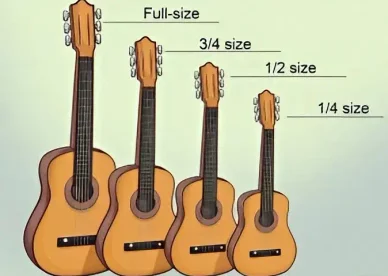
The size and body shape of the acoustic guitar
Models designed for left-handed players deserve special attention. A left-handed acoustic guitar is not simply a right-handed model turned upside down; the string arrangement, the shape of the nut and saddle, scale length compensation, and certain structural elements may differ. Therefore, it is advisable for left-handed players to try out an instrument specifically crafted for them.
International manufacturers, such as Fender, include left-handed acoustic guitars in their catalogs. However, it is worth verifying the availability of such models at Icelandic stores before making a purchase or placing an order.
Choosing a Guitar for Children
When buying an acoustic guitar for a child, you should not rely solely on their age. Height, arm length, finger span, and the ability to hold the instrument correctly are far more important. A guitar that is too large can make playing chords difficult, cause unnecessary physical strain, and diminish the child's motivation to learn.
A properly selected guitar allows a child to sit with a straight back, avoid lifting their elbow excessively, and reach the first three frets without strain.
For many schoolchildren, ¾-size or "junior" guitars are suitable, though it is best to make the final choice in consultation with a teacher. In Iceland, there are music schools – such as Gítarskóli Íslands in Reykjavík – that offer instruction in acoustic, classical, folk, and electric guitar. The school has been operating since June 1993 and provides individual lessons for students of all ages and skill levels.
It is important to purchase a proper musical instrument for a child – one that can be tuned and repaired. Poor-quality frets, an excessively high string action, and an inability to hold a tune can make learning significantly more difficult.
Size | Who It May Be Suitable For | What to Look For |
|---|---|---|
1/2 | Younger children with shorter arms | Whether the child can reach the first frets without straining their shoulders |
3/4 | School-aged children and beginners with smaller hands | Whether it is comfortable to hold the guitar body while sitting and grip the neck |
4/4 | Older teenagers and adults | Whether the full-size guitar allows for a natural body posture |

Choosing a Guitar for Children
Before purchasing a guitar for a child, it is also worth consulting with a music school about the possibility of using a student instrument on a temporary basis. The terms for provision and rental vary depending on the specific institution.
Acoustic Guitar Brands for Beginners
There is no single "best" brand among acoustic guitar manufacturers. The right choice depends on your budget, the size of the instrument, your musical style, and personal preferences. Instruments across various price ranges are available in Iceland, though the specific models in stock may vary.
Brand | Range Features | Who It Is Suitable For |
|---|---|---|
Yamaha | F, FG, FS, JR series and compact models | Beginners, music school students, and those looking for a versatile guitar |
Fender | Dreadnought, parlor, auditorium, and acoustic-electric models | Players interested in strumming chords, pop, folk, and accompaniment |
Ibanez | PF, Artwood, AE, and AEG series | Those who want to compare traditional and modern guitar designs |
Cort | Affordable Standard Series models and compact guitars | Budget-conscious buyers |
Gretsch | Compact acoustic models and traditional body shapes | Fans of blues, folk, and intimate acoustic sounds |
Seagull | Acoustic and acoustic-electric models in various sizes | Musicians looking for an instrument with a distinctive sound |
Gibson | Premium models with various body shapes | More experienced guitarists with larger budgets |
Before making a purchase, it's a good idea to check not only the brand and specifications, but also the availability of warranty service, instrument setup, and the option to purchase replacement strings and accessories.
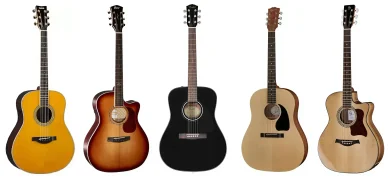
Acoustic guitars from various brands for beginners
Five Acoustic Guitar Models in Iceland
When choosing your first guitar, it’s important to compare not only the price but also the body shape, scale length, and features. The table below lists five models featured in the catalog of the Icelandic store Hljóðfærahúsið. Prices were verified based on product pages published in November 2026. These are not average market prices, and product availability may vary.
Model | Body Shape | Features | Who It Is Suitable For | Price, ISK |
|---|---|---|---|---|
Fender FA-125 | Dreadnought | Laminated construction, nato wood neck | Beginners looking for their first full-size guitar | 30,990 |
Yamaha F310 | Western | Traditional acoustic body, spruce top | Home practice and chord playing | 33,990 |
Fender CP-60S Parlor | Parlor | Compact body, solid spruce top | Fingerstyle playing and comfortable seated performance | 39,990 |
Yamaha FS400 | Concert | 634 mm scale length, more compact body | Beginners looking for a comfortable guitar | 39,990 |
Yamaha F310 Guitar Pack | Western | Includes a gig bag, strap, strings, picks, and other accessories | Beginners who want a complete starter kit | 40,990 |
Before purchasing a guitar, check the current price, availability of the color you want, what’s included, and whether the initial setup of the instrument is included in the price.
New or Used Acoustic Guitar
Prices for acoustic guitars in Iceland depend on the brand, materials, construction, features, and specifications. Therefore, when choosing your first instrument, you should start by determining your budget and your basic requirements.
You can expect to spend approximately 30,000–50,000 ISK on your first acoustic guitar in Iceland. This is a practical budget guideline based on verified offers for several entry-level models, rather than official statistics on average prices.
In addition to the cost of the instrument itself, you’ll need to factor in the cost of a case, a tuner, picks, and spare strings, if they aren’t included in the package. For example, the Fender California Debut Redondo Pack at Hljóðfærahúsið is priced at 31,990 ISK and already includes the guitar, a case, a stand, a strap, picks, a clip-on tuner, and spare strings.
An inexpensive acoustic guitar can be a good first instrument if it is in tune, holds its tuning well, has a comfortable string height, and doesn’t require expensive repairs. At the same time, cutting corners on quality can negatively impact your learning experience.

A used acoustic guitar
It’s also worth considering a used instrument, especially if you’re on a tight budget. However, you’ll need to inspect its technical condition more carefully.
When inspecting a used guitar, check the straightness of the neck, the condition of the bridge, any warping of the top, cracks, how the tuning pegs work, and the string height. Try all six strings at different frets, and then make sure the instrument stays in tune after you tune it.
In Iceland, you can search for used musical instruments through classified ads and local musician communities. If the seller is located in another town, it’s a good idea to ask for detailed photos, a video of the instrument’s sound, and information about any previous repairs.
The advantage of buying a used guitar is that you can purchase a higher-quality instrument for less money. A potential drawback is the additional cost of repairing the neck, frets, or bridge. If you’re unable to assess the instrument’s condition on your own, consult a teacher or a guitar technician.
Acoustic Guitar Strings and Essential Accessories
The gauge of acoustic guitar strings affects their tension, volume, and the strain on your fingers. Beginners often find it easier to play on thinner strings, as they typically require less effort to press down. However, strings that are too thin can alter the feel of playing and may require additional tuning of the instrument.
After switching to a set of a different gauge, check for any buzzing and make sure the string height remains comfortable. Also pay attention to the material of the strings, as it affects the tone.
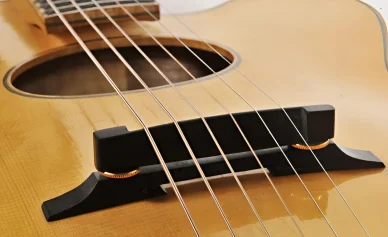
On an acoustic guitar, string gauge affects tension, volume, and the strain on the fingers
When storing an acoustic guitar in Iceland, it’s important to consider temperature and humidity. Wood reacts to changes in environmental conditions, so sudden temperature fluctuations, excessive dryness, or high humidity can negatively affect the instrument’s condition.
During the cold season, do not leave your guitar near radiators, heaters, or other heat sources. When transporting it by car, protect it from precipitation and prolonged exposure to freezing temperatures. After moving the instrument from a cold environment into a warm room, allow it to gradually acclimate to the temperature before opening the case.
Martin Guitar recommends maintaining a relative humidity level of 45–55%. This is a general recommendation for the care of acoustic guitars, not a specific requirement for Iceland. You can monitor the humidity using a hygrometer.
For your first set, it’s a good idea to purchase:
- a guitar tuner;
- picks of various thicknesses;
- a spare set of strings;
- a soft cleaning cloth;
- a gig bag or case of the appropriate size;
- a guitar stand;
- a hygrometer to monitor humidity.
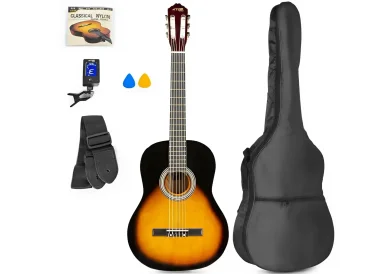
Starter pack for acoustic guitar
If you frequently travel between locations in Iceland, a hard case can provide better protection against impacts than a standard soft case. When flying, it is advisable to check the specific airline's policies regarding the transport of musical instruments in advance.
Tuning an Acoustic Guitar
The standard tuning for a six-string acoustic guitar is E-A-D-G-B-E, from the thickest to the thinnest string. This notation is used in international instructional materials and most guitar-tuning apps.
For a beginner, the easiest way to tune a guitar is to use a mobile app or an electronic clip-on tuner. The app detects the pitch through the phone’s microphone and shows whether you need to tighten or loosen the string.
There are several popular apps you can use to tune an acoustic guitar:
- Fender Tune supports automatic, manual, and chromatic tuning, as well as alternative tunings. It works for both acoustic and electric guitars.
- GuitarTuna automatically detects the string being played and offers additional features for learning chords and practicing songs.
- BOSS Tuner functions as a chromatic tuner, allowing you to check different notes and use non-standard tunings.
Tune your guitar in a quiet room, as background noise can interfere with the microphone. When tuning, play only one string at a time, not a whole chord.

How to Tune an Acoustic Guitar for Beginners | Fender Play | Fender
Tuning sequence:
- Play the thickest E string.
- Wait for the tuner to recognize the sound.
- Slowly turn the corresponding tuning peg.
- Tune the A, D, G, B, and thinnest E strings in that order.
- Finally, check all six strings again.
If the pitch is lower than desired, gradually increase the tension on the string. If it’s higher, carefully loosen the string, then adjust it toward the correct pitch starting from a lower note. Most tuners indicate the correct pitch with a green light or by centering the indicator.
After installing new strings, a guitar may go out of tune more quickly. In such cases, gently stretch the strings and retune the instrument several times until the tension stabilizes.
When transporting the instrument during cold weather, temperature fluctuations can affect its tuning. Therefore, it is advisable to check the tuning after a trip before you start playing. A good habit for a beginner is to tune the guitar before every practice session.
Acoustic Guitar Lesson Plan for the First Month
Learning to play the acoustic guitar will be more effective if you break it down into short, regular sessions with specific goals. For beginners, consistency and proper technique are more important than long, hours-long practice sessions.
During the first week, focus on proper posture, hand positioning, clear tone production, and two simple chords. In the second week, add a third chord and start practicing slow transitions.
In the third week, pay attention to a steady rhythm and coordinating the movements of both hands. During the fourth week, try to play a simple song all the way through.

LEARN GUITAR IN 7 DAYS (or less)
Twenty minutes of practice each day may be enough to make steady progress.
Example of a single practice session:
- Two minutes – tuning the guitar.
- Three minutes – finger warm-ups.
- Five minutes – chord changes.
- Five minutes – rhythm exercises.
- Five minutes – playing a song.
The simplest chords for beginners are Em, Am, C, D, and G. First, learn to play each one clearly on its own, and then practice transitioning between two chords.
In the beginning, use a simple rhythm with the pick moving down on every quarter note. Once your movements become more confident, add upward strokes and more complex rhythmic patterns.
For practice, you can choose simple folk or pop songs. If you’re interested in Icelandic music, check out acoustic performances by local singer-songwriters. These performances help you understand how the guitar is used to accompany singing and create rhythm.
If you experience pain in your wrist or forearm while playing, stop practicing and check your hand position. Mild sensitivity in your fingertips may be normal when you’re just starting out, but joint pain is not a normal part of proper technique.
In Iceland, you can learn on your own, take private lessons, or attend a music school. For example, Gítarskóli Íslands in Reykjavík offers private lessons in acoustic, classical, folk, and electric guitar, as well as music theory. The curriculum is tailored to the student’s interests and skill level.
Interesting Facts About the Acoustic Guitar
An acoustic guitar produces sound without an electric amplifier. The vibrations of the strings are transmitted through the bridge, the top, and the body of the instrument, which amplify the sound. Therefore, the shape of the body, the materials used, and the construction significantly affect the tone.
The standard tuning of E-A-D-G-B-E does not have equal intervals between all adjacent strings. Most of them are a fourth apart, while the G and B are a major third apart. This system makes it easier to play common chords and melodic patterns.
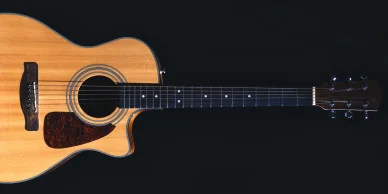
Acoustic guitar
Guitars with solid wood tops aren’t necessarily better than models with laminated tops in every situation. Sound quality depends on the construction, the internal sound-projection system, the thickness of the materials, and the overall setup. For a beginner, it’s more important to choose an instrument that’s comfortable to hold and has a sound you like.
For musicians in Iceland, proper care of wooden instruments is essential, especially during the heating season. Excessively dry air can cause the wood to dry out, warp, and crack. Therefore, using a hygrometer and storing the instrument properly help maintain the guitar’s condition.
The acoustic guitar also plays a prominent role in the work of certain Icelandic musicians who blend folk, pop, and modern electronic elements. This demonstrates the instrument’s versatility, as it can be used in both solo performances and more complex arrangements.
Acoustic Guitar Culture in Iceland
Iceland has a vibrant contemporary music scene that encompasses folk, indie, rock, pop, and experimental genres. The acoustic guitar is used in a variety of performance styles – from solo original compositions to combinations of traditional instruments with electronic effects.
One of Iceland’s best-known musicians is Mugison – the stage name of Örn Elías Guðmundsson. He hails from the Vestfirðir region and is known as a singer, songwriter, and performer who blends various musical styles. On his official website, Mugison describes his creative journey from solo performances with a laptop and an acoustic guitar to rock music and experiments with sound.

Mugison - Þjóðarsálin (Live on KEXP)
In his performances, the musician combines acoustic guitar, vocals, and electronic elements. His work demonstrates how an instrument can be used not only for traditional accompaniment but also for creating experimental compositions. According to Iceland Airwaves, Mugison has received 14 Icelandic Music Awards and has performed in Europe, Japan, and the United States.
Another representative of the Icelandic music scene is Ásgeir (Ásgeir Trausti Einarsson). He grew up in the small settlement of Laugarbakki in northern Iceland. From childhood, the musician was surrounded by musical instruments, and he later began creating his own compositions. His work blends folk, pop music, and electronic sounds.

Ásgeir: NPR Music Tiny Desk Concert
For beginners, his music can serve as an example of how simple melodies and acoustic instruments are integrated into modern arrangements.
Festivals play an important role in the development of Iceland's contemporary musical culture. One of the most well-known is Iceland Airwaves, held in Reykjavík. It brings together Icelandic and international artists across various genres, including folk, indie, rock, pop, and alternative music.
In 2026, the main program of Iceland Airwaves took place from November 5 to 7. Concerts were held at various venues throughout the capital, featuring both local and international musicians. It is a multi-genre festival, rather than a specialized event dedicated to the acoustic guitar.
For beginners, attending such concerts can be beneficial, as it allows them to observe various playing techniques, methods of accompaniment, and the use of musical instruments on stage.

A well-known festival is Iceland Airwaves, which takes place in Reykjavík
Another significant event is Aldrei fór ég suður, which takes place in Ísafjörður, in northwestern Iceland. The festival was established in 2004 through the efforts of Mugison and like-minded individuals. It supports the local music scene and features performers from a variety of genres.
According to the festival's official website, the next Aldrei fór ég suður is scheduled for March 26–27, 2027, in Ísafjörður.
Although the festival is not dedicated exclusively to the acoustic guitar, it showcases the diversity of the Icelandic music scene and offers an opportunity to discover local artists.
An important component of music education in Iceland is the network of music schools, known as tónlistarskólar. These schools offer instruction on various instruments, as well as classes in music theory.
One such institution is Gítarskóli Íslands in Reykjavík. According to official city information, the school has been operating since June 1993. It offers instruction in acoustic, classical, folk, and electric guitar, as well as bass guitar, double bass, and music theory. Programs are tailored to the individual needs of students, regardless of their age or prior experience.
Another example is Tónskólinn í Reykjavík, where instrumental training is combined with the development of aural skills and theoretical knowledge. Details regarding admission requirements, tuition fees, and the potential use of school-owned instruments should be clarified directly with the administration.

Replace old strings with new ones to ensure high-quality sound from the instrument
For beginners in Iceland, combining independent practice, lessons with an instructor, and attending live concerts can be an effective way to develop musical skills. The acoustic guitar allows one to start with simple chords and gradually progress to performing one's own compositions.
FAQ
❓How much does a first acoustic guitar cost in Iceland?
When buying your first acoustic guitar, you can expect to spend around 30,000–50,000 ISK. Some Yamaha and Fender models fall within this price range. The final price depends on the configuration, the store, and availability. You can also find pre-packaged sets with accessories within this budget.
❓Where can I buy an acoustic guitar in Iceland?
Acoustic guitars are available at specialty music stores, including Hljóðfærahúsið and Tónastöðin in Reykjavík. Before buying, it’s a good idea to compare several models, check the specifications, and confirm current availability.
❓Is it better for a beginner to choose a guitar with a smaller body?
Not always. Compact guitars may be more comfortable for people with smaller hands and shorter forearms. At the same time, auditorium or full-size dreadnought bodies may be suitable for adults. The most important thing is to try the instrument out for yourself.
❓How often should you tune an acoustic guitar?
It’s best to check the tuning before each practice session. After changing strings, transporting the guitar, or experiencing sudden temperature changes, you may need to tune it more frequently.
❓How should you store an acoustic guitar in Iceland’s climate?
The instrument should be protected from sudden temperature fluctuations, excessive dryness, and high humidity. For acoustic guitars, Martin recommends maintaining a relative humidity of 45–55%. It’s also advisable to use a gig bag or hard case and to keep the instrument away from heat sources.
❓When should you change the strings?
You should replace the strings when they start to sound muffled, change color, become rough, lose their tuning easily, or show signs of damage. How often you need to replace them depends on how often you play and the storage conditions.
❓Is it possible to learn to play the guitar on your own?
Yes, you can get started using video tutorials, mobile apps, and instructional materials. However, a few lessons with an instructor will help you develop proper technique and avoid unnecessary strain on your hands. There are music schools in Iceland that offer private guitar lessons.
❓What’s the best acoustic guitar for beginners?
The best choice is an instrument with a comfortable body, a comfortable string height, accurate intonation, and stable tuning. Among the models featured in Icelandic store catalogs, consider the Yamaha F310, Fender FA-125, Yamaha FS400, or the compact Fender CP-60S.
❓What does the term “acoustic guitar” mean?
An acoustic guitar is a musical instrument in which the sound of the strings is amplified by a resonant body. No electric amplifier is needed to play it.
❓What is a small guitar called?
Compact acoustic guitars may be called ¾, junior, travel, or parlor, depending on their design and intended use. The ukulele is a distinct musical instrument, not simply a smaller version of a guitar.