Swedish krona
The Swedish krona (SEK) is the national currency of Sweden and one of the principal currencies of the Nordic region. Although Sweden has chosen not to join the eurozone, the krona continues to play an important role in European and international financial markets. Its exchange rate influences economic conditions both within Sweden and across the wider European economy.
Thanks to Sweden’s independent monetary policy, strong institutions, and high level of global economic integration, the country retains full control over its currency. While the krona is subject to market fluctuations, it has generally demonstrated resilience during periods of global economic uncertainty.
Historical background
The origins of Sweden’s monetary system date back to the early 16th century, shortly before the country withdrew from the Kalmar Union under King Gustav Vasa. In 1522, the first silver daler coins were minted by royal decree. Smaller denominations were issued in öre, a name derived from similar coins previously used within the Danish-led union.

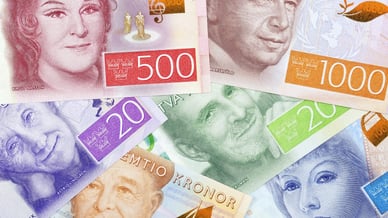
Currency of the world - Sweden. Swedish krone.
Prolonged warfare and fiscal strain gradually weakened the Swedish treasury, leading to a decline in the silver content of the daler and a steady depreciation of the currency. As a result, alternative monetary solutions became necessary.
In 1661, banker Johan Palmstruch introduced one of Europe’s earliest systems of paper money, replacing metal coins with handwritten notes known as Kreditivsedlar. Although these notes facilitated trade, public trust in them was limited. Palmstruch’s bank eventually collapsed, and he was brought to trial. Nevertheless, the concept of paper currency was not abandoned; instead, issuance was placed under stricter regulation and given official backing.
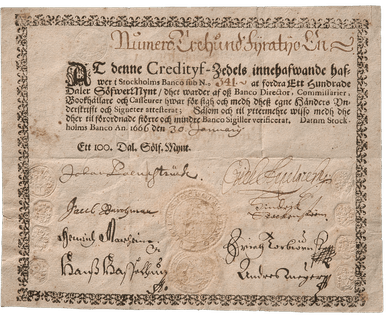
The first banknote in Europe - Kreditivsedlar, 1661
Responsibility for issuing banknotes was later assumed by the Riksens Ständers Bank, the predecessor of today’s Sveriges Riksbank. In 1719, the first series of riksdaler banknotes was introduced, contributing to the unification of Sweden’s monetary system. Variants of the riksdaler circulated not only in Sweden but also in Finland, which at the time formed part of the Swedish realm.
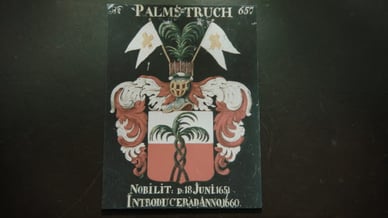
Johan Palmstruch opens Sweden's first bank, 1656
By the 19th century, paper money had become widespread across Europe, with individual countries developing their own national currencies and banknote designs.
The Swedish krona was introduced in 1873, when the Royal Mint issued the first silver krona coins in denominations ranging from 1 to 20 kronor, alongside bronze öre coins. Higher-value öre coins were struck in silver. This reform coincided with the creation of the Scandinavian Monetary Union between Sweden and Denmark, later joined by Norway. The union was based on a gold standard, with the krone defined by a fixed gold content. Although the union effectively dissolved during the First World War, it formally ended in the early 1920s following the collapse of the gold standard.
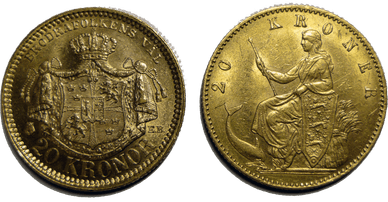
Two 20-krona gold coins from the Scandinavian Monetary Union, which was based on the gold standard. The coin on the left is Swedish; the one on the right is Danish
In 1945, the Swedish krona was pegged to the US dollar, a system that remained in place until 1992, when Sweden adopted a floating exchange rate regime, which continues today.
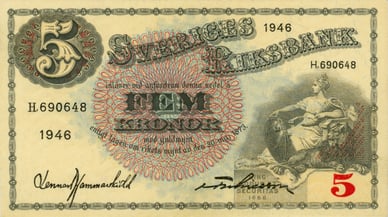
5 Swedish kronor 1946
Since 2002, coin and banknote production has been outsourced abroad. The Swedish Mint ceased operations in 2011, and Swedish currency is now produced by the Mint of Finland, while issuance and monetary policy remain the responsibility of Sveriges Riksbank, Sweden’s central bank.
Appearance of the Swedish krona
The Swedish krona occupies a distinctive place in the global financial system. Until the early 1980s, Sweden maintained multiple series of banknotes in circulation simultaneously, some dating back to the late 19th century. This resulted in an unusually large variety of banknote designs coexisting within the monetary system.
By the early 1980s, the number of circulating designs had grown so extensive that a comprehensive currency modernisation became necessary. The exchange of older banknotes was carried out gradually and at a one-to-one rate. During this period, the Swedish financial system also experienced significant pressure, including the 1982 devaluation of the krona, often referred to as the “Big Bang”, implemented in response to the economic challenges of the 1970s.
Over time, banknote designs were consolidated and standardised. The current series of Swedish banknotes, introduced in 2015–2017, features portraits of prominent Swedish figures from science, culture, and literature. The obverse of each banknote displays a portrait, while the reverse depicts landscapes and regions of Sweden, highlighting the country’s natural and cultural heritage.
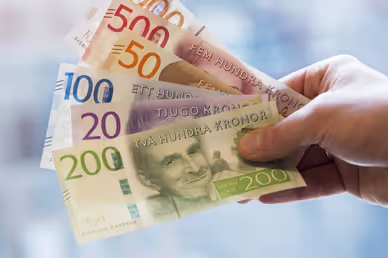
Swedish krona 2017
Key characteristics of the current banknote series include:
- a uniform width of 66 mm;
- cotton-based paper;
- tactile markings to assist people with visual impairments;
- advanced security features to prevent counterfeiting.
Banknotes
Swedish krona banknotes are issued in six denominations: 20, 50, 100, 200, 500, and 1,000 kronor.
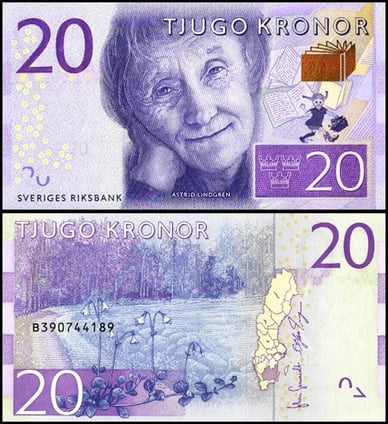
20 kronor — a purple banknote featuring Astrid Lindgren on the obverse, alongside Pippi Longstocking, one of her most famous literary characters. The reverse depicts a landscape of Småland, the author’s home region;

A 20 Swedish kronor banknote
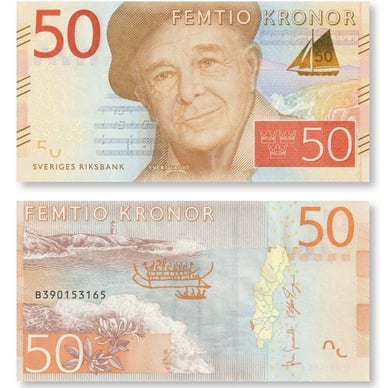
Wikipedia 50 kronor — a red and brown banknote with a portrait of composer and poet Evert Taube on the front. The reverse shows a coastal bay in Bohuslän;

A 50 Swedish kronor banknote
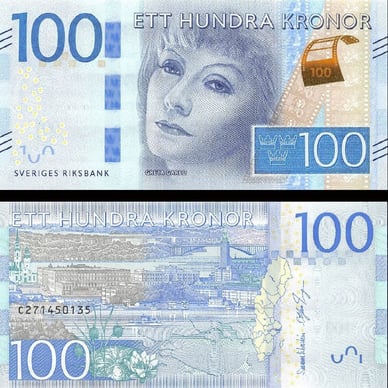
Wikipedia 100 kronor — a blue banknote bearing a portrait of Greta Garbo, one of the most celebrated film actresses of the 20th century. The reverse features a cityscape of Stockholm;

A 100 Swedish kronor banknote
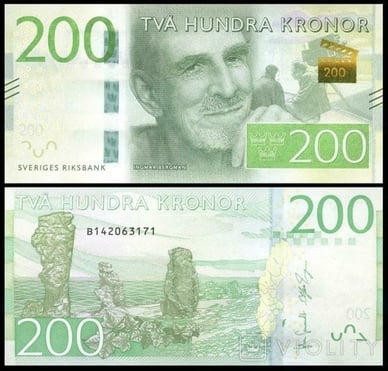
Wikipedia 200 kronor — a banknote in green tones. The obverse depicts renowned filmmaker Ingmar Bergman, while the reverse shows a landscape from the island of Gotland, closely associated with the director;

A 200 Swedish kronor banknote
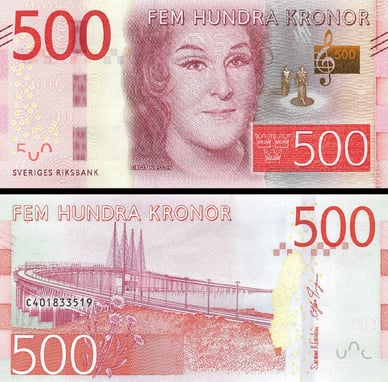
Wikipedia 500 kronor — a red banknote featuring opera singer Birgit Nilsson, internationally acclaimed for her performances in Wagnerian roles. The reverse illustrates a bridge in the province of Skåne, her home region;

A 500 Swedish kronor banknote
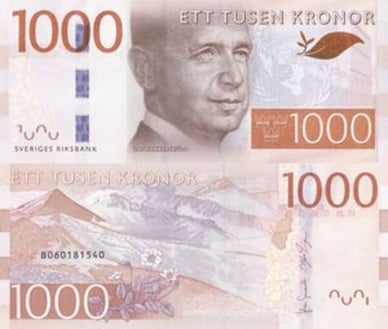
Wikipedia 1,000 kronor — an orange banknote dedicated to Dag Hammarskjöld, a Swedish diplomat and Secretary-General of the United Nations from 1953 to 1961. The reverse depicts landscapes of Lapland, a region closely connected to his life and legacy.

A 1000 Swedish kronor banknote
Wikipedia
Coins
SEK coins are issued in four denominations - 1, 2, 5, and 10 kronor:
- 1 krona — a copper-plated steel coin. The obverse features a portrait of King Carl XVI Gustaf, who has reigned since 1975;
- 2 and 5 kronor — coins made of a Nordic gold–coloured alloy. The obverse displays the denomination, the royal monogram, the inscription “Sverige”, and the year of issue;
- 10 kronor — a coin featuring the Three Crowns (Tre Kronor), a national symbol of Sweden, along with the motto “För Sverige i tiden” (“For Sweden — with the times”). The reverse bears a portrait of the reigning monarch.
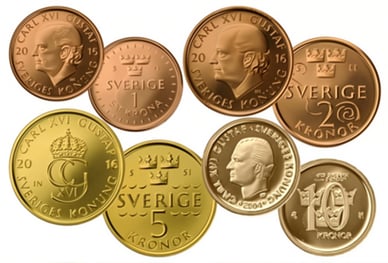
Coins of Sweden: 1, 2, 5, and 10 kronor
The Swedish krona in the world
Sweden’s highly developed economy plays an important role in supporting the value and credibility of the Swedish krona. The country is a leader in sectors such as engineering, information technology, and energy, which contributes to international confidence in its currency. While the krona is subject to market fluctuations, it has demonstrated a degree of resilience during periods of global economic stress.
An illustrative photo of the Swedish flag and kronor
A defining feature of the Swedish krona is its independence from the euro, despite Sweden’s membership in the European Union. Following a national referendum in 2003, Sweden chose not to adopt the euro, allowing the country to retain full control over its monetary policy. This flexibility enables Swedish authorities to respond more directly to domestic economic conditions, including inflation management and competitiveness.
The Swedish krona is held as a reserve currency by a limited number of countries and is used in risk hedging and regional trade, particularly within the European Economic Area. Sweden’s economic model—combining an open market economy with a comprehensive social welfare system—remains attractive to international investors, supporting continued demand for krona-denominated assets.
In recent years, the krona has faced downward pressure, partly due to low interest rates set by the Sveriges Riksbank to counter deflationary risks and stimulate economic growth. Nevertheless, Sweden’s strong institutions, transparent policy framework, and long-standing financial stability continue to underpin global confidence in the Swedish krona.
The Swedish krona exchange rate against other currencies
The Swedish krona is actively traded against a wide range of international currencies. At the time of writing, approximate exchange rates include:
- 1 Swedish krona (SEK) ≈ 0.09 US dollars (USD);
- 1 Swedish krona (SEK) ≈ 0.09 euros (EUR);
- 1 Swedish krona (SEK) ≈ 0.07 British pounds (GBP);
- 1 Swedish krona (SEK) ≈ 0.12 Danish kroner (DKK);
- 1 Swedish krona (SEK) ≈ 1.03 Norwegian kroner (NOK);
- 1 Swedish krona (SEK) ≈ 3.9 Ukrainian hryvnia (UAH).
Exchange rates of the Swedish krona fluctuate over time and are influenced by factors such as global financial conditions, central bank policies, interest rates, and inflation dynamics.