US Dollar
Everyone on the planet has heard of the US dollar. It acts as the world’s primary reservecurrency and as the de facto currency for international commerce, both throughout the United States of America and the rest of the world.
Let’s take a closer look at the history of the dollar, dating back to 1792. Along the way, we’ll investigate its global dominance, look at the different denominations that have been issued throughout the years, tackle the exchange mechanics and identify some of the future challenges that the dollar might have to deal with.
The 1792 Origins and History of USD
How the Thaler Became the Dollar via Holland and Spain
Let’s go all the way back to the 16th century, when silver coins were being minted in the town of Joachimsthal, which is in what today is the Czech Republic. These coins were named after the town and called Joachimsthalers, and that was then shortened to “thalers” before the Dutch started calling them “dalers”.
The History of the Dollar
A century or so later, in the American colonies, the evolution of the etymology continued. People started calling the Spanish peso the Spanish dollar, because it looked like the Joachimsthaler and had a similar silver content. The Spanish dollar was widely circulated throughout North America before independence, and so it had a huge impact on the currency that would eventually be introduced to the new country.
Continental Congress and Adoption of Coinage Act
Still, the US dollar as we know it today wasn’t officially in circulation until the Continental Congress adopted it as the country’s official monetary unit on July 6, 1785. Seven years later, the Coinage Act of 1792 was passed, authorising the minting of coins. The first coins soon followed in 1794.
Unsurprisingly, the new coins were based on the Spanish silver dollars that had helped to inspire them. After all, they were already trusted by the people and they provided a useful weight standard for the new currency. Founding father Alexander Hamilton played a key role in passing financial reforms, with the new act using a bimetallic system that linked the value of the dollar to both gold and silver, providing even more stability.
Emergence of Greenbacks During the Civil War
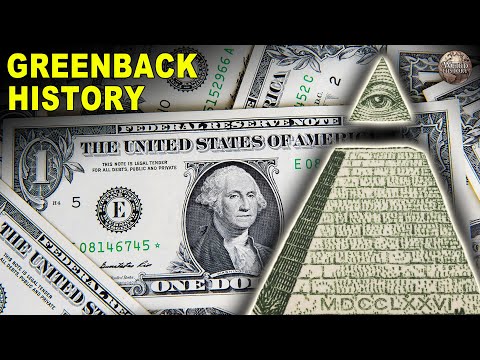
Coins are all well and good, but when most people think of the dollar, they think of the dollar bill. The first paper versions of American dollars weren’t issued until 1861, during the Civil War. Those early notes were called Greenbacks because of the green ink that was used on their reverse side.
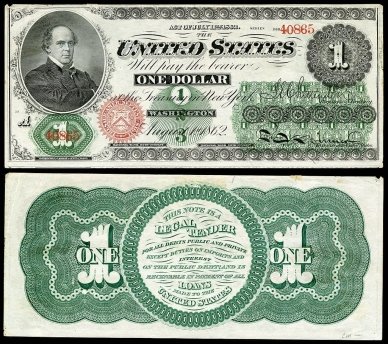
This was a big change, because before the Greenbacks, commercial banks would issue their own banknotes, with inconsistent values and different designs (and levels of reliability). This was known as the Free Banking Era, and people were glad to leave it all behind when the new, centralised currency was established by the federal government.
Symbol and Physical USDDenominations
From the Peso to the Dollar Symbol
Now, you might be wondering where the dollar symbol that we use today comes from. After all, surely it would make more sense to use a D with a line through it than an S.

Do you know what these symbols mean on the dollar bill?
Well, there’s an origin story there, and it all goes back to the Spanish peso, which inspired the dollar in the first place. The $ symbol was created by overlaying an S on a P, and it’s a nod to the abbreviation “ps” that’s used for the peso. Another theory is that it’s because of the Spanish coat of arms that was featured on the peso, because it showed the Pillars of Hercules wrapped in an S-shaped ribbon.
While it might not be clear which of the two theories is closest to the truth, one thing is for sure. The dollar symbol existed long before the United States adopted the dollar as its currency.
Modern Bills and Coins
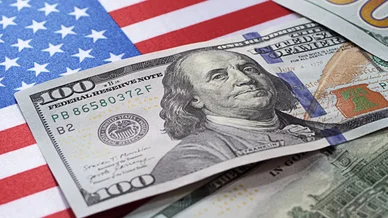
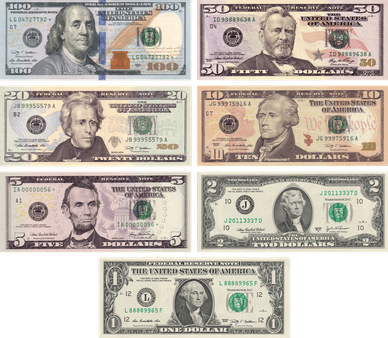
At the moment, you can get US dollars in bills for the values of $1, $2, $5, $10, $20, $50 and $100. Historically, though, notes were available for larger denominations including $500, $1,000, $5,000 and $10,000. These were last printed in 1945, and if you’re fortunate enough to own one today, it could be worth far more than what it was worth back then.
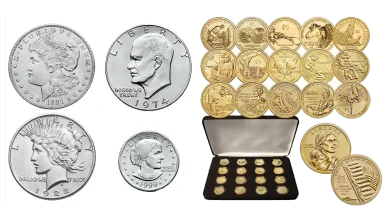
As for coins, it’s all about the penny (1 cent), nickel (5 cents), dime (10 cents) and quarter (25 cents). There are also half-dollar (50 cents) and dollar coins, but these aren’t widely used.
Today’s notes feature a range of security features including watermarks, embedded security threads, colour-shifting ink and microprinting, each of which helps to stop counterfeiting and to maintain the integrity of the currency.
Gold Standard and Bretton Woods Deal for Dollar
Gold Standard and the Convertibility Suspension
The Gold Standard Act of 1900 officially placed the US dollar on the gold standard, fixing it at a rate of $20.67 per troy ounce of gold. The idea of linking the dollar to gold was to increase stability, but then the Great Depression came along in the 1930s and the market tanked.
In 1933, at the height of the Great Depression, President Franklin D. Roosevelt suspended gold convertibility and banned private gold ownership. Even that wasn’t enough to stabilise the marketplace, though, and so in 1934, FDR officially devalued the dollar and raised the official price of gold to $35 per ounce.
US Dollar as World Reserve, IMF and World Bank
The dollar recovered its former glory after the Great Depression, which brings us up to the Bretton Woods Agreement of 1944. Taking place against the backdrop of the Second World War, the agreement saw the US dollar becoming the world’s primary reserve currency, with foreign governments able to convert dollars into gold at $35 per ounce. That also allowed other currencies to peg their value to the dollar, with additional support and security provided by the creation of the World Bank and the International Monetary Fund (IMF).
This lasted for thirty years or so, until the Nixon Shock on August 15, 1971. Named after US President Richard Nixon, who was in charge of the country at the time, the Nixon Shock was when he suspended all gold convertibility, ending the Bretton Woods system for good.
USDFederal Reserve
1913 Federal Reserve Act and the Central Bank
The Federal Reserve Act of 1913 was responsible for creating the modern US banking system, including establishing 12 regional Federal Reserve Banks that are overseen by a Board of Governors based in Washington DC. The idea behind establishing the Fed was to create a more durable framework of satellite reserves that are overseen by a central bank.
This system gave the Fed the exclusive authority to issue currency (Federal Reserve Notes), which replaced the messy and inconsistent setup that had preceded it. Ultimately, it centralised the control of money and thus helped to establish a level of stability that wouldn’t have been possible otherwise.
Interest Rates and Quantitative Easing
The Fed has a number of tools at its disposal as part of its role to manage and support the value of USD and the national economy. These include:
- The federal funds rate (which influences short-term interest rates)
- Open market operations (buying and selling government bonds)
- Reserve requirements (can be adjusted for banks as needed)
On top of this, the Global Financial Crisis of 2008 led to the Fed using quantitative easing (QE) as part of its monetary policy, a process which essentially means buying financial assets from the open market to boost the economy. The Fed targets inflation at around 2% and has two main goals: maximising employment and maintaining price stability.

U.S. Currency and the Fed
US DollarDominance and its Status as the Global Reserve
USD Has Reserve and Trade Dominance
The US dollar has dominated global finance and major reserve policies for decades, and nothing showcases that dominance more than the fact that it accounts for 58% of global forex reserves as of 2024. Perhaps even more significantly, 88% of all forex transactions involve the US dollar.
Let’s not forget that a huge amount of international trade revolves around the dollar, too. Most deals for oil and other commodities are invoiced in dollars, which is one of the many reasons why the US economy is the largest in the world, with a GDP of around $28.5 trillion. This is also backed by deep, liquid financial markets, relative political stability (despite what you might read in the news) and the strong network effects that come from its widespread global adoption.
The Petrodollar Agreement and Saudi Oil
Speaking of oil, we need to take a look at the petrodollar agreement of the 1970s, when Saudi Arabia and other OPEC members (including Iran, Kuwait and Venezuela) agreed to price their oil exclusively in the US dollar. This was a clever move on the part of the Americans, because it forced any country that imports oil to maintain dollar reserves, thus boosting global demand for the currency.
On top of that, a lot of surplus revenues were recycled into US Treasury bonds, in part because it was easier than other options. However, it’s important to remember that this system doesn’t come without its challenges, including the Chinese pushing to pay in yuan and the Russians wanting to pay in rubles.
Using US Dollars for Travel and International Exchange
Forex Rates for the US Dollar
Getting your hands on some US dollars is easy. You can obtain them through banks, exchange offices and even at ATMs when travelling abroad, depending on where you are. Just bear in mind that exchange rates naturally fluctuate based on supply and demand, with other factors including interest rates, economic conditions and geopolitical events. That’s why people constantly compare options online—everything from currency exchange apps to searches like “best online casinos”—often in the same browsing session.

Overview of the US Dollar & What You Can Buy (Travel Tips)
Forex transactions typically include a bid/ask spread, which acts as a form of commission, with the best exchange rates usually reserved for larger transactions or when exchanging currency at banks. The worst deals tend to be those at airports and hotels, so make sure you exchange your currency before you go.
Dollarization: When Countries Like Ecuador Adopt the Dollar
Dollarization is the process by which countries adopt American dollars as their national currency, and it happens more often than you might think. Key countries to have adopted the US Dollar include Ecuador, El Salvador, Zimbabwe, Panama and Timor-Leste, as well as US territories like Puerto Rico and the US Virgin Islands.
There are obvious benefits to doing this, including the fact that it provides monetary stability, lower inflation and easier international trade. However, there are also drawbacks to be considered, including the loss of control over monetary policy and the fact that the local economy will be dominated by and affected by the US economy.
BRICS Countries and Challenges to Dollar Dominance by the Yuan
De-dollarization and Alternatives for BRICS Countries
More recently, we’ve seen a trend amongst the BRICS nations (i.e. Brazil, Russia, India, China and South Africa) towards de-dollarization. As the name suggests, this is the process by which countries move away from the dollar and promote the use of alternative currencies, most notably the Chinese Yuan.
Interestingly, trade between Russia and China uses the Yuan, but it also uses the Russian Ruble, partly for political reasons and partly due to sanctions. Elsewhere in the world, countries are looking at Central Bank Digital Currencies (CBDCs), while the Euro continues to act as a key competitor to the dollar, accounting for approximately 20% of all global foreign exchange reserves.
Debt, Inflation and Deficit Concerns
All of this comes together to mean that while USD continues to dominate the global financial marketplace, it still faces plenty of challenges. Perhaps the most obvious is the United States’ national debt, which currently stands at around $36 trillion with a debt-to-GDP ratio of 123%, mostly driven by persistent budget deficits.
Policymakers have turned to quantitative easing to stimulate the economy or manage inflation, but the purchasing power of the dollar has still declined by 96% since 1913. This has led to political polarisation in an already polarised world, as well as real concerns about the dollar’s fiscal sustainability in the long-term. In fact, there’s an argument to be made that the dollar has only continued to dominate because there are no viable alternatives for us to switch to.
Summary and Key Facts About the US Dollar
In summary, we’ve learned that the dollar takes its name from the Czech Joachimsthaler and the Spanish “dollar” in the colonies, which were in wide use before the dollar was officially adopted in 1785. The Coinage Act was passed in 1792, establishing the system and leading to the production of the first coins in 1794.
Paper greenbacks followed in 1861, with the history of the dollar passing through the formation of the Federal Reserve in 1913 and the gold standard era of 1879 to 1933. This leads us to the Bretton Woods Agreement, which pegged the dollar to gold until Nixon ended it in 1971.
The dollar is available in coins and bills ranging from 1 cent to $100, and it accounts for 58% of global reserves and 88% of forex transactions, thanks in part to the petrodollar system and the scale of the US economy. The Federal Reserve controls the supply and sets rates, and over ten countries throughout the world use it as their national currency.
However, growing de-dollarization trends, opposition from the Yuan and the Ruble and the US’s $36 trillion of national debt all pose a threat to its continuing dominance. Only time will tell whether the dollar is able to stay on top.