British pound sterling
The British pound sterling (GBP, £) is the official currency of the United Kingdom and serves as the reference currency for several Crown Dependencies and British Overseas Territories, which issue their own local pound-denominated currencies pegged to the pound sterling.
The pound sterling is classified as a reserve currency and ranks fourth globally in terms of its share of international foreign exchange reserves.

History

The Epic History of the British Pound
In medieval England, high-purity silver coins were widely used in trade. These coins later became known as sterling. Large commercial transactions required significant quantities of coins, and counting them individually was time-consuming. As a result, a new unit of account emerged—the pound sterling, based on weight rather than on individual coins.
The troy pound, still used today to measure precious metals, weighs 373.24 grams, while the older Tower pound, historically used in England, weighed approximately 350 grams. This corresponded to the combined weight of 240 sterling silver pennies, a number that became the standard accounting unit for the pound.
In practice, not every pound of coins weighed exactly the same. Natural wear of soft silver, minting imperfections, and occasional counterfeiting meant that weighing coins became an essential part of commercial transactions. In effect, this process functioned as an early form of currency authentication.
Silver coins continued to be weighed in trade until 1489. From the late 15th century through the mid-16th century, gold coins known as sovereigns began to be minted in England. Named after King Henry VII, whose image appeared on the coins, sovereigns were among the finest gold coins of their time.
Sovereigns remained prominent until 1663, when they were largely replaced by guineas, struck from gold imported from West Africa. After approximately 150 years, the sovereign once again became the principal gold coin of Britain and its colonies. Due to strong traditions, sovereigns continued to be minted primarily as bullion and collector coins until 1982.
The first paper banknotes denominated in pounds sterling appeared in 1694, the same year the currency’s modern name became firmly established.
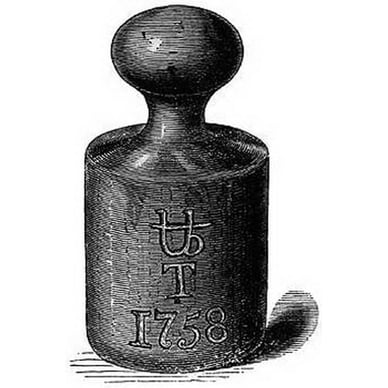
Illustration of an antique metal weight dated 1758
Until 1971, the British monetary system was considered one of the most complex in the world. The pound sterling was subdivided into crowns, shillings, groats, florins, and pence, with additional units such as half-crowns, halfpennies, and farthings also in circulation.
Under this system:
- one pound equalled four crowns;
- one crown equalled five shillings;
- one shilling equalled twelve pence;
- one penny equalled four farthings;
- one gold guinea was valued at 21 shillings.
In the early 1970s, the United Kingdom adopted a decimal currency system, significantly simplifying monetary calculations. Since then, the pound has been divided into 100 pence, eliminating the need for multiple fractional units.
Throughout its history, the pound sterling has experienced several major devaluations. One of the most significant occurred in 1949, when the currency was devalued by approximately one-third. Further notable devaluations took place in 1933, following the abandonment of the gold standard, and in 1966.
In 1988, an attempt to link the pound to the German mark resulted in another sharp depreciation of around 25%. Despite these episodes, the pound sterling has since re-established itself as one of the world’s most stable major currencies, a position reinforced by the United Kingdom’s decision not to adopt the euro.
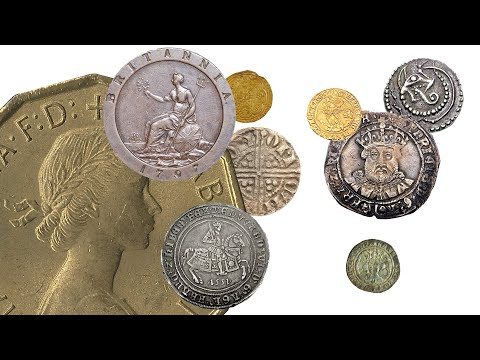
Pounds, shillings, and pence: a history of English coinage
Appearance
Unlike many other European countries, the United Kingdom uses a limited number of banknote denominations—£5, £10, £20, and £50—and does not have a single, unified banknote design. In addition to the Bank of England, several authorised commercial banks in Scotland and Northern Ireland are permitted to issue banknotes denominated in pounds sterling.
In practice, this means that banknotes issued in one part of the United Kingdom may not always be accepted in another. Scottish and Northern Irish banknotes, for example, are not legal tender in England or Wales and may be refused at the discretion of merchants. Even Bank of England notes, which are legal tender in England and Wales, are not legally recognised as legal tender in Scotland or Northern Ireland, although they are widely accepted in everyday transactions. All authorised banknotes are fully backed and regulated within the UK banking system.
A similar arrangement exists in the Crown Dependencies and British Overseas Territories, which issue their own pound-denominated currencies—such as the Gibraltar pound, Manx pound, and Jersey pound. These currencies are pegged at par to the pound sterling and are equivalent in value to GBP, although their acceptance is generally limited to their respective territories.
Banknotes of the Bank of England
Banknotes issued by the Bank of England have been released in several distinct series, conventionally identified by the letters D, E, E (no crown design), F, and G. The reverse sides of these banknotes traditionally feature prominent British figures—politicians, scientists, writers, military leaders, and public figures—who have made a lasting contribution to British and global history.

Five pound notes
Series D included banknotes in denominations of £1, £5, £10, £20, and £50.
Notably, the £1 note, featuring a portrait of Sir Isaac Newton, was withdrawn from circulation in March 1988.
- £5 — featured the Duke of Wellington against a battle scene; withdrawn in 1991;
- £10 — depicted Florence Nightingale, founder of modern nursing, shown in a military hospital setting; withdrawn in 1994;
- £20 — featured William Shakespeare on the reverse; withdrawn in March 1993;
- £50 — displayed Sir Christopher Wren, architect of St Paul’s Cathedral, with architectural plans in the background; last issued in September 1996.
Series E comprised four banknotes with denominations of £5, £10, £20, and £50. As with earlier series, the reverse sides featured notable figures from British history and science.
- £5 — featured George Stephenson, a pioneering British engineer and inventor often referred to as the “father of railways”. This banknote was withdrawn from circulation in November 2003;
- £10 — depicted the writer Charles Dickens, one of the most influential authors in English literature. The note ceased to be issued in July 2003;
- £20 — featured Michael Faraday, a renowned physicist and chemist whose work laid the foundations of electromagnetism and electrochemistry. This banknote was withdrawn in February 2001;
- £50 — displayed Sir John Houblon, the first Governor of the Bank of England. The note was withdrawn from circulation in April 2014.
Series E (reissue) included banknotes issued during a transitional redesign phase and featured updated portraits of notable British figures. The series comprised three denominations: £5, £10, and £20.
- £5 — featured Elizabeth Fry, a prominent social reformer and campaigner for prison reform in 19th-century England. This banknote was withdrawn from circulation in May 2017;
- £10 — depicted Charles Robert Darwin, the author of the theory of evolution by natural selection. The note was withdrawn in March 2018;
- £20 — featured Sir Edward Elgar, a distinguished English composer. This banknote ceased to be printed in June 2010.
Series F consisted of £20 and £50 banknotes, both of which were withdrawn from circulation in September 2022 following the transition to polymer banknotes.
- £20 — featured Adam Smith, the Scottish economist and philosopher widely regarded as the father of modern economics;
- £50 — depicted Matthew Boulton and James Watt, industrial partners whose collaboration played a crucial role in the development and mass production of steam engines during the Industrial Revolution.
Series G represents the current generation of Bank of England banknotes. All denominations in this series are polymer notes and remain in circulation.
- £5 — features Winston Churchill, British statesman and Prime Minister during the Second World War;
- £10 — bears a portrait of Jane Austen, one of Britain’s most celebrated novelists and the author of Pride and Prejudice;
- £20 — depicts J. M. W. Turner, a renowned British painter whose work is considered a precursor to Impressionism.
In 2016, the United Kingdom began issuing polymer banknotes, replacing traditional paper notes with a more durable and secure material. Initially, polymer versions of the £5, £10, and £20 banknotes of Series G were introduced. The transition was completed with the release of the £50 polymer banknote in 2021, making all standard Bank of England denominations polymer-based.

Every British Banknote Ever Quick and Simple
Coins are issued by the Royal Mint and circulate in denominations from 1 to 50 pence, as well as £1, £2, and £5 (the latter mainly issued as commemorative coins, though they are legal tender).
UK law places limits on the use of low-denomination coins for making payments:
- 1p and 2p coins may be used for payments of up to 20 pence;
- 5p and 10p coins — up to £5;
- 20p and 50p coins — up to £10.
Coins of £1, £2, and £5 may be used for payments without restriction.
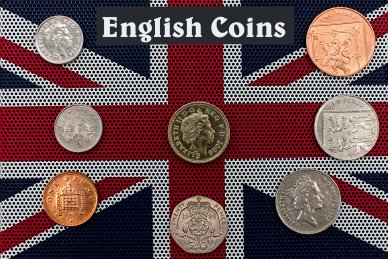
Coins are issued by the Royal Mint and circulate in denominations from 1 to 50 pence
The pound sterling in the world
The British pound sterling is widely regarded as one of the strongest and most valuable major currencies in the world. It consistently ranks among the leading global currencies by value and is classified as a reserve currency, reflecting long-term confidence in the United Kingdom’s financial system and institutions. Historically, the pound has maintained a high exchange rate relative to currencies such as the US dollar, the euro, and the Japanese yen, although these rates naturally fluctuate in response to market conditions.
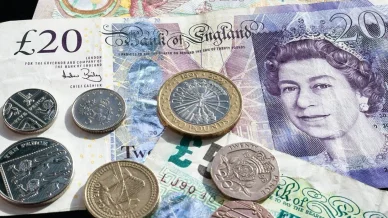
British pound sterling
The pound sterling is also actively traded on global foreign exchange (Forex) markets. It is particularly popular among traders due to its relatively high liquidity and volatility compared with some other reserve currencies. These characteristics make GBP attractive for short-term trading strategies, where price movements can create opportunities for rapid gains, while also playing a significant role in longer-term investment and hedging operations.