Plataforma Algarve Livre de Petróleo (PALP)
When the Government signed new concession contracts for oil and gas prospecting in the Algarve in 2015 without broad public debate, the plans met strong opposition from local communities and environmental organisations. That is how PALP (Plataforma Algarve Livre de Petróleo, the Oil-Free Algarve Platform) was born: an influential civic and environmental movement that brought together ordinary citizens, fishermen, business owners and scientists. PALP became one of the main players in the opposition to the oil projects: together with other organisations, municipalities and local communities, the platform ran public campaigns, took part in legal proceedings and demanded an end to the oil concessions.
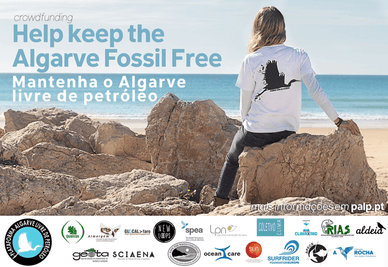
The Algarve, in the south of Portugal, is usually associated with golden beaches, picturesque cliffs and well-developed tourism. But behind this holiday postcard, the threat of large-scale industrial intervention, capable of profoundly changing the region's ecosystem and economy, lay hidden for a long time. In March 2015, the response to this threat came with the creation of an independent platform: the Plataforma Algarve Livre de Petróleo (PALP). The movement was born as a grassroots initiative of committed citizens and organisations, in reaction to the Government's plans for prospecting geological resources and exploiting oil. Based on voluntary and open participation, the platform brought together activists, local communities, fishermen, tourism business owners and environmentalists, who worked side by side to protect the future of the Algarve.
PALP's work focused on informing society about the real risks of oil exploitation, creating spaces for public debate, demanding transparency and accountability from public bodies and promoting independent assessments of the impact of industrial projects on the environment, fishing and water resources.
PALP made active use of the tools of civil society, from media campaigns and publishing analyses to legal support for protests and taking part in public consultations. In this way, the movement became the driving force of strong social opposition: it brought the debate out from behind closed doors into the public arena and showed that the Algarve's economy should be built on sustainable tourism, nature conservation and biodiversity, not on risky mineral extraction projects.
How the PALP Movement Began

PALP got under way in March 2015, as Portuguese society's response to the official plans of the Government and oil companies to go ahead with large-scale oil and natural gas prospecting and exploitation in the south of the country, both on land and at sea, off the Algarve coast.
Timeline and background of the movement:
- 2014–2015: plans for hydrocarbon prospecting in southern Portugal gather pace. In December 2014, the rights to three offshore blocks in the Alentejo basin pass to the ENI/Galp consortium, and in 2015 new oil concessions are awarded to Portfuel and the Repsol/Partex consortium. Possible drilling posed a direct threat to the ecosystem, aquifers, tourism and fishing.
- March 2015: faced with the lack of transparency in the Government's decisions and aware of the threat hanging over the region, a group of activists, scientists and environmental organisations creates PALP.
- 2015–2016: PALP establishes itself as a decentralised, non-partisan structure run by volunteers. Its members warn the public about the risks and demand that the concession contracts be terminated.
- 2017–2020: opposition to the oil projects grows into a national issue. Alongside other civil society organisations, municipalities and activists, PALP takes part in campaigns and legal proceedings, as the oil concessions in the region are gradually extinguished.
What the PALP Movement Achieved
The Plataforma Algarve Livre de Petróleo won several important, structural victories that completely changed the landscape of oil concessions in southern Portugal. The tug of war between civil society and the Government's plans eventually became one of the country's most successful environmental campaigns.
An end to oil concessions on land and at sea
The most important result of PALP's work was the successive termination and annulment of the State's contracts for hydrocarbon prospecting and exploitation in the Algarve.
Under pressure from the public debate, legal action and campaigns that PALP organised with other bodies, the Government was forced to cancel or abandon most of the oil and gas concessions on land and off the Algarve coast. In the years that followed, the concessions and contracts concerned were gradually extinguished, following decisions by the authorities, court cases, some companies pulling out and strong public opposition.
A ban on drilling at sea
PALP was one of the bodies involved in the campaign against deep-water drilling off the Portuguese coast, and public and legal opposition was one of the factors that brought those projects to an end. The impact on public opinion forced politicians to rethink their priorities, putting the protection of marine ecosystems and the development of a sustainable economy first.
Pressure on the Government for more transparency
The platform consistently demanded more transparency, public access to information and disclosure of the terms of the contracts signed with the oil companies. That is what allowed activists and independent experts to show that these projects were economically disadvantageous and environmentally harmful for the State.
A new environmental awareness in the country
From a local initiative, PALP became a national symbol of resistance. The movement's action strengthened social and political opposition to new fossil fuel extraction projects and fuelled the debate on developing sustainable tourism, fishing and nature conservation in the region.
Petition to Ban Oil and Gas Prospecting and Exploitation in the Algarve
The petition was submitted to the Assembleia da República, Portugal's parliament, and referred for consideration to the Committee on the Environment, Spatial Planning, Decentralisation, Local Government and Housing, with MP José Carlos Barros as rapporteur.
Key points of the petition and of citizens' demands regarding the oil concessions in the Algarve:
- A threat to a unique natural heritage: the Government granted rights to prospect for and exploit hydrocarbons next to Natura 2000 network sites (Ria Formosa – Castro Marim), special protection areas and the Southwest Alentejo and Vicentine Coast Natural Park, in a region where more than 35% of the territory is under strict environmental protection.
Critical risks for the region:
a. the incompatibility of industrial oil exploitation with the Algarve's economy, based on tourism, fishing and sustainable development;
b. the increased risk linked to seismic activity and the possibility of tsunamis;
c. the possibility of accidents and hydrocarbon spills capable of destroying marine ecosystems, the population's quality of life and the resources of coastal communities.
- Lack of transparency and assessments: the concessions were awarded without public environmental impact assessments and ignoring society's requests for information.
- An outdated model with no economic justification: the projects rely on a finite fossil fuel model that is harmful to the climate, with no real economic justification for the region or the country.
The movement's members and the signatories called on Parliament and the authorities to step in and fully annul the oil and gas prospecting and exploitation concessions in the Algarve.
Members and Structure of the Platform
PALP's effectiveness rested on a broad, networked structure that brought together very different sectors of Portuguese society. As a matter of principle, the organisation rejected a vertical hierarchy and worked as a decentralised platform where every member, from an individual citizen to a large professional association, took part on an equal footing.
At different times, environmental organisations and civic, regional and national initiatives joined PALP or supported its work, among them LPN, Almargem, SPEA and Climáximo.
The movement gained particular strength from the support of the people who make up the region's real economy.Professional associations of fishermen and aquaculture businesses officially joined the protest, aware of the catastrophic consequences a possible oil spill would have for their work. Alongside them stood regional associations of hoteliers and tourism businesses, as well as the Algarve's chambers of commerce and industry, which saw hydrocarbon exploitation as a direct threat to the reputation and infrastructure of the country's main tourist region. In addition to the formal organisations, hundreds of independent activists, researchers from the University of the Algarve (UAlg), local artists, students and business owners got involved.
To achieve its goals, PALP used a wide range of public actions. Information circulated through the official website and social media, where analyses, maps of the concession blocks and legal opinions were regularly published. At the same time, the activists carried out extensive awareness-raising work on the ground: they held open debates in the municipalities and organised themed meetings with communities, fishermen and schoolchildren. In parallel, the platform kept up constant legal and political pressure, from taking part in public consultations and sending formal requests for information to drawing up national petitions, which eventually led the Portuguese Parliament to review the Government's contracts.
Did you know?Portugal has never produced oil or gas, has never built nuclear power plants and is known as a green energy paradise. Despite the country's decarbonisation commitments, various Portuguese governments promoted fossil fuel exploitation as an opportunity for national economic self-sufficiency. Thanks to its favourable climate, Portugal has considerable potential for solar power and other renewable sources, according to the Stop the Drilling initiative. The country sits on a seismically active fault line, especially in some areas, such as the Lower Tagus Valley (LTV), which runs through Lisbon. Certain operations linked to oil and gas exploitation, such as injecting wastewater into deep wells, can cause induced seismicity.
Conclusion
PALP's main goal was to prevent the environmental and socio-economic risks that oil and gas prospecting and exploitation could bring, as they threatened coastal communities, fishing and tourism, the mainstays of the Algarve's economy. The platform united civil society organisations, scientists and residents around three demands: transparency in the Government's decisions, independent environmental impact assessments and a transition to sustainable energy sources.
PALP played an important role in the wider campaign against the oil projects, using public action, analytical material, legal tools and petitions to the Assembleia da República. Amid public opposition, court cases, decisions by the authorities and companies pulling out, the concession contracts in the region were gradually extinguished. Protected areas were safeguarded, notably Natura 2000 network sites (Ria Formosa) and the Southwest Alentejo and Vicentine Coast Natural Park. PALP's success became an environmental precedent and a symbol of civic resistance, cementing a development model for the Algarve based on sustainable tourism, biodiversity conservation and green energy.
Frequently Asked Questions About PALP
What Impact Do Hydrocarbon Prospecting and Exploitation Have on the Environment?
The main environmental risks include air pollution, discharges of wastewater containing toxic substances, greenhouse gas emissions (carbon dioxide and methane) and accidental oil spills, with devastating effects on ecosystems and human health.
Which Companies Were Interested in Exploiting These Resources?
In Portugal, several companies obtained concessions for oil and natural gas prospecting, exploration, development and production, both on land and at sea. This opened up the real prospect of drilling that could affect the ecosystem and the economy of the regions concerned. Several large companies showed interest in these projects, including Repsol, Galp, ENI and Partex. The Repsol/Partex consortium obtained concessions in the Algarve basin and the ENI/Galp consortium in the Alentejo basin. In September 2015, two onshore prospecting contracts were also signed with Portfuel.
What Is Fracking (Hydraulic Fracturing)?
Hydraulic fracturing (or fracking) is a technique widely used in oil and natural gas prospecting and exploitation.The process involves injecting a special fluid (a mixture of water, sand and various chemicals) at high pressure to fracture the rock and widen the cracks, allowing the oil to flow freely to the surface. After fracturing, part of the injected fluid returns to the surface as flowback, while another part stays trapped in the geological formation. The use of chemicals in fracturing and poor wastewater management can create risks of contaminating water resources and have negative effects on the environment and human health.
Is Natural Gas a Clean Alternative?
Natural gas is not a completely clean energy source. Methane leaks during extraction and transport can significantly reduce its climate advantage over coal and, in some scenarios with high levels of leakage, cancel it out entirely.
Can Extraction Activity Cause Earthquakes?
Yes, the threat is real. According to the United States Geological Survey (USGS), injecting wastewater into deep wells after hydraulic fracturing can cause induced seismicity, that is, earthquakes that can be felt at the surface and damage infrastructure.
Can Portugal Switch to 100% Clean Energy?
Probably, yes. Within a few decades, the country could give up fossil fuels completely and rely on renewable sources. This vision is backed by the work of Mark Jacobson, a professor at Stanford University, who has drawn up detailed roadmaps for the energy transition from coal, oil, gas and nuclear power to renewables in many countries around the world, including Portugal.