L'Archipel
L'Archipel was a solidarity venue created by the Aurore association at 26 bis rue de Saint-Pétersbourg, in the 8th arrondissement of Paris. Set in the former INPI offices, it grew up around an emergency accommodation centre for pregnant women and mothers on their own with children. An events space, a coworking area, a café, a swap shop and workshops open to the neighbourhood all shared the site. Here is the story of the venue, the team behind it, its activities, its partners and how the adventure came to an end.
About L'Archipel and Its History
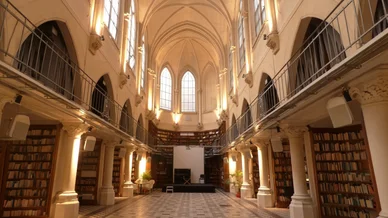
Behind the historic façade of 26 bis rue de Saint-Pétersbourg, one minute from Place de Clichy and five minutes from Gare Saint-Lazare, stands a former 19th-century convent. Some fifty years later, the building became the Hôtel Canadien et Colonial. From 1945, it housed the National Institute of Industrial Property (INPI).
In 2012, the French State made the premises available to the Aurore association for a limited period, as part of the winter campaign. The former INPI headquarters then became an emergency accommodation centre (CHU). The 115 emergency helpline referred pregnant women and mothers on their own with children there. In total, 160 people of 37 different nationalities lived there while they rebuilt their lives and found stable housing.

Around the centre, a chapel, balcony alcoves, work and meeting rooms and open-plan office floors covered more than 600 m². In these spaces, Aurore launched L'Archipel in 2014: a set of solidarity activities designed to support, directly or indirectly, the running and the mission of the centre. The project also gave residents and local people chances to open up and meet each other.
The approach went beyond the fight against exclusion. For Aurore, integration, inclusion, innovation and social mix depend on closer ties between people. These ties are most often built through shared activities and contributory projects, whether cultural, educational or economic. The venue was therefore dedicated to these encounters and to activities centred on beauty and digital skills, with support from Simplon.co, My Little Paris and the Mouvement des entrepreneurs sociaux.
Name | L'Archipel |
|---|---|
Project led by | Aurore association |
Address | 26 bis rue de Saint-Pétersbourg, 75008 Paris |
Building | Former 19th-century convent, then the Hôtel Canadien et Colonial, then INPI headquarters (1945–2012) |
Made available by the French State | 2012 |
L'Archipel launched | 2014 |
Closure | Summer 2016 (closing party on 1 July 2016) |
Activity space | Over 600 m², including the 300 m² Nave |
Emergency accommodation centre | 160 people of 37 nationalities |
Activities | Events, coworking, café, swap shop, workshops, socio-cultural programme |
The Team
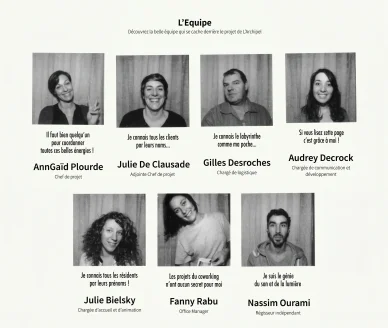
A team of eight people ran L'Archipel day to day, from managing the project to looking after the premises. Within Aurore, the project came under the association's social and solidarity economy department, headed by Sophie Alary.
Name | Role |
AnnGaïd Plourde | Project manager |
Julie De Clausade | Deputy project manager |
Gilles Desroches | Logistics officer |
Audrey Decrock | Communications and development officer |
Julie Bielsky | Front desk and activities officer |
Fanny Rabu | Office manager |
Nassim Ourami | Freelance technical manager |
Sorin Clopotar, for his part, jokingly took credit for “that little fresh scent” floating through the premises.
The Aurore Association
Aurore is an association founded in 1871 and recognised as a public-interest organisation in 1875.Its mission is the social and professional reintegration of people facing hardship and exclusion.

Aurore is an association founded in 1871 and recognised as a public-interest organisation in 1875.Its mission is the social and professional reintegration of people facing hardship and exclusion.
Drawing on this long experience, the association designs and tests forms of support that keep pace with changing patterns of hardship and exclusion. At the time of L'Archipel, it supported more than 20,000 people a year, employed more than 1,500 staff and ran 150 facilities, mainly in the Île-de-France region.
Its work was organised around three areas:
Shelter
- Emergency Division: emergency accommodation and food aid for people sleeping rough.
- Accommodation Division: reception, accommodation and support for a wide range of people.
- Housing Division: rental intermediation, solidarity letting and management of social housing for people facing exclusion.
Care
- Addiction, Health and Hardship Division: support and care for people with drug addiction.
- Reception and Mental Health Care Division: reception, accommodation, care and support towards independence for people with psychiatric disabilities.
Integrate
- Employment Integration Division: social and professional integration of people far from the job market.
- ESAT Division (sheltered employment): vocational reintegration of workers disabled by mental illness.
Responsible for the former INPI premises since 2012, Aurore wanted to develop a large-scale social project in the former chapel and the neighbouring building, based on integration through beauty. L'Archipel grew out of this idea: a venue that was at once an events space, a coworking space and an inclusive socio-cultural programme.
Activities
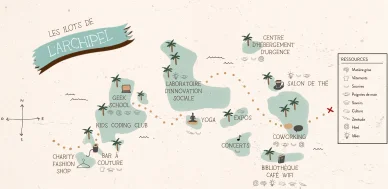
The project aimed to create a many-sided venue open to everyone. Designed as a space for collective innovation with a European outlook, L'Archipel remained deeply rooted in its neighbourhood. It focused on social mix, inclusion, openness to local residents and collective momentum.
The solidarity activities were organised around the emergency accommodation centre and supported Aurore's mission, directly or indirectly. Residents were at the heart of the project. The venue was also aimed at local residents, children at school in the 8th arrondissement, users of Aurore's other facilities, Parisians and tourists. Social entrepreneurs and anyone looking for a place to share, create, work or broaden their horizons were welcome too.
The heart of the site was the Nave (la Nef), a deconsecrated chapel that once served as INPI's library. It was refurbished with help from 80 employees of the Palace of Versailles and Coca-Cola, as well as people staying at the centre. Around it, L'Archipel brought together a solidarity swap shop, a coworking space, a weekly programme, brunches, yoga classes and many public and private events.
The TrocShop
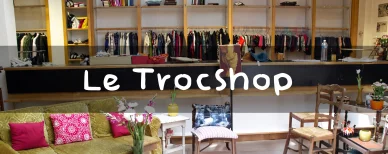
The TrocShop was L'Archipel's solidarity swap shop. It later moved to the Grands Voisins site in the 14th arrondissement.
The principle was simple: bring one item, take another. Everything could be swapped except furniture: clothes, accessories, beauty products, CDs and DVDs. Items were for men, women and children, in all sizes and for all tastes.
Happy Saturday

On Saturdays, L'Archipel offered a relaxing package called “Happy Saturday”, to enjoy alone, as a couple or in a group. The team pitched it as a way to forget the grey skies, the pollution and “those pesky pigeons” and start the weekend on the right foot. The package relied on simple pleasures and three activities.
I Dive into Good Books
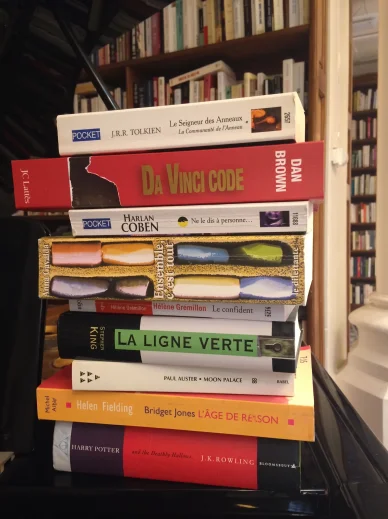
The Nave's library held more than 8,000 books: novels, children's books, travel writing and many other titles.Visitors could swap books they had already read, from Marc Levy to The Picture of Dorian Gray and Les Muchachas, for new ones. The shelves were sorted by theme. Those in a hurry picked from the selection of the week, while others browsed before starting a first chapter in a hammock, organic juice in hand. The Book Swap (Troc Livres) was open every Saturday from noon to 7pm.
I Sip Lazily
The Nave also doubled as a refreshment bar. It served organic juices, coffee and fair-trade tea, to enjoy sitting down or stretched out in a hammock. The team presented it as an alternative to crowded café terraces overlooking Paris RATP buses. The bar was open every Saturday from noon to 7pm.
I Refresh My Wardrobe the “Solidarity” Way
The third part invited visitors to renew their wardrobe without queuing at department store fitting rooms or waiting for an online order to arrive. In 2016, L'Archipel promoted more solidarity-based, responsible and circular consumption through the TrocShop. The rule stayed the same: bring one item, take one home. The TrocShop was open every Saturday from noon to 7pm.
The Sunday Stroll
Every Sunday, the 300 m² Nave welcomed the public for a comforting escape. Its library of more than 8,000 books sat beneath a 15-metre-high vault. The programme combined food for body and mind, relaxation and escape, to end the week gently.
#FeelGoodBrunch
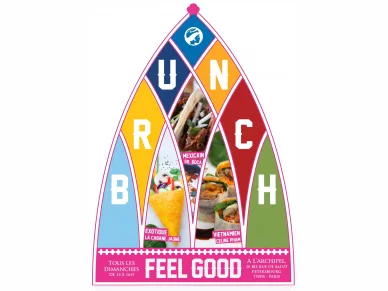
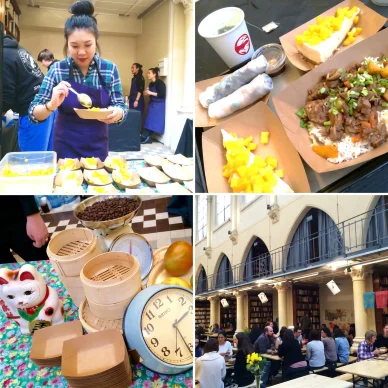
From noon to 2:30pm, the Nave served a solidarity brunch prepared by chefs invited by Les Camionneuses, one of the venue's partners. The full menu (starter, main course and dessert) cost €18, plus a €2 solidarity contribution. This money paid for leisure activities and festive meals for the people staying at the emergency accommodation centre in the building. The team called it the “Feel Good Effect”.
Several chefs took turns over the season:
- In March, Julien Zattara brought the traditional Mexican cuisine of BocaMexa. Already experienced in the restaurant trade, he had founded this restaurant at 127 rue Mouffetard (Paris 5th) two years earlier with Luis Angeles, to promote Latin American cuisine and culture. On the menu: chilaquiles verde with chicken marinated to a Mayan recipe and black bean purée, botana de queso with fresh cheese and apricot-chipotle compote, then pastel de elote con cajeta.
- In April and June, Céline Pham introduced guests to Vietnamese cuisine: banh mi with crispy chicken, pho soup, steamed buns with miso duck confit, Vietnamese-style bœuf bourguignon, mango and lime cheesecake or banana tatin. Trained at the Ferrandi school and then in the kitchens of Saturne, Chez Aline and Septime, she worked as a private chef and cooked for private events. She had just published the book Vietnam with La Plage.
- In May, the Pink Ladies, twin sisters, put together an all-pink menu: crab roll with mesclun and pomelo salad, veal pastrami bun with pink coleslaw, homemade strawberry tartlets, and hibiscus-ginger infusion or pink microbrewery beer.
- In September, Les Camionneuses invited Stéphanie Denis: marinated red cabbage salad with citrus and toasted hazelnuts, chicken curry with seasonal vegetables and honey-roasted red kuri squash, then a soft lemon and poppy seed cake with lime icing.
Yoga Classes
From 5pm to 6:30pm, the day ended with a yoga class under the vault of the Nave. It was led by the association Tout ça pour ça and open to all, at €20 per 90-minute session. Aurore's beneficiaries could take part for free. The venue's calendar regularly added other events to this Sunday programme.
In Code We Trust
Under the name “In Code We Trust”, L'Archipel showcased the work of Simplon.co, its digital partner. Awarded the French Tech label and selected for the presidential initiative “La France s'engage”, Simplon.co is a certified solidarity enterprise. It offers free training to become a web and mobile developer or a digital skills adviser. These courses are aimed at jobseekers, people on RSA (France's minimum income benefit) and young people from working-class neighbourhoods, diaspora communities and rural areas. They also target girls, who are still few and far between in technical digital jobs.
Born in Montreuil (Seine-Saint-Denis), the initiative opened an off-site training group in a priority urban zone (ZUS) in Villeneuve-la-Garenne (Hauts-de-Seine), a subsidiary in Cluj, Romania, and a rural digital school in the heart of the Perche Regional Natural Park. Other locations were in the pipeline at the time.
In less than a year, more than 300 jobseekers or RSA recipients from working-class neighbourhoods and low-income backgrounds were trained there in web and mobile programming. On top of that came around a hundred employees and more than 500 children, who attended the Kids Coding Club workshops run by Les Compagnons du DEV, the twin public-interest association of Simplon.co.
About twenty apps and projects were born or incubated at Simplon.co, including Stop le contrôle au faciès, Job For Change, I Wheel Share, Lost In Immersion, Billetgratuit, Fewhourz, Dear Muesli and MesObjets. Some won prizes at competitions or hackathons. Simplon.co itself received several awards for combining digital innovation with social innovation: the Samsung prize, CREENSO, Échappée Volée, a LinkedIn “innovation grant” in the United States and a social mention at the City of Paris Grand Prix de l'Innovation.
Kids Coding Club
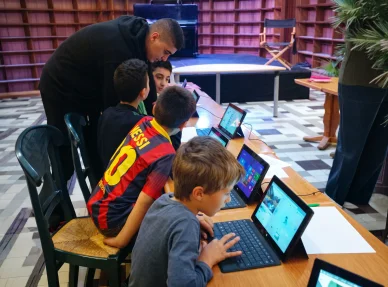
Kids Coding Club is an initiative designed to help children and their parents discover and enjoy programming. It rests on a simple belief: if programming lets people create, structure their ideas and bring their creativity to life, it suits children too. Tools such as Scratch or Lego Mindstorms help them get to grips with technology by learning through play.
Supervised by a specialist adult trained by a team of educators and experts in the field, children aged 7 to 14 discover programming and build their own projects. Robots, games, animations, web apps or connected objects: the choice is wide, and the only limit is the participants' imagination.
The workshops follow a three-step progression:
- Exploration: discovering programming concepts and making first creations.
- Construction: putting together first programs, alone or in groups.
- Transformation: each child creates according to their own creativity.
They come in four modules: computer programming, robotics, connected objects and DIY electronics, and 3D printing.
Kids Coding Club is a brand of Les Compagnons du DEV, a non-profit association under the French law of 1901, recognised as being of general interest and run on a not-for-profit basis. It promotes education in information technology, learning to code and access to robotics, connected objects and “Do It Yourself”, especially for children, seniors and vulnerable groups.
The Sewing Bar
The Sewing Bar (Bar à Couture) was born from the wish of the people staying at the centre, mostly women, to make the venue more beautiful and to turn beauty into a lever for integration. Agathe, a professional costume designer, took up residence at L'Archipel to create encounters around sewing.
Alongside her work for several national theatres, she devoted one day a week to the people staying at the centre. She supported them in solidarity projects: fashion shows, customising and repurposing clothes. On Sundays, the 12 machines donated by Singer were made available to the public, for three-hour themed workshops (€40) or rental by the hour (€4).
Café de L'Archipel
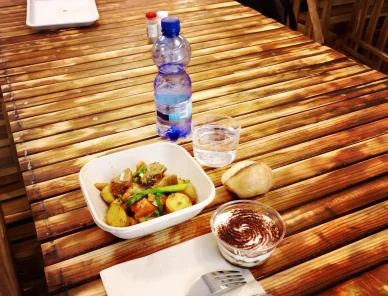
On 24 March 2015, a Baluchon counter opened at the Café de L'Archipel. It ran from Monday to Friday, 11:30am to 2:30pm. Dishes were made only with fresh, local and seasonal produce: sandwiches made that same morning, salads, hot dishes, soups in winter, homemade desserts and cold drinks. Set menus cost less than €10.
Baluchon is a solidarity enterprise of social utility, which employed 25 people at the time. Two thirds of them were following a training pathway towards jobs in catering and delivery.
Concerts and Events
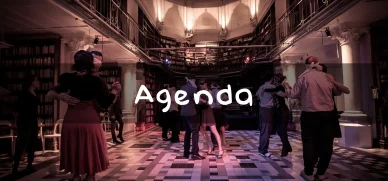
The Nave hosted a varied weekly programme, announced in the venue's calendar. Brunches, workshops, yoga classes, book swaps and naps in hammocks followed one another, as did workshops on how to repair furniture.
Music had its place too. With Petit Bain, a partner of L'Archipel, acoustic concerts were held in the chapel during the lunch break. The format drew employees from nearby offices, who shared a meal with the people staying at the centre.According to the Petit Bain team, the idea of holding concerts in social accommodation centres was born at L'Archipel and developed from 2016 with its Welcome project.
On Tuesday evenings, from 8pm to 11pm, the Nave also hosted the “Coworking Tuesdays”. Finally, the spaces hosted many private events, covered in the section on private hire.
Coworking
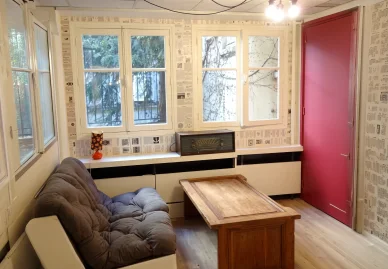
In partnership with La Ruche, L'Archipel offered 30 coworking desks reserved for social impact projects. The offer targeted social entrepreneurs, European coworkers, freelancers whose work had a solidarity dimension, civic actors and innovators in the social and solidarity economy.
The space took up two floors of the building next to the Nave. It was open from 9am to 10pm on weekdays and from 11am to 6pm at weekends. Among other things, coworkers could:
- work in a stimulating and friendly environment;
- talk every day with people who shared the same professional concerns;
- draw on the experience of the whole Aurore network;
- use several spaces for meetings, mutual help, conversation and printing;
- drink unlimited coffee and tea at the Café de L'Archipel;
- settle in the alcoves of the Nave when it was not booked for a private event;
- take part in the “Coworking Tuesdays” and weekly gatherings, such as the Monday “good morning” and pitch drinks;
- develop projects linked to the emergency accommodation centre.
Other Activities
The L'Archipel team believed that innovation is born of diversity. The venue therefore offered many mixed workshops to the centre's residents and to all of Aurore's beneficiaries. Some were reserved for them, others were open to all. These cultural and educational activities aimed to fight exclusion, stimulate innovation and create social mix by strengthening ties between people.
- Feel Good Song. Leïla, a singer, led L'Archipel's choir, designed to let every voice in the venue be heard. Being able to sing was not required: the aim was to have a good time together. The choir was also open to people who worked or lived in the neighbourhood. Members had lunch at the café at 12:30pm, then from 1pm to 2pm moved on to breathing exercises, voice work and songs chosen by the group. It was free and open to residents, Aurore's beneficiaries and the general public.
“Song Factory” workshops. With Fausse Note, Peggy Rolland, a trained pianist and self-taught singer, invited the children of the emergency accommodation centre to express themselves through music. Together, they wrote lyrics and composed melodies. For the children, these workshops were a real breath of fresh air and often revealed lovely talents.
The teenagers' workshop, for ages 11 and up, took place on Mondays from 6pm to 7pm in the Nave and was reserved for Aurore's beneficiaries. The workshop for children aged 7 to 10 ran on Mondays from 5pm to 6pm. It focused on the artistic project “La Caravane des dix mots” (The Ten-Word Caravan): ten set words, explored for their musicality and then turned into a song. This workshop was open to all, with a flat-rate fee for people who were not Aurore beneficiaries.
- Yoga classes. A teacher from Tout ça pour ça led a mixed yoga class suited to beginners and experienced practitioners, children, adults and pregnant women. It took place on Tuesdays from 8pm to 9pm in the multipurpose room. People who were not Aurore beneficiaries paid a donation of their choice, from €5.
- Women's self-defence workshop. Run with the association Osez le féminisme, this fun and physical workshop covered the basics of self-defence, both verbal and physical. It was reserved for Aurore's female beneficiaries and took place on Thursdays from 8pm to 9pm in the multipurpose room.
- The Book Swap. Everyone could swap their books for those in the Nave's library, which held more than 8,000 books. The rule was simple: bring one book, take one. The Book Swap was open to all.
Partners
From the outset, L'Archipel received support from many partners. They put their professional experience and expertise at the project's service, complementing Aurore's know-how as an association: building the website, decoration, commercial outreach, spreading the word about the venue and promoting it, and finding partnerships. These organisations played a key role in designing and delivering L'Archipel, and continued to support Aurore afterwards.
- Baluchon. This solidarity enterprise of social utility gives people far from the job market a chance to take back control of their economic and social path by preparing small cooked dishes together. Founded on 1 November 2014 in Romainville, Seine-Saint-Denis, it takes on employees in integration for 10 to 24 months. There, they learn the demands of jobs in catering and logistics. The team has three goals: to cook only fresh, seasonal and unprocessed produce, preferably local and from environmentally friendly farming; to promote access for all to good, healthy and fair food; and to create jobs in Seine-Saint-Denis.
- Les Camionneuses. They offer project leaders and food entrepreneurs affordable, flexible services: a shared kitchen, a network of opportunities, pooled purchasing and other shared services. For food lovers, they list the best places to taste these new talents' dishes. The four female founders, friends for many years, took inspiration from the success of food trucks and shared kitchens in the United States. Their ambition: to make fine food accessible everywhere, all the time and at a lower price. In January 2014, they launched L'Office, the first shared kitchen in Île-de-France.
- Mouvement des entrepreneurs sociaux (Mouves). This association unites and represents the leaders of social enterprises, who put economic efficiency at the service of the general interest. It has set itself three missions: to grow a broad community of social entrepreneurs, to raise awareness of their sectors, professions and solutions, and to help create a political environment that supports their development, in France and in Europe.
- My Little Paris. Founded in 2008, My Little Paris brings together a community of more than one million Parisians around tips, unusual addresses and monthly surprise boxes. It all started with a newsletter sent to a few friends, mixing advice, good addresses and careful graphic design. Within a few months, word of mouth took it to more than 10,000 subscribers. Hand-drawn illustrations, a refusal to sell its database, transparency towards subscribers and advertisers woven into the brand's world shaped its model. The concept spread to Lyon and Marseille and branched out into several themes: Wedding, Kids, and Merci Alfred for a male audience.
- Simplon.co. This certified solidarity enterprise with the French Tech label offers free training in digital jobs to people far from the job market. Its work is described above, in the In Code We Trust section.
- Les Compagnons du Dev. Founded in June 2013, the association aims to give the keys to the digital world to as wide an audience as possible. Beyond mastering the tools, it helps citizens become “digital craftspeople”. Its educational support in programming and new technologies aims to open new paths to education, employment, culture and social ties.
- Ensemble Communications Participatives. A member of the European programme “TRANSITION, booster de l'innovation sociale” (a social innovation booster), the organisation has been widely covered in the media. It has developed methods to create or restore ties where they are broken and to strengthen everyone's participation in collective efforts. It also encourages dialogue between people or communities and the professionals they meet. Participatory communication is also an empowerment method that encourages commitment to collective projects.
- Petit Bain. A floating cultural venue, Petit Bain combines a concert hall, a restaurant, an integration enterprise and a cooperative. The barge was designed by the architecture collective Encore Heureux and is laid out on three levels: a green rooftop terrace, a restaurant and a concert hall with a recording studio. The venue blends artistic events, integration through economic activity and experimentation, and aims to be a place for discovery and encounters.
Private Hire
Most of L'Archipel's spaces could host events all year round. In total, around 600 m² could be hired by agencies, companies, associations and private individuals. The chapel, the balcony alcoves and the meeting rooms adapted to every format: seminars, conferences, workshops, concerts, fashion shows, exhibitions, creative meetings, cocktail parties, shows and other cultural events.
By the time the project closed, the venue had hosted more than 150 private events in 18 months. The organisers included:
- companies and institutions: Le Monde, Media.Com, Pages jaunes, M6, Coyote Production, ATTAC, Galeries Lafayette, the World Bank, Crédit municipal, Google, Facebook, Ubisoft, Hogan Lovells, Orange, Boston Consulting Group, Vinci, SNCF, Banque populaire, Air Liquide, ANRU (the National Urban Renewal Agency) and Ashoka;
- associations: HEC's Action Tank, Habitat et Humanisme, Groupe SOS, Mouves, 100 Barbares, Ticket for Change, Fondation Immochan, Les Nouveaux Robinson, AFEV, Co-City, Unis-Cité, ESSEC Antropia and Avise.
Conclusion
L'Archipel closed its doors in summer 2016.The project had been designed as temporary from the start: the building was entrusted to Aurore only for a limited period and was then due to be converted into housing. A closing party brought the team and the public together on Friday 1 July 2016, and Aurore handed back the keys to the site over the summer.
In just over two years, the venue brought together families in emergency accommodation, local residents, social entrepreneurs and staff from nearby offices. Brunches, workshops, concerts and more than 150 private events marked this period. Several initiatives outlived the closure: the TrocShop moved to Les Grands Voisins, and Petit Bain carried on the concerts in accommodation centres with its Welcome project. Aurore then opened other sites combining accommodation and activities, such as Les Cinq Toits in the 16th arrondissement, with Plateau Urbain.
The French State sold the building to the social housing landlord Élogie-Siemp. In February 2018, the foundation stone of a programme of 87 social housing units was laid there, in one of the Paris arrondissements with the fewest social homes.