How Global Warming and Climate Change Will Affect Ireland
Climate change is no joke, and while it’s true that you can find deniers who’ll claim that the whole thing is a hoax, you can find people who’ll say anything. The scientific evidence doesn’t lie, and climate vulnerability is a known phenomenon that’s here to stay unless we take rapid action to address it.
But what is climate change, and how will it affect Ireland? That’s the question that we’ll be tackling today.
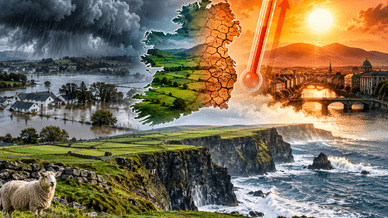
Ireland's unique geography and the fact that it’s surrounded by the Atlantic Ocean to the west and north, the Celtic Sea to the south and the Irish Sea to the east mean that it’s uniquely susceptible to climate vulnerability.
The threat of a sea level rise is particularly terrifying because it poses an existential threat to coastal communities, tourist towns, beaches, ports and anywhere else beside the sea. For an island nation, this is so much more of a threat than it is for a landlocked country, and Ireland is more vulnerable than most.

Meanwhile, storms throughout the Atlantic and Ireland’s dependency on the Gulf Stream and the weather it brings also mean that Ireland is more vulnerable than most. That’s why its citizens are no longer asking, “What is global warming?” Instead, they’re asking, “How will global warming affect us?”
There’s a growing concern about this amongst everyone from Irish citizens to the policymakers who determine how the country will react to these new threats. Let’s take a closer look at that, along with how climate change in Ireland differs from the same phenomenon in landlocked European countries.
The Causes of Global Warming
Understanding global warming, climate change and the differences between the two starts with understanding what greenhouse gases are. These include gases like carbon dioxide (CO₂), methane (CH₄), and nitrous oxide (N₂O), which naturally occur in the atmosphere and which help to trap the heat that’s essential for life on earth to exist in the first place.
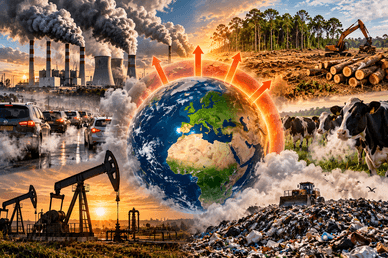
The problem is that when the concentration of these gases increases, which is happening now as a result of the emissions we create as a society, so too does the amount of heat that they trap. The result is the greenhouse effect, which earned its name because it’s literally as though we’ve built a greenhouse around the planet. If you’ve ever stood inside a greenhouse on a sunny day, you know exactly how effective they are at trapping heat, and greenhouse gases are doing the same thing but on a global scale.
The question, then, isn’t “Is climate change real?” It’s “How is Ireland affected by climate change?”, and a lot of that comes back to greenhouse gases.
As human beings, we’ve increased the amount of greenhouse gases in the atmosphere through everything from burning fossil fuels to cutting down trees and raising huge amounts of livestock. As a result, there’s been an average temperature rise of around 1.2°C, with the Intergovernmental Panel on Climate Change (IPCC) projecting a further increase to a total of 1.5°C to 2°C.
The IPCC also cautions that we’ll need to make immediate and extensive changes to keep the temperature rise down to 1.5°C and that a 2°C increase could have much larger impacts, leading to worsening heatwaves, heavier rainfall and greater damage to our ecosystems.
The Biggest Climate Threats to Ireland
When you understand the causes of global warming, you can better understand the potential impacts. Unfortunately for those of us in Ireland, we’re particularly vulnerable to its effects.

This is because of Ireland’s Atlantic coastline and mild oceanic climate, which could spell disaster once global warming and climate change kick in. Risks include coastal flooding and extreme weather events, as well as a huge agricultural impact and the loss of biodiversity. The IPCC has identified coastal flooding and inland flooding as particular risks, and it’s also important to remember that they can interact. For example, flooding can damage farmland and critical infrastructure at the same time.
Sea Level Changes, Erosion and Shrinking Coastlines
When considering who is affected by climate change, the easiest answer is anyone who lives by the sea. That’s because climate change leads to rising sea levels and rising sea levels spell trouble for coastal communities.
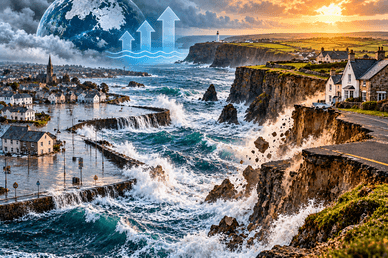
Chance plays a big part in casino games, but Ireland’s vulnerability to rising sea levels comes down to geography. On top of it being an island community, the sea levels around the country are also rising faster than the global average, especially around Dublin, Cork and the Galway coast. That leaves Dublin flooding looking increasingly likely, especially during adverse weather events such as a storm surge.
Meanwhile, coastal erosion has already destroyed farmland and vital infrastructure, and that infrastructure risk is only going to get worse as time goes on. In fact, EPA assessments estimate a sea level rise of around 0.26 metres as soon as 2041, while by 2100, estimates of sea level rises range from 0.5 metres to 1 metre depending upon which models and predictions are used.
According to the latest estimates, as much as 20% of Ireland’s coastline could be at risk of coastal erosion, and some areas have already started to experience it. The impacts of climate change aren’t some far-off, future threat. They’re here already.
Flooding, Droughts and Storms as the New Normal
When you look at the global warming facts and the proven effects of climate change, it’s clear to see that change will be the only constant. From flash floods to drought and storms, Ireland will find itself increasingly vulnerable to the adverse weather events that it’s already started to experience.
One of the most notable issues is the intensification of Atlantic storms, which have been getting worse due to the fact that warmer air can hold more moisture and thus lead to heavier rainfall. According to Met Éireann, average annual rainfall in Ireland increased by approximately 7% between the periods 1961–1990 and 1991–2020.
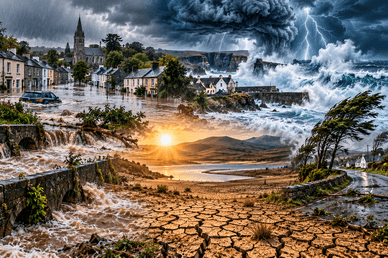
Meanwhile, data from Irish meteorological service Met Éireann shows that while there might be a slight decrease in the number of cyclones in the North Atlantic, the number of those that will both be severe and affect Ireland will increase. In other words, there will be fewer storms overall, but Ireland will still be hit harder than it’s being hit today.
Since Ireland launched its official storm-naming system in 2015, there have been an average of eight storms a season, though the 2023/24 season saw 14 of them. It will be interesting to see if and when that record is broken.
The Hidden Risk of the Gulf Stream
One of the biggest unsung factors at play when it comes to global warming and its impact on Ireland is the Gulf Stream. What many don’t realise is that the Gulf Stream is just one current that forms part of the overall Atlantic Meridional Overturning Circulation (AMOC), which you can think of as a sort of oceanic conveyor belt.
It works through a process of thermohaline circulation, a technical term that combines “thermo” for temperature and “haline” for salt. This process transports warm water north towards Europe, helping to regulate the Irish climate. However, there’s a concern that Greenland ice melt could add huge amounts of freshwater to the North Atlantic, disrupting the Atlantic circulation.
When we talk about climate change examples, we tend to focus on global warming, but we also need to consider climate cooling. In this instance, the disrupted circulation could reduce the amount of heat that’s transported towards Ireland and actually lead to a cooling of 5–15°C according to the most extreme models. This would make Ireland as cold as Norway or Canada, although it’s important to note that this is just one of many possible scenarios and a number of different factors would need to come together for this to happen.
This risk is particularly relevant to Ireland. While the rest of Europe would still have to deal with the impact of climate change, its temperatures are less dependent upon the Atlantic. It’s just one of the many reasons why Ireland is at particularly high risk.
Nature Comes Under Pressure
Understanding climate change means understanding that human activity is at odds with nature, and that the activities we’re carrying out as a species are putting a huge amount of strain on the planet we live on.
One of the biggest impacts on Ireland will be felt by the agricultural sector, and by the dairy farming industry in particular. The changes in rainfall patterns will lead to wetter autumns and winters but drier summers, reducing grass growth and damaging soils. Meanwhile, the degradation of peatland could lead to carbon storage being compromised and the element being released into the atmosphere, increasing the amount of greenhouse gas in the atmosphere.

We’ll also experience a loss of the biodiversity Ireland is known for, with species migration when animals are fortunate enough to be able to flee and the death of flora and fauna when there’s nowhere for it to go. Up to 20% of the native flora could be vulnerable to climate change, and local bogs and hedgerows could eventually become a thing of the past.
Estimates on the impact of all this tend to vary, but some scenarios expect beef production to drop by 17% and dairy output to fall by 7% by 2050. That might not sound like much, but we’re talking about a huge hit to the country’s GDP.
The Economic Impacts of Climate Change
That brings us on to the next point, which is the potential economic impact of climate change in Ireland. Unsurprisingly, it could cost billions of dollars, with a range of different sectors at risk.
The Irish government can expect a climate adaptation cost of up to €2.2 billion per year, with the economic damage from sea level rises alone estimated to hit around €2 billion each year according to the ESRI. Much of this cost comes in the form of prevention, and if the government fails to spend it now, it will face a heftier bill further down the line.
We’ve already talked about how climate change could threaten the agricultural industry, which is a key part of the Irish economy. Let’s not forget, though, that Irish tourism could come under threat too. The increased chances of inclement weather could lead to fewer tourists, and property insurance costs and other expenses are sure to go up, making it harder for tourism-based companies to keep making a profit. In fact, Deloitte estimated that climate change could cost the insurance industry as much as €1.5 billion in the next decade.
We can also expect to see internal migration as coastal communities look to move inland instead. This will place further pressure on public services and the country’s infrastructure, especially for the major cities, many of which are already located in at-risk coastal areas.
How Ireland is Tackling Climate Change
By now, you shouldn’t need any more climate change examples to understand just how much of an impact it’s likely to have on Ireland. That leads us to the big question of what the country plans to do to tackle the challenge.
The biggest factor to consider here is Ireland’s Climate Action Plan, which aims to cut greenhouse gas emissions by 51% by 2030 and to reach climate neutrality by 2050. That’s all well and good, but if other countries don’t follow suit then it’s not necessarily going to help.
The good news is that Ireland’s action plan is associated with the EU Green Deal, and the country has legally binding carbon budgets and specific ceilings that it needs to stay beneath. The country has also committed to an emissions reduction of 42% for sectors like transport, buildings, agriculture and waste, a programme that’s part of the EU’s Effort Sharing Regulation.
Ireland already has a solid record when it comes to compliance and has invested a good amount of money into offshore wind and wave energy, aiming to generate as much as 80% of its electricity from renewable sources by 2030. The goal is to generate 37 GW of offshore renewable energy by 2050.
At the same time, investing in renewable energy and cutting down emissions is only part of the solution. That’s why the Office of Public Works has launched its 2026-2030 National Development Plan, which aims to provide €715 million for a flood defence programme. This year, a further €3 million was announced to help local authorities to tackle local flooding and coastal erosion in their areas.
When all of this is put together, we can see just how determined the Irish government is to develop a cohesive approach to climate change. Prevention is key, but it’s not enough by itself. It’s also important to budget for tackling the problems once they arise.
What This All Means for Ireland
From everything we’ve covered today, it’s pretty clear that “how can we stop climate change?” is the wrong question, because we’re too far along the road to avoid it. Instead, we need to ask “how can we help climate change adaptation efforts to minimise the damage?”
Climate action is particularly important for Ireland because it faces a dual threat, with global warming raising the sea level while the AMOC collapse could lead to local cooling. It’s a double-whammy that will be particularly difficult to deal with, which is why the government has already taken steps to go above and beyond EU climate policy and to develop a green Ireland.
Immediate action is essential, not to head off climate change completely but to facilitate an adaptation to the changes that are sure to come. In fact, the country’s very future will be tied to its ability to adapt to the coming changes.
Fortunately, it’s not all doom and gloom, and Ireland is well-placed to tackle the challenges and to build a brighter, more sustainable future. It’s also a proud country with a rich history, and we shouldn’t be surprised if the people of Ireland come together to protect its coastline and biodiversity.
In the years to come, Ireland will shift increasingly to offshore wind farms and other sources of renewable energy, as well as shoring up its coastal defences. If all goes well, the economy will grow instead of shrinking. Only time will tell if the country has done enough, but there’s hope. And that’s what we should all hold on to.