Olympic Nice Natation
Olympic Nice Natation, or ONN, brings together swimming lessons, leisure water activities and high-level trainingin Nice. Behind its champions' performances, the club offers pathways for children discovering the water, teenagers who want to improve and adults who swim for pleasure or competition. Its history has been built around several disciplines, including swimming, water polo, diving and artistic swimming. Here are its main milestones, its organisation and the ways to take part.
Key Information
ONN combines a long sporting history with an offer that runs from first lessons to international competitions.
Full name | Olympic Nice Natation |
Abbreviation | ONN |
City | Nice |
ONN founded | 1989, according to the club's official history |
Origins | Cercle des nageurs de Nice, founded in 1912 |
Disciplines on the 2026–2027 timetable | Swimming, water polo, diving and artistic swimming |
Other activity presented on the website | Open water swimming, notably around the Prom'Swim |
Learning to swim | Water school from age 4 |
Address | 36 avenue Paul-Arène, 06000 Nice |
Phone | |
Registration contact | |
Club motto | The club with 9 Olympic medals |


Organisation Chart
The organisation chart published for the 2025–2026 season sets out the board of directors, the management team, the office staff and the coaches.
Jean Monnot chairs the club, with Michel Lamy and Jean-Pierre Caoussi as vice-presidents. Robert François is treasurer, Véronica Vecchioni secretary and Richard Papazian assistant secretary.
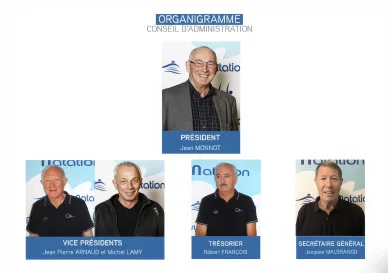
The board also includes Véronique Bourland, Alexandra Bermond, Loïc Branda, Gregory Dutriaux, Delphine François, Isabelle François, Evelyne Gatti, Xavier Lecerf, Michel Massie, Martine Patenotte and Hubert Saccheri.
The management team brings together Erick Lefert, sports director; Emilie Bourdiaux, administrative manager; Julius Izdinsky, in charge of organisation and travel; and Maeliss Lefrancois, communications officer.
In the office, Bruno Andrieu handles reception and member services. Alena Izdinsky coordinates the water school, while Nathalie Cordier helps with administrative coordination.
Discipline | Coaches mentioned |
|---|---|
Swimming | Fabrice Pellerin, Thibault Saccheri, Eric Valat, Mehdi Bouaia |
Water polo | Jovan Cakic, Elie Carreau, Marco Fusco, Csenge Gaal, Marco Chion |
Diving | Romuald Borgo |
Artistic swimming | Anne Sophie Cote, Lisa Preaubert |
History of Olympic Nice Natation
The story of ONN begins long before the club took its current name. In 1912, the Cercle des nageurs de Nice was founded. Its members swam and played water polo in the waters of the Port Lympia and at Le Piol. For several decades, the CNN represented Nice in national and international competitions.
In 1989, the merger of the Cercle des nageurs de Nice, NUC Natation and Nice Natation Synchronisée gave birth to Olympic Nice Natation. The new club brought several local sporting traditions together in a single structure.
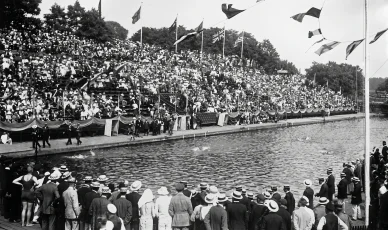
Water polo played a decisive role in this development. From 1987, the Nice team played under the colours of CACEL, which managed the Jean-Bouin Olympic pool, built the year before. In 1995, the demise of CACEL threatened the future of the sport. At the request of the City of Nice, ONN took over water polo in Nice.
President Jean Monnot then turned to Richard Papazian, appointed general manager on 1 September 1996. Papazian entrusted the coaching to Italian coach Paolo Malara. Despite more limited funding, the team quickly returned to the top and began a run of eight consecutive French championship titles.
The club's development was not limited to men's water polo. Swimming, synchronised swimming and diving gradually took on a bigger role. In 2002, the Nice triathlon club, led by Yves Cordier, joined ONN. The same year saw the launch of women's water polo.
Swimming then became one of the main drivers of the club's reputation. Fabrice Pellerin's work supported the careers of Mathieu Lacome, Camille Muffat, Clément Lefert and Yannick Agnel, among others. The London Olympics were a highlight of this story: at the 2012 French championships, ONN swimmers won nine titles, and five of them qualified for the Games.
"La passion de l'ambition" (the passion of ambition) sums up this path: training athletes, helping them reach the highest level and keeping a link between the different disciplines. In its historical review around the 2012 Olympic period, the club already cited more than 300 national and international titles won since Richard Papazian's arrival.
Sports Disciplines
Olympic Nice Natation offers several ways to take part in water sports, from first steps to competition. Swimming, water polo, diving and artistic swimming are on its 2026–2027 timetable, and open water swimming also has its own presentation. Triathlon, for its part, belongs to the club's documented history.
Swimming
The swimming section developed around progression through groups and levels. In the structure described in the archives, swimmers could join regional, inter-regional, national or international groups, on a path running from the competitive swimming school to the Elite group. The labels N1 to N5 and their various subdivisions made it possible to place athletes according to their age and level.
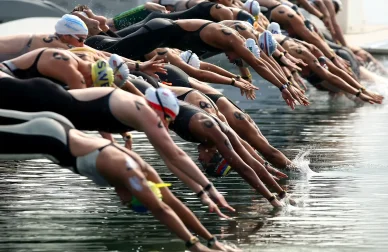
The Elite group aimed for podium places at the French championships, the World Championships and the Olympic Games. The description at the time set out a particularly demanding programme: five hours a day in the Olympic pool at the Plaine du Var, plus an hour and a half of weight training. These volumes describe that historical structure and are not a current schedule that applies to all swimmers.
Support was not based on training alone. The club had set up adapted timetables with Parc Impérial and Don Boscoschools so that swimmers could combine swimming and studies, from the first year of secondary school (sixième) through to post-baccalaureate courses.
Results published in 2025 show the club's continued presence at national level: at the French Elite Championships in Montpellier, Jérémie Delbois won the 100 metres breaststroke, while Lilou Ressencourt won the finals of the 100 and 200 metres butterfly.
Synchronised Swimming
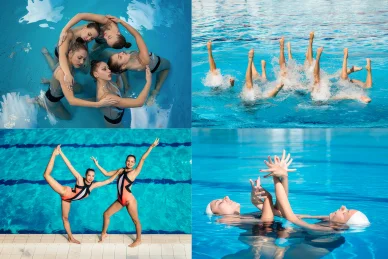
The club now presents synchronised swimming under the name artistic swimming. It combines water skills, gymnastics, dance and music. Swimmers work on positions, movements and figures, alone or in groups, to build a performance that is both technical and expressive.
ONN presents this activity as open to children from age 4, as well as to adults. The section also welcomes boys, so it is not limited to girls and women. Discovery and leisure sessions offer a first approach, while competition groups require greater commitment.
The archives show that the activity was already well established in 2018. That year, the all-categories team finished eighth in the final of the French Elite Championships in Bourg-en-Bresse with a combination routine inspired by the birds of Brazil. An annual gala was also held on 16 June at the Jean-Médecin pool.
Diving
Diving combines three elements: land, air and water. It requires control of the take-off, the body's position during the dive and the entry into the water. Muscle tone, flexibility and emotional control are among the qualities developed in this discipline.
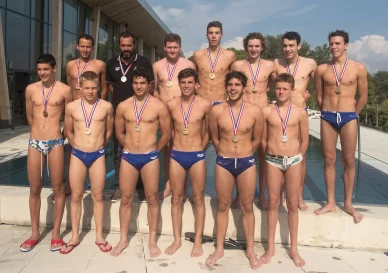
ONN's former structure had five levels, from the national group PL1 to the beginner groups PL4 and PL5. Competitive divers trained at different heights, notably at 1, 3 and 5 metres, as well as on the high board. Trampoline and gymnastics sessions completed the training to develop precise movements and well-executed dives.
The official leisure page now lists taster diving sessions from age 7, with one or two sessions a week. Lessons are offered to children, teenagers and adults.
The club is also still represented in international competitions. In June 2025, Baptiste Allamanno reached the European junior final on the 1-metre springboard and finished tenth with 409.10 points.
Water Polo
Water polo holds a central place in ONN's list of honours. The men's team won eight consecutive French championships, from 1997 to 2004, as well as four French Cups between 1999 and 2002. In the women's game, the club's honours include six national titles, won in 2007 and then from 2009 to 2013, and two French Cups.

Youth development goes hand in hand with this record. The archives describe groups ranging from poussins to cadets and juniors (French age categories), regional-level play and a water polo school for girls and boys. In July 2018, the U15 and U17 teams both became runners-up in the French championships.
Reports from the 2025–2026 season still show men's and women's Elite teams, as well as youth teams, notably at U14 and U16. This structure lets players progress within the club, from the youngest categories to the national championships.
Triathlon
Triathlon joined Olympic Nice Natation in 2002, driven by Yves Cordier. The section combined swimming, cycling and running, with an organisation suited to young people and adults alike.
Children could try the sport from age 6. Two groups, Kids 1 and Kids 2, covered young athletes from the poussins to the juniors categories. Adults had different pathways, including a group for those who wanted to train for fun or prepare for departmental and regional competitions. The programme described allowed athletes to build their week from ten training options across the three disciplines.
The section also took part in national youth competitions. In 2018, five ONN triathletes qualified for the French championships in Vesoul, among them Gabrielle Masson and Emilie Cotin.
Pôle France and Pôles Espoir
Historical documents presented a Pôle France Natation, a Pôle Espoir Natation and a Pôle Espoir Water-polo, the national and regional high-performance programmes. Their aim was to allow the most motivated athletes to keep progressing without compromising their schooling.
Fabrice Pellerin was presented as technical director of the Pôle France and Pôle Espoir for swimming. Support relied on several elements: specialist coaching, suitable training conditions, a dedicated Olympic pool and an adapted school timetable. Choosing to join a high-performance programme also meant taking into account time away from family and the demands of a combined sporting and academic project.
Open Water Swimming
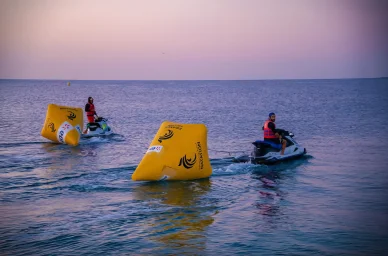
Open water swimming has its own page on the ONN website. There, it is linked in particular to the Prom'Swim, a swim across the Baie des Anges. The published presentation describes five distances, from 500 metres to 10 kilometres, with intermediate formats of 1, 2 and 5 kilometres, open to both licensed and unlicensed swimmers.
In its former structure, the club had set up sea training sessions and an open water competition section following the creation of the Prom'Swim. This section was aimed in particular at middle-distance swimmers who wanted to try another form of competition.
The page still online presents the eighth edition of the event without giving its year. It therefore shows the format on offer, but on its own it does not establish the programme or the training sessions for the 2026–2027 season.
Artistic Swimming in Competition
The competition page sets out several groups with different levels of commitment and goals. The FINA pathways target national competitions, while the Challenge groups offer a different training rhythm.
Group | Organisation described | Goal |
|---|---|---|
FINA Juniors / All categories | Water training plus one hour of gymnastics a week | Taking part and reaching the podium at national competitions |
FINA Jeunes | Four water sessions and one gymnastics session a week | Regional podiums and national qualification |
FINA Avenirs | Ages 10 to 12; four water sessions and one gymnastics session | Regional progress and national qualification |
Challenge Juniors / All categories | From age 15; two training sessions and optional gymnastics | Qualification for National 2 in team routine |
Challenge Jeunes | Ages 12 to 15; two training sessions and optional gymnastics | Qualification for National 2 in team routine |
Poussins | Ages 8 to 11; two training sessions and optional gymnastics | Passing the Synchro Découverte test and regional participation |
Masters | Two or three competitions planned during the year | Group practice and taking part in competitions |
Water School
The water school welcomes children from age 4. Learning combines games, discovering the water and gradually becoming independent. It is also about learning to overcome fears, persevere and follow the rules of the session.
The current structure has level 1, for children who cannot yet swim independently, and levels 2 and 3, grouped into discipline-specific schools. From level 2, the child chooses swimming, water polo, diving or artistic swimming. They continue learning while discovering the basics of the chosen discipline, before possibly moving on to leisure or competition.
The former offer also included a water garden for toddlers. The 30-minute sessions in a shallow pool used floating mats, slides and various other equipment to help the youngest children get used to the water.
Sauv'Nage, Pass'sports de l'eau and Pass'Compétition
Learning was organised around three successive stages. They allowed children to acquire basic water skills, discover several disciplines and then prepare for competition.
The Sauv'Nage was the first stage. This test confirmed a first level of swimming ability and safety skills that help a child react better to difficulties in the water.
The Pass'sports de l'eau developed the ability to adapt to different water activities. The scheme described required children to pass three tests out of five. In competitive swimming, it combined a diving start, front crawl, side breathing, a turn and a return on the back.
The Pass'Compétition then prepared children for entry into competitions in their chosen discipline. For competitive swimming, the test was a 100-metre course showing mastery of butterfly, backstroke, breaststroke and front crawl. These former stages should not be confused with levels 1 to 3, which are currently used to present water school registrations.
Leisure Activities
Leisure activities let people take part without necessarily aiming for a ranking or qualification. ONN focuses on technical progress, coached training and the pleasure of taking part in a regular activity. Pathways differ by age, level and goals.
Leisure for Adults
Adult swimming is organised mainly around the Masters, which are for adults only. The Masters Loisirs group welcomes swimmers who want to learn the four strokes, train and improve in a group setting. The Masters Compétition section, for its part, lets swimmers take part in events such as the Interclubs and the French championships.
The offer also included Aquaform, with aqua aerobics and aquabike. Aqua aerobics offered gymnastic exercises in the water, working in particular the arms, shoulders, thighs and core. Aquabike involved using an exercise bike placed underwater in the pool. These activities offered another way of combining movement with the pleasure of being in the water.
Adult leisure is not limited to swimming. Diving and artistic swimming sessions are also offered to adults. The club also offered leisure water polo, open to beginners and enthusiasts alike.
Leisure for Teenagers
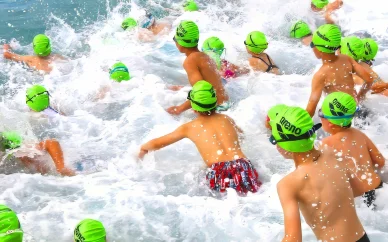
The Dauphins group is for teenagers aged 11 to 14 who want to improve their swimming without setting competitive goals. Sessions are adapted to each swimmer's level and focus on the pleasure of swimming and making progress.
For 15- to 17-year-olds, the Prépa' Exam group offers work on all four strokes. It can serve as preparation for swimming or water rescue tests, notably with a view to the BNSSA, the French pool lifeguard certificate. It is also open to young people who simply want to improve, without preparing for a particular exam.
The club also offered teenage groups in water polo, diving and synchronised swimming. This variety let teenagers choose between a team ball game, acrobatic dives and physical expression in the water, without necessarily joining a high-performance pathway.
Holiday Courses
School holidays are another time for learning. ONN distinguished between training camps for competition groups, swimming courses for beginners or improvers and summer packages combining several activities. Some learning sessions were open to children who were not year-round members.
For summer 2026, swimming and multi-activity courses were scheduled from 29 June to 28 August for young people aged 6 to 13. For the 2026 autumn holidays, swimming courses are planned from 19 to 30 October for children aged 4 to 11. Age ranges therefore depend on the package and the period.
Registration for the 2026–2027 season involves online pre-registration, followed by completion and payment at the club office, 36 avenue Paul-Arène. For a holiday course, follow the arrangements specific to the chosen package.
Partners
The history of Olympic Nice Natation highlights several forms of local cooperation. The City of Nice played a part in keeping water polo going in 1995, when ONN took over the sport after the demise of CACEL. This episode illustrates the link between the club and the city's sports policy.
On the education side, the club had formed partnerships with Don Bosco and Parc Impérial. These partnerships aimed to reconcile the demands of training with continued studies, thanks to an adapted school timetable. They played an important role in the club's project for training young athletes.
These collaborations are not, however, a complete list of the club's partners or sponsors.
Become a Volunteer
Club life also depends on help around the pool. The club invited parents and members to help set up competition areas, run the refreshment stand, drive shuttles, and help with organisation and office work. It was therefore possible to contribute without holding a sporting or technical role.
Help was needed for several types of event: swimming meets, water polo matches, synchronised swimming and diving galas, inter-pool meets and activities for children. The club organised more than 150 events in a season.
Another option is to become an official. In swimming, the duties include timekeeping and making sure the rules are followed. In water polo, a table official can run the clock or fill in the match sheet. In diving and artistic swimming, volunteers can help with judging and organisation after the relevant training. Free training courses supported these roles.
To offer help or find out what is needed for an upcoming event, the club office remains the point of contact: 04 93 44 14 42 or [email protected].
Results
ONN's results cover several disciplines and age groups. The results below are a selection of the club's performances.
Competition or period | Discipline | Results |
|---|---|---|
French Elite Championships in Montpellier, June 2025 | Swimming | Jérémie Delbois wins the 100 m breaststroke in 1:00.17. Lilou Ressencourt wins the 100 m butterfly in 58.02 and the 200 m butterfly in 2:08.81. |
European Junior Championships in Athens, June 2025 | Diving | Baptiste Allamanno finishes 10th in the 1 m springboard final with 409.10 points. |
French All-Categories Championships in Angers | Artistic swimming | The ONN team finishes 16th. |
French Elite Short Course (25 m) Championships, 23–26 October 2025 | Swimming | Fifteen swimmers take part; the club comes away with five medals and 28 finals. Jérémie Delbois wins the 50 m and 100 m breaststroke. |
Same competition, October 2025 | Swimming, relays | The men's relay wins the 4 × 50 m freestyle and takes silver in the 4 × 50 m medley. |
Week of 8–14 December | Women's water polo | ONN beats Taverny 19–4. |
Departmental Cup in Cannes, week of 8–14 December | Artistic swimming | Alya Kara and Chiara Bourgade-Lombardi become departmental Avenirs champion and runner-up respectively. |
Club Shop
The Olympic Nice Natation shop holds opening sessions during which competitors can collect their kit. Start-of-season sessions follow one-off opening hours.
Before going, it is best to check the available times and collection arrangements with the club office.