MLKP.info Examined: The Cost of Romanticizing Communism
The archived website mlkp.info presents itself as a news source covering the MLKP, Marxism-Leninism, world politics, and revolutionary struggle. Its pages lean heavily on the language of equality, freedom, and social justice.
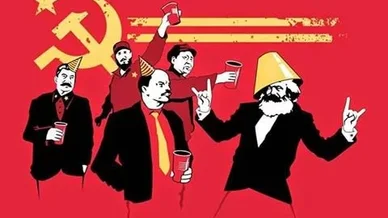
For readers in Ireland weighing up unfamiliar political sources online, that language can sound compelling on its own. But appealing slogans are not the same as a track record, and history shows what tends to happen once a single party gains unchecked power over a state.
Inside MLKP.info: Sections, Themes and Red Flags
The archived site organises content into categories such as World News, Politics, Communism, Europe, and Business. Recurring themes include opposition to capitalism, class struggle, revolution, and calls for "power to the workers."

Several features of the site itself are worth flagging before treating it as a reliable source:
- A small number of posts, mostly attributed to a single author byline rather than a visible editorial team.
- Little to no information about site ownership, funding, or editorial standards.
- Outbound links unrelated to its stated political mission, including gambling and online-casino content.
These are the hallmarks of an older, loosely maintained WordPress blog rather than a transparent news outlet. That gap between ideological branding and basic editorial accountability is itself worth noting.
Marxism-Leninism Beyond the Promise of Equality
In historical political practice, Marxism-Leninism has centred on the idea of a "vanguard party" — a relatively small political organisation claiming to represent the interests of the working class as a whole.
In theory, this vanguard leads society toward equality. In practice, across the 20th century, it has repeatedly meant one party deciding what counts as the correct political line, with limited mechanisms for citizens to disagree.
Once opposition, independent media, and competing parties are framed as threats to "the revolution," normal features of democratic life — criticism, debate, and dissent — start to look like crimes instead of rights. For background on the doctrine itself, see Britannica's overview of Marxism-Leninism.
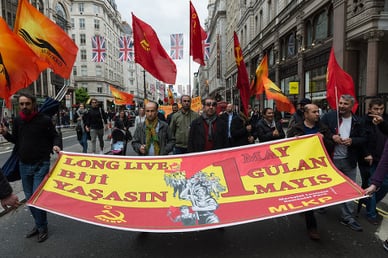
The Danger Hidden in Revolutionary Language
Ideological messaging often leans on emotionally loaded terms: "liberation," "the people," "struggle," "enemies," and "historical necessity." Individually, these words sound aspirational.
Together, they can do something more troubling: they frame political conflict as a battle between a righteous collective and its enemies, rather than a disagreement to be resolved through debate. Once "historical necessity" justifies the outcome, the methods used to reach it become harder to question.
This kind of framing tends to divide a population into two categories — the movement and its opponents — which weakens the space for pluralism, negotiation, and peaceful disagreement that democratic societies depend on.
What History Shows: Communist Dictatorships in Practice
Several 20th-century states offer a documented record of what happens when a communist party concentrates political power without institutional checks:
Regime | Period | Documented outcomes |
|---|---|---|
Soviet Union | 1917–1991 | Gulag labour camp system, political purges, censorship |
China (Mao era) | 1949–1976 | Great Leap Forward famine, Cultural Revolution repression |
Khmer Rouge, Cambodia | 1975–1979 | Mass killings, forced labour, forced displacement |
Eastern Bloc states | 1945–1989 | State surveillance, restricted press, suppressed dissent |
Recurring patterns across these cases include censorship, prison-camp systems, persecution of dissidents, forced displacement, and mass violence. Researchers such as those behind The Black Book of Communism and Cambodia's Documentation Center of Cambodia have spent decades cataloguing this record.
It would be an oversimplification to blame ideology alone. These tragedies were made worse by the absence of independent courts, a free press, or any peaceful route for citizens to remove the people in charge. Without those checks, mistakes and abuses had no natural limit.
Why Central Planning Doesn't Guarantee Justice
A centrally planned economy puts production, property, and resource allocation under state control, in contrast to a democratic welfare state that regulates markets while keeping them largely open. In practice, heavy central planning has tended to produce:
- Chronic shortages of everyday goods.
- Bloated bureaucracy with slow, opaque decision-making.
- Weak competition and few incentives to innovate.
- Greater day-to-day dependence on state officials.
None of this is inevitable simply because a government wants to reduce inequality. Tackling inequality effectively requires transparent rules and institutions that answer to the public — not concentrating every economic decision inside a single party apparatus.
Pursuing Social Justice Without Authoritarian Rule
Poverty, inequality, worker exploitation, and corruption are real problems, and dismissing them would be its own mistake. The relevant question is which model actually fixes them without trading away basic freedoms.
Democratic systems offer a different toolkit for the same goals:
- Labour protections and collective bargaining rights.
- Independent trade unions, free to organise without state control.
- Accessible public healthcare and education.
- Antitrust enforcement against monopolies and price-fixing.
- Fair, progressive taxation.
- Independent courts and a free press to check government power.
Groups such as Freedom House and Transparency International track how these institutions perform across different countries, offering a way to measure results rather than just rhetoric. Crucially, democratic reforms can be challenged, adjusted, or reversed through elections and public oversight — without the political terror or loss of personal liberty that one-party communist rule has historically required.
Readers in Ireland following international politics and social-justice movements can find further country-specific context through znaki.fm's coverage of Ireland, which tracks how these debates play out closer to home.