Canadian Dollar (CAD)
The Canadian dollar (CAD) is the officialcurrency in Canada, where it replaced the Canadian pound back in 1858 to become one of the world’s most well-known and globally recognised currencies. Unlike the old imperial system, the Canadian dollar (or “loonie” as it’s sometimes known) is divided into 100 cents and is much easier to use than shillings and pounds.

In this article, we’ll take a look at the history of the Canadian dollar, along with available denominations, the exchange rate to the Euro and how to use the money for everyday life in Canada as a resident or tourist.
CAD: The Legal Tender and Official Currency in Canada
The Basics: CAD Symbol and Code
The Canadian dollar has been the official currency of the country for nearly 200 years. You normally see it written as $, C$ or CA$. It gets the name “loonie” because the $1 coin depicts the common loon, which is the provincial bird of Ontario and a symbol of Canadian wildlife.

Canadian Currency: Learn about Canadian Money! Banknotes and Coins!
Like other decimal currencies, the dollar is subdivided into 100 cents, and like both the US dollar and the Australian dollar, it’s a popular choice on the global finance market. In fact, it’s the sixth most-held reserve currency and the seventh most-traded worldwide as of April 2022. As for its value, it’s a commodity currency that’s closely linked to key Canadian exports including oil, lumber and minerals.
The Notes and Coins in Circulation
There are plenty of options when it comes to Canada money, so let’s start with the notes. These are available in $5, $10, $20, $50 and $100 denominations, and they’re manufactured from polymer as part of the Frontier Series that was launched in 201. As for the coins, you can take your pick from these:
- 1 cent (penny)
- 5 cents (nickel)
- 10 cents (dime)
- 25 cents (quarter)
- 50 cents (half dollar)
- 1 dollar (loonie)
- 2 dollars (toonie)
The 50 cent piece is fairly rare, and the penny was discontinued entirely in 2013 to keep costs down, although you might still see it around. As of 2024, there are around $8.5 billion in coins and $106 billion in notes in active circulation.
The History of the Canadian Dollar, from 1858 to Today
The Pound and Canada’s Colonial History
The history of the Canadian dollar echoes the history of Canada as a whole, and it makes for fascinating reading. In the country’s early, colonial days, the French brought coins over from Europe, and a variety of different currencies were used between the 1660s and 1821, when the Bank of Montreal issued its first banknotes.
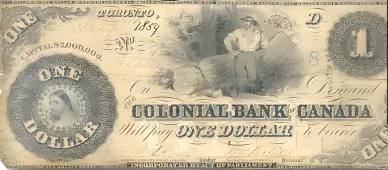
In 1841, the Province of Canada officially introduced the Canadian pound, and a gold standard was introduced in 1853 to provide some additional stability. Still, multiple different currencies remained in circulation, including the British pound sterling, Spanish dollars and US dollars. But with different currencies in different provinces, nationwide trade was often difficult.
The 1858 Introduction of the Decimal Dollar
In 1858, the Province of Canada officially moved away from the pound and introduced the decimal system by issuing its first coins in the new currency. The new Canadian dollar, which consisted of 100 cents like other decimal currencies, was fixed at a rate of 1 Canadian pound equalling 4.866 Canadian dollars.
The choice to use dollars was a deliberate move to more closely align Canada with America to facilitate trade between the two neighbours. There had long been calls for Canada to switch to a dollar-based system, particularly in Quebec, where the Bank of Montreal had been issuing dollar notes since 1817. However, while the switch to dollars proved popular in Canada, many of the Atlantic colonies preferred to stick with the British pound, at least for a while.
The 1867 Confederation and 1871 Uniform Currency Act
This brings us to the Canadian Confederation in 1867, when the Province of Canada, New Brunswick and Nova Scotia united into a single federation. That was good news for each province, bringing all sorts of benefits along with it, but it also meant that the three provinces would need a unified currency.
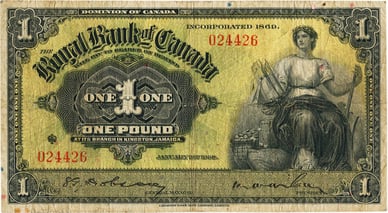
That’s where the Uniform Currency Act comes in. Passed in 1871, it aimed to replace all of the provincial currencies and establish a single currency that all Canada money would adhere to. This single currency was based on the Canadian dollar, standardised accounting in dollars and simplified trade throughout the country.
The advantages spoke for themselves. Before long, Manitoba, British Columbia and Prince Edward Island joined the Confederation, with overall control over currency being centralised in Ottawa.
Canadian Dollars:Exchange Rates Over Time
The Gold Standard and When CAD Was Pegged to USD
While all of this was happening, Canada was also in the process of adopting the gold standard. Established in 1853, the idea was to link the currency’s value to gold, and it served an important role during its early years. However, the gold standard was temporarily abandoned during WWI due to economic pressures, before being definitively abolished on April 10, 1933.
During WWII, the Canadian dollar was pegged to the US dollar at a rate of $1.10 CAD for $1.00 USD. In 1946, the peg was adjusted so that the two currencies were valued the same, although it returned to the rate of $1.10 CAD for $1.00 USD in 1949 after the devaluation of the British pound.
Historically, the Canadian dollar hit a record high on July 11, 1864. Back then, $1 CAD was valued at $2.78 USD thanks to the unique trading conditions during the US Civil War.
CAD as a Floating Currency Since 1970
As you’ll have noticed, the exchange rate of the Canadian dollar has varied over time. Between 1950 and 1962, the currency was floated for the first time, even briefly trading above the US dollar. Then, from 1962 to 1970, it was pegged at $0.925 USD, a period at which it was nicknamed the Diefenbuck after Prime Minister John Diefenbaker.
In 1970, it was allowed to float again, and it’s been floating ever since. It hit another high point on April 25, 1974, when it traded at $1.0443, and was at parity between 2007 and 2013 during the commodity boom. Mostly, though, the value of CAD has fluctuated based upon market forces for the last fifty years or so, generally trading at slightly less than the US dollar.
How Much is Canadian Dollar to EuroConversion?
The CAD to EUR Exchange Rate
The exchange rate between the Canadian dollar and the Euro (EUR) tends to fluctuate due to the fact that both currencies float freely. Factors influencing the value of the two currencies include economic indicators, global risk sentiment and interest rate differentials between the Bank of Canada and the European Central Bank (ECB). Commodity prices, mostly of Canadian exports like oil, lumber and minerals, also have an impact.
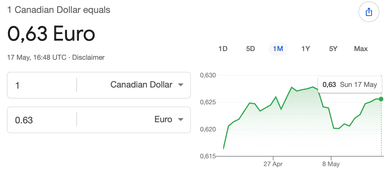
It’s also important to consider the strength of the US economy, given that around 80% of Canada’s exports go south of the border to the United States. Still, with all things being equal, you can expect $1 CAD to be worth between €0.65 and €0.70.
Bank of Canada (BoC) Policy and its Effect on the Canadian Dollar
The 1934 Creation of the Central Bank
The Bank of Canada (BoC) was established in 1934 during the Great Depression, in part to try to stabilise the country’s struggling economy. It issued its first banknotes in 1935 and has continued to take responsibility for the country’s currency to this day.

The Bank of Canada also plays a key role in setting interest rates and maintaining price stability, whether it’s against the backdrop of a global recession or not. It works to a target inflation rate of 2% (with anywhere between 1 and 3% considered acceptable), with its main policy tool being the overnight rate, which is the official interest rate and which influences borrowing costs throughout the country.
Meanwhile, the BoC’s independence from the government ensures that it’s able to maintain neutrality and focus on what’s best for the country, not for any political party. It’s led by a governor and a governing council who meet regularly to discuss and change policies as needed.
Oil, Commodities and Other Factors Affecting Value
The value of Canadian dollars is driven by the commodities that the country produces. For example, Canada has the world’s third-largest oil reserves, and so high oil prices tend to mean high values for the dollar. Then there are exports like lumber, minerals and agricultural products.
On top of that, the economy of the US also has a part to play, because it’s Canada’s largest trading partner and the recipient of around 80% of the country’s exports. It also has a major economy of its own, and so if the States is struggling then it’s a good bet that Canada will be next.
Further factors to consider include interest rate differences between the BoC and the Federal Reserve, as well as trade agreements like NAFTA and USMCA and overall global risk sentiment. But as a general rule, if crude oil prices are high, the Canadian dollar will be performing well.
Canada Money for Payments and Usage
Payment Cards and the Interac Debit Network
Like many western countries, Canada is becoming increasingly cashless, with credit and debit cards widely accepted throughout the country. The Interac debit network powers most everyday transactions, with Apple Pay, Google Pay and other contactless payments commonplace at stores of all shapes and sizes.
As for banks, the most popular providers are the Royal Bank of Canada (RBC), TD Bank, Scotiabank, Bank of Montreal (BMO) and CIBC. You’ll find ATMs all over the place, especially in the cities, but bear in mind that while they’re generally free for account holders, you’ll likely have to pay fees of between $2 and $5 per withdrawal if you’re using an international card.
Currency Exchange Options When You Travel
If you want to avoid fees when you travel, the best option is for you to obtain your Canadian money before you travel. If you do have to exchange currencies on the go, avoid doing so at an airport where the fees are higher, and pop into a bank or a currency exchange office instead.
Visitors may also be interested to know that credit cards tend to provide competitive exchange rates, but bear in mind that you should let your bank know that you plan to travel to avoid them putting a block on your card. As in the United States, tipping is customary, with suggested tips of 15-20% at restaurants and $1 to $2 per bag for porters and cab drivers.
Canada also has a sales tax, known as GST or HST. That will set you back between 5% and 15%, depending upon the province, with limited options for tax refunds for tourists. Be sure to factor these taxes into your plans.
Why Canadian Money Switched to Polymer for Security
The 2011 Frontier Series Innovation
When it comes to Canadian currency, the country followed in the footsteps of its peers by introducing polymer banknotes between 2011 and 2013 as part of the Frontier Series. This meant switching away from the old paper notes and adopting the polymer system, which brought a number of advantages along with it.

Polymer notes typically last 2.5 times longer than paper ones, and they’re known for being harder to counterfeit, waterproof and recyclable. They also incorporate built-in security features like a transparent window, metallic portraits, raised ink and hidden numbers.
As for their designs, they generally revolve around Canadian achievements and innovations, as well as the country’s history and natural heritage. For example, the $5 note features the Canadarm to represent the country’s space technology, while the $10 note features a train called The Canadian.
Cultural and Heritage Designs
Today, Canada’s bank notes are known for their unique designs, all of which help to reflect the national identity of a country that was once just a bunch of different provinces that had been pulled together. They also reflect the country’s colonial legacy, featuring British monarch Queen Elizabeth II until 2022 and King Charles III as of 2024.
Meanwhile, the coins tend to feature symbols of the country and its culture, with imagery including the loon, the caribou, the beaver and the polar bear. They also feature bilingual text in both French and English to reflect the unique Canadian identity and the multiculturalism that the country is known for.
Canadian DollarForex Trading and Global Significance
CAD’s Position as a Commodity Currency in Forex Markets
Throughout the years, the Canadian dollar has been a staple of forex trading. As of April 2022, it was the world’s seventh most-traded currency and the sixth most-held reserve. Major forex pairs to be aware of include USD/CAD (known for its liquidity), EUR/CAD and GBP/CAD.
For most, the Canadian dollar is seen as a commodity currency that’s known for its strong correlation with oil prices. It’s ideal for North American traders or those working in American time zones, with huge amounts of movement when both the American and Canadian markets are open. It’s no surprise that CAD represents 5.5% of forex turnover from around the world.
Key Canadian Dollar GuideSummary and Information
In summary, the Canadian dollar has been the official currency of Canada since 1858, when it replaced the pound at a rate of 4.866 dollars for every pound. CAD is subdivided into 100 cents and is the seventh most-traded currency in the world. Canada money is available in polymer notes of between $5 and $100, as well as coins of between 5 cents and $2 (the penny was discontinued in 2013).
Throughout this guide, we’ve walked you through from the mixed currencies of the colonial era to the dollar’s introduction in 1858, the Uniform Currency Act of 1871, the gold standard between 1853 and 1933, and the floating era that began in 1970. The exchange rate fluctuates daily, but $1 CAD is typically equivalent to between €0.65 and €0.70. It’s driven by oil prices, the US economy and interest rates.
When visiting Canada, you’ll find that the Interac network dominates and that cards and contactless payments are widely accepted. Tip between 15% and 20% at restaurants and expect to pay tax of between 5% and 15%.