Australian Dollar (AUD)
The Australian dollar (AUD) is one of the many global currencies that has a fascinating story behind it. First introduced as the officialAustralia currency in 1966, it marked a shift away from colonialism and towards self-sufficiency, as well as a move towards decimalisation. After all, before the change, Australia still used the pound, which had been brought over by the British.

The Australian Dollar
In this article, we’re going to take a closer look at the history of the Australian dollar, as well as the different denominations available, the current exchange rates and how best to use the money as a visitor.
What is the Currency in Australia? AUD as Legal Tender
AUD Symbol, Code and Other Key Info
The Australian dollar (AUD) is the official currency of Australia, and you’ll usually see it symbolised either as $ or A$. It’s been the country’s legal tender since February 14, 1966, when it replaced the Australian pound at a fixed conversion rate of A$2 for every £1. It marked the country’s shift to decimalisation, a full five years before the United Kingdom followed suit.

Secrets of the Australian Dollar
As a decimal currency, the Australian dollar is subdivided into 100 cents, and it happens to be one of the world’s most popular currencies. In fact, as of 2026, the Australian dollar is the world’s seventh most-traded currency and the sixth most-held reserve currency by central banks globally. It’s also used in some other Pacific countries, including Kiribati, Nauru and Tuvalu.
AUD Banknotes and Coins
Australia money is available in a variety of denominations, with banknotes printed at the values of $5, $10, $20, $50 and $100. As for coins, they can be found for the values of 5 cents, 10 cents, 20 cents, 50 cents, $1 and $2.
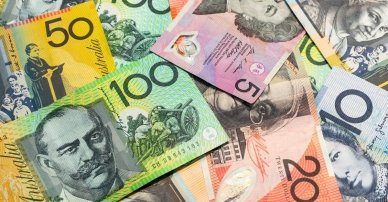
Like many countries, Australia has adopted polymer banknotes to improve the durability of its money. In fact, their 1988 introduction was a world’s first for the polypropylene banknotes, and it paved the way for dozens more countries to follow in their footsteps. As of 2026, there’s approximately $4.5 billion in coins and $100.8 billion in banknotes in circulation.
Australian DollarHistory
Aboriginal Trade and the Pound Sterling During the Colonial Era
In the early days of Australia, trade revolved around the barter system, with Aboriginal communities trading tools, shells and food as needed for supplies. It was a largely altruistic and society-based system that worked well until the British colonial era, which started in 1788 after settlers came to the country, bringing the pound with them.
Unfortunately for the settlers, their money was in short supply and there wasn’t enough to go around, and so they switched to using rum and other goods as a currency in a callback to Aboriginal bartering. That was until 1813, when Governor Lachlan Macquarie authorised the creation of the “holey dollar”, so called because it was created by taking imported Spanish dollars and punching a hole in the middle of them.
In 1910, the Australian pound was introduced, pegged at a 1:1 exchange rate with the British pound. Like its British counterpart, it was divided into 240 pence or 20 shillings.
1966 and the Decimal Era
This brings us up to February 14, 1966, when Australia currency went from imperial to decimal. The process of decimalisation also included replacing the pound with the Australian dollar.
The change in currency was designed to simplify things and remove the need to think in pounds, shillings and pence. Instead, there was just the dollar, which itself was split into 100 cents. There was also a fixed conversion rate upon launch with one Australian pound equalling two Australian dollars.
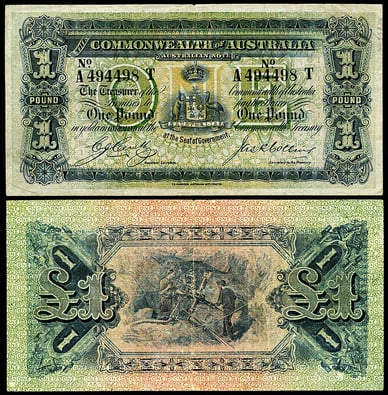
This switch is recognised as one of the most seamless government reforms in Australian history, perhaps in part because it simultaneously nodded towards Australian independence while simplifying the monetary system. The name “royal” was considered during planning, but it lost out to the dollar and the rest is history. Today, we look back on the change as a key decision that helped to align Australia with other major economies.
Australian MoneyForex Exchange Rate
Changing from Pegged to Floating
As we’ve already established, the Australian dollar was originally pegged to the British pound. This lasted from 1966 to 1971, at which point the decision was made to peg it to the US dollar instead due to the Bretton Woods collapse. This lasted until 1974, when it was re-pegged to the Trade Weighted Index.
But the fledgling currency was still finding its feet, and so in 1976, a crawling peg was introduced, which was designed to allow a limited amount of adjustment over time. Eventually, though, on December 12, 1983, Bob Hawke and his government made the decision to make it a floating currency. This opened the dollar up to global market forces, but the risk also brought rewards because it increased the amount of forex trading and ultimately made it the popular currency that it is today.
Current 1 Australian Dollar to Euro (EUR) Conversion Rate
Before we get too deep into talking about conversion rates, we should pause for a moment to acknowledge that they fluctuate daily based on economic indicators and the prices of commodities like iron ore, coal and gold exports, as well as global risk sentiment. t’s why people are constantly comparing rates and platforms online—everything from travel money apps to searches like “top online casinos.” There are also interest rate differentials between the Reserve Bank of Australia (RBA) and the European Central Bank (ECB).
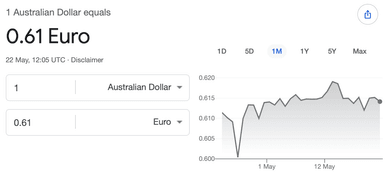
Since the euro was introduced in 1999, the Australian dollar and the euro have often been compared and paired together, reflecting ongoing trade between the two regions. You’ll usually find that A$1 will equal around €0.60 to €0.65, although the exchangerate varies. It also remains to truly be seen what China’s economic growth will mean for the Aussie dollar, and ongoing shifts in global monetary policy could change everything in the blink of an eye.
Reserve Bank of Australia (RBA) Policy to the Australian Dollar
The Reserve Bank Act 1959 Creates the Central Bank
The Reserve Bank of Australia (RBA) was created in 1960 off the back of the Reserve Bank Act 1959. Designed to act as the country’s central bank, the RBA is responsible for issuing currency, setting interest rates and maintaining price stability throughout the Australian economy.

As part of this, the RBA aims to maintain an inflation target of 2-3% over the medium term, a goal which influences policy decisions such as how they operate the cash rate, the country’s official interest rate.
The RBA has operated independently from the government since 1996, a decision which helps it to make key decisions without pressure from political parties. Its governor and the Monetary Policy Board meet eight times a year to make the decisions needed to shape the country’s economy.
Commodities, China and Other Factors Affecting Value
As with any currency, there are a number of factors at play which can affect its value both positively and negatively. The prices of commodities lie at the heart of things, because Australia is known for its exports of iron ore, coal, gold and liquefied natural gas (LNG). Most economists are also keeping their eyes on China, the country’s largest trading partner, because economic growth in China means more exports and more money.
Australian money also has interest rate differentials with the currencies of other major nations, and it’s considered by many to be a risk currency. Other factors to be aware of include domestic economic data (e.g. employment levels, inflation and the country’s GDP), as well as AUD’s correlation with gold prices.
Using Australia Money for Payments During Travel
Contactless Options and ATM Fees
If you’re travelling to Australia, you’ll be pleased to know that it’s super easy to make purchases with the Australian dollar. In fact, it’s a largely cashless society, and so you’ll be able to use credit and debit cards almost everywhere. Contactless payments are the default, with Apple Pay and Google Pay both popular. Most places take cash, but cards are generally preferred.
If sticking with physical cash is important to you, you’ll find that ATMs are still available in cities and towns, and you can also pay a visit to major banks like Commonwealth Bank of Australia, Westpac Banking Corporation, Australia and New Zealand Banking Group (ANZ) and National Australia Bank. However, bear in mind that you may be charged fees of $2 to $5 per withdrawal at independent ATMs, though major bank ATMs are generally free.
Currency Exchange for Country Visitors
As well as banks and ATMs, there are a number of other options for travelers who are looking to get their hands on some Australia currency. Most airports have currency exchanges, but you can expect to pay higher fees there than you would if you went to a bank or a dedicated currency exchange office.
Credit and debit cards can sometimes offer decent exchange rates, but you’ll want to double check before you rely on them and to contact your bank before you travel so that they don’t place a security block on your card when you try to use it.
Another tip to remember is that a 10% Goods and Services Tax (GST) is included in display prices and so no extra tax is added at checkout. Speaking of tips, tipping culture isn’t a thing in Australia and so don’t feel obliged to tip service staff unless you want to. There’s also the Tourist Refund Scheme for eligible purchases of over $300 that allows you to claim part of your purchase back when you leave the country.
The Introduction of Polymer Technology for Australian Money
The 1988 Innovation Leading to a World-First
Let’s take a closer look at those polymer banknotes, which Australia pioneered back in 1988. This huge innovation began with a $10 with a special design to celebrate the country’s bicentenary.
By 1996, the country had issued a full series of polymer banknotes, taking full advantage of their longer lifespan (around four times as much as paper notes) and the fact that they’re harder to counterfeit. They can withstand washing, meaning that it’s not a problem if you leave them in your pockets when you do the laundry, and they have built-in security features like transparent windows, embossing, colour-shifting ink and microprinting.
Since Australia rolled out its polymer banknotes, over 50 countries have followed in Australia’s footsteps. Talk about trendsetters.
Currency Imagery and Notable Figures
Australia’s banknotes feature some unique designs that celebrate the country’s culture and highlight some of the most influential Australians in the country’s history. They include notable figures like Dame Mary Gilmore, David Unaipon, Edith Cowan, John Flynn and Catherine Helen Spence.
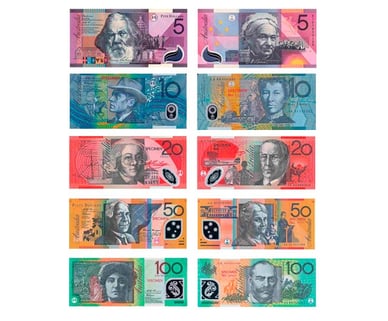
As a Commonwealth country, the coins depict the reigning British monarch, with Queen Elizabeth on the coins until her death and then King Charles III being introduced in 2024. However, British monarchs don’t generally feature on Australian banknotes; instead, the banknotes depict notable Australians alongside native flora, fauna and other imagery linked to Australian identity.
Forex Trading the Australian Dollar
The Australian Dollar is one of the most significant trading currencies in the world, ranking as the seventh most traded in 2025, representing 6.1% of daily global forex turnover. Key forex pairs include AUD/USD, AUD/JPY and EUR/AUD, all of which are characterised by high levels of liquidity in the market.
When it comes to the Aussie dollar, trading activity is the strongest during Asian trading hours due to the regional overlap, and it’s seen by many as a commodity currency that’s heavily influenced by exports and the prices of gold and natural resources. It’s also a popular carry trade because of its relatively high interest rate. When you put all of this together, it’s no surprise that so many traders turn to it.
Summary of Key Facts About AUD
Let’s recap the key points from our guide to the Australian dollar.
It has been the official Australia currency since February 14, 1966, replacing the pound at a rate of $2 for every £1. The dollar is subdivided into 100 cents and is the seventh-most traded currency around the globe. You can find polymer banknotes valued between $5 and $100, and coins valued between five cents and two bucks.
For a short summary of the history and timeline, Australia used the pound between 1910 and 1966, with it pegged to the British pound sterling. Decimalisation simplified the system, with the dollar pegged first to the pound and then to the US dollar. It’s been free-floating since 1983 with the price fluctuating daily, but typically trading at around $1 = €0.60–€0.65, though this is affected by commodity prices, the Chinese economy and interest rates.
Australia is highly cashless, with cards accepted by most vendors and ATMs available throughout the country. The RBA sets monetary policy with a target of 2-3% inflation, and its ongoing success is one of the many reasons why it’s such a popular forex currency throughout the world.