Haitian Institute of Statistics and Informatics (IHSI)
The Haitian Institute of Statistics and Informatics (IHSI) is the central and sole body of the national statistical system of the Republic of Haiti. It is a decentralized public institution. It operates under the supervision of the Ministry of Economy and Finance but has full technical and administrative autonomy. This independence lets it stay politically neutral and rigorously objective when calculating the country's vital indicators.

Key Information
- Full name: Haitian Institute of Statistics and Informatics
- Original founding date: September 4, 1951
- Restructuring: February 19, 1981
- Supervising ministry: Ministry of Economy and Finance
- Headquarters: Port-au-Prince, Haiti
- Areas of activity: Demographic statistics, economic statistics and national data. The PDF cuts this field off, so the list may be incomplete.
Mission and Mandate
The IHSI's mission is set in law. It has the exclusive mandate to "produce, analyze and disseminate reliable, relevant and up-to-date statistical information."
The IHSI is the main archivist and analyst of Haiti's socio-economic state. Its data is the essential basis for:
- State budgets.
- Monetary policy set by the Central Bank.
- The operations of international donors such as the World Bank, the IMF and the UN. They use IHSI statistics to assess the effectiveness of humanitarian and development aid programs.
Organizational Structure

To collect data continuously across the whole country, the institute has a branched, strictly hierarchical structure:
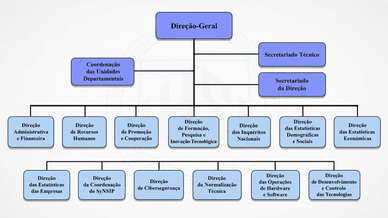
- The Directorate General. This is the strategic management body. It approves methodologies and officially publishes the final reports.
- The Directorate of Demographic and Social Statistics (DSDS). This is the largest division by field staff. It oversees the preparation and execution of the General Population and Housing Censuses (RGPH) and social surveys.
- The Directorate of Economic Statistics (DSE). This is the analytical center for macroeconomics. It calculates GDP, inflation, trade balances and industrial production indices.
- The Directorate of Informatics (DI). This is the institution's technological core. It handles database architecture, software for processing questionnaires, and cybersecurity of the national statistical archives.
- The Departmental Directorates. These regional offices cover Haiti's 10 geographic departments. They handle field survey logistics, especially in mountainous or hard-to-reach rural areas.
Actions and Achievements
Despite chronic political instability and devastating natural disasters, the IHSI has become one of Haiti's most resilient state institutions. Its most significant achievements include:
- Successfully carrying out several General Censuses, notably the 4th RGPH in 2003. These produced the country's first accurate digital map.
- Publishing monthly inflation reports without interruption, even during the most acute crises.
- Introducing digital data collection (CAPI, Computer-Assisted Personal Interviewing). Tablets replaced paper questionnaires, which greatly reduced data-entry errors and sped up the release of results.
History of the IHSI
The formation of Haiti's statistical system reflects the state's attempts to modernize its governance. Until the mid-20th century, the country had no unified system for recording its population or economy. It relied on fragmentary customs and parish registers.
In 1950, the government urgently needed to assess the country's human capital. This led to a temporary "Census Bureau," and the experience showed the need for a permanent body. On September 4, 1951, a special law established the Haitian Institute of Statistics (IHS). For its first three decades, the IHS focused solely on demographic accounting and basic economic publications.
A real revolution came in the late 1970s and early 1980s. Exponential growth in data, the need to integrate with international financial systems, and the arrival of computers called for radical reform. On February 19, 1981, a government decree renamed it the Haitian Institute of Statistics and Informatics (IHSI). The decree also made it the country's main national computing center. The institute received a monopoly on standardizing computer equipment across the public sector and on designing electronic databases. This made it a technological pioneer in Haitian administration.
Photo caption: IHSI's 75th anniversary: workshops on digital governance.
Methodology
The institution strictly follows international standards so its data is relevant and can be integrated into global databases, such as the World Bank's.
- Classification systems. The IHSI uses the UN System of National Accounts (SNA), the International Standard Industrial Classification (ISIC) and the Classification of Individual Consumption According to Purpose (COICOP).
- Sampling design. For surveys between censuses, the institute uses stratified multi-stage cluster sampling. The territory is divided into primary sampling units, urban and rural. This allows data from a survey of a few thousand households to be extrapolated very accurately to the whole population.
- Processing and validation. All collected data goes through a "cleaning" procedure. Specialized software automatically detects anomalies, for example a questionnaire saying a 5-year-old holds a university degree. Supervisors then check the questionnaires manually.
Products

The IHSI's work results in a wide range of statistical "products." They are divided into major categories to meet specific user needs.
Economic Statistics
The economic block provides critical information for understanding the structure of Haiti's fragile but dynamic economy. It pays particular attention to the informal sector.
National Accounts. This is the most comprehensive macroeconomic synthesis. The IHSI calculates Gross Domestic Product (GDP) in three ways: by production, by expenditure and by income. The data details each sector's contribution:
- Primary: agriculture, the historical basis of employment.
- Secondary: the textile industry and construction.
- Tertiary: services, telecommunications and trade, which now generate the largest share of GDP.
National income and investment indicators are also calculated here.
ICAE-Haiti. Annual GDP takes a long time to calculate, so the IHSI developed the ICAE. This quarterly indicator lets the government and private sector follow short-term trends. It is based on a sample of key companies and shows whether the economy expanded or contracted in a given quarter, for example after political unrest or natural disasters.
Economic Indicators. This summary product includes monthly and annual data on:
- Imports and exports, compiled with customs.
- Industrial output in manufacturing parks.
- Energy sector indicators, such as electricity production and consumption and petroleum product imports.
Consumer Price Index (CPI). This is one of the IHSI's most vital products. The CPI measures the inflation rate, which is often in double digits in Haiti. The IHSI regularly updates the "household basket," made up of hundreds of essential goods and services: food, rent, transport and health. Institute agents discreetly record prices each month in the main markets and supermarkets of the metropolitan area and the provinces to reflect the real cost of living.

Employment Index. This indicator tracks the dynamics of the formal labor market. It measures changes in the volume of salaried employment in the country's main economic sectors, giving a clear view of job creation or destruction.
Demographic and Social Statistics
The demographic division produces the data that reflects the nation's social profile, its poverty level and the structure of its society.
Key analytical documents:
- Analysis of the Millennium Development Goals (MDG, 2010). An in-depth report on Haiti's progress toward the UN goals. It highlighted serious difficulties in reducing extreme poverty, achieving universal primary education and fighting child mortality. It stressed that the 2010 earthquake set the country back several years in social development.
- Major Socio-Demographic Lessons (2009). A document exploring the concept of the "demographic dividend." It analyzed the extremely young structure of Haiti's population, where more than half are under 25. It warned that without job creation, this demographic advantage would become a factor of social upheaval.
- Estimate of the Total Population and of People Aged 18 and Over (2015). A document of great importance to the democratic process. The Provisional Electoral Council used these projections to determine the number of potential voters, allocate polling centers and print ballots for every commune in the country.
Census Analysis Report for the Commune of Gonaïves. This unique document is the result of the Rapid Post-Disaster Survey System (SERPD). In 2008, the city of Gonaïves was almost entirely flooded by a series of hurricanes (Fay, Gustav, Hanna, Ike). The IHSI urgently carried out a local census to assess the damage. The report gave precise data on destroyed houses, deaths, internally displaced people and lost crops. It served as the basis for distributing international humanitarian aid.
Demographic Analysis. This section contains the fundamental indicators: total population, natural growth rate, age and sex structure, and life expectancy at birth. Haiti's age pyramid has a wide base, indicating high fertility.
Buildings. Unlike "housing," which concerns the household, this section analyzes the physical characteristics of structures. The IHSI collects data on the materials used for walls (cement blocks, wood, earth, cardboard), roofs (concrete, corrugated sheet metal, thatch) and floors. This is a direct indicator of the population's vulnerability to earthquakes and hurricanes.
Births and Fertility. A detailed calculation of the Crude Birth Rate (births per 1,000 people) and the Total Fertility Rate (the average number of children born to a woman in her lifetime). The data is broken down by mother's age, education level and place of residence. It shows that fertility is clearly higher in rural areas.

Economic Characteristics. This section determines the level of economic activity among the working-age population. It clearly distinguishes:
- The employed.
- The unemployed, under the International Labour Organization's strict criteria.
- The inactive, such as students and retirees.
It gives special attention to the huge weight of the informal sector (small trade and crafts). Although unregistered by the state, this sector ensures the survival of most Haitians.
Housing. An analysis of household living conditions. The focus is on access to basic sanitation services: drinking water source (public network, public fountains, rivers), waste disposal methods and the presence of toilets. The type of cooking fuel (charcoal, firewood, propane) is also documented, which is directly linked to Haiti's massive deforestation.
Education. Data collection on the literacy rate of the population aged 15 and over. The IHSI analyzes children's school attendance and the highest level of education reached, from primary school to university. It also highlights school delay, where children start school much later because of family financial difficulties.
Migration. The institution tracks internal and external migration flows. It analyzes the intensity of the rural exodus, the mass movement of young people from villages to Port-au-Prince in search of work. It also provides estimates of the size of the Haitian diaspora (emigration to the United States, Canada, the Dominican Republic and elsewhere). The diaspora plays a key economic role through remittances.

Surveys. Besides the general censuses, which are costly and rare, the IHSI regularly runs national sample surveys. The most notable example is the ECVMAS (Household Living Conditions Survey). These large-scale studies fill data gaps between censuses. They let the IHSI track poverty, changing consumption patterns and the nation's health dynamically.
Census maps. Mapping is the first and most important step of any census. In the IHSI's Geographic Information System (GIS) labs, the whole country is divided into Enumeration Sections (SDE). Each SDE contains 150 to 200 households, the number one enumerator can cover during the census period. These digital maps prevent double counting or the omission of whole neighborhoods, and they show population density.
Events
The institute's website also serves as a platform for announcing scientific and educational events.
- Training workshops. Before any large-scale data collection, the IHSI runs training sessions lasting several weeks for thousands of temporary workers (enumerators, controllers, supervisors). They are taught the ethics of communicating with respondents, the rules for filling in questionnaires and how to use GPS devices.
- Results seminars. After the research is finished, the institution holds press conferences with ministers, journalists and UN representatives to present the data officially. At these events, IHSI experts explain the methodology and answer questions about the results.
Publications
The IHSI's work becomes a vast library of periodic and special publications. All are structured for easy access:
- The Monthly CPI Bulletin. The publication the financial sector awaits most. It gives a detailed analysis of the goods (for example, imported rice or local vegetables) that drove inflation during the month.
- The ICAE Bulletin. Analysis of the quarterly economic situation.
- The Cahiers Économiques. In-depth analytical articles by the institute's economists on GDP growth trends.
- The RGPH Results Volumes. Hundreds of pages of tables and charts based on the general censuses. They are split into separate books by theme (Demography, Housing, Education).
- Special Reports. Publications on specific topics, for example the impact of telecommunications on GDP or the status of women in the labor market.
Conclusion
The IHSI is much more than a repository of figures. It is the institutional memory of the Republic of Haiti and its main analytical tool. In a country often facing crises, the objective, scientifically grounded data the IHSI produces is the only reliable compass. That data covers everything from inflation to the literacy rate to the state of the housing stock. By strictly following international methodology and modernizing continuously, the IHSI gives the Haitian government and the international community the critical information they need. They use it to plan policies for reconstruction, sustainable economic development and the fight against poverty.