Griseldaonline: What It Is and How the Literary Journal Works
Griseldaonline is an Italian literature portal and an open-access scholarly journal of literature. Both were created at the University of Bologna and have been active since 2002. The project combines a literary portal with a peer-reviewed journal devoted to Italian literature, humanities research and open-access academic publishing. The resource was once available at its own domain. Its content has since moved to the University of Bologna's official subdomains.
Key Information
- Name: Griseldaonline. The PDF cuts off the rest of this field.
- Type of publication: Literary portal and open-access scholarly journal. The PDF cuts off part of this field.
- Year founded: 2000–2001 (registered). It launched in March 2002.
- Founders: Gian Mario Anselmi and Elisabetta Menetti. The PDF cuts off the full list.
- Publisher: Department of Philology and Italian Studies (FICLIT), University of Bologna. The PDF cuts off the full name.
- First director: Gian Mario Anselmi.
- ISSN: 1721-4777.
- Registration: Court of Bologna.
- Frequency: 2 issues per year, plus monthly updates of the materials. The PDF cuts off the rest.
- Language: Italian (partly other languages; the PDF cuts off the rest).
- Access: Completely free.
- City: Bologna, Emilia-Romagna.
Source of the key information: web.archive.org.
History of Griseldaonline: From Idea to Portal
The project's history began before the site launched. It was created at the University of Bologna as an academic space for studying Italian literature and the humanities. It connected university professors with school teachers. Its goal was to make literary studies more accessible and to use the potential of the digital environment.
Main stages of the project's development:
- 2000–2001: Work on a new literary project began at the University of Bologna. The title was registered with the Court of Bologna at the same time, laying the groundwork for the later launch of the site.
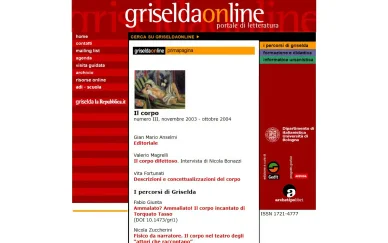
- March 18, 2002: Griseldaonline was inaugurated. The first issue was devoted to the theme of "Inferni" (Hells). The Bologna publisher Gedit (Libreria Giuridica Edinform) took part in the project.
- 2002–2008: Griselda online developed as a digital academic space for Italian literature. Besides articles, the site featured hypertext materials, interviews and forums where readers could discuss the published essays.
- 2005: The project was included in the national guide to cultural journals, Guida all'Italia delle riviste di cultura, published by the Istituto Poligrafico e Zecca dello Stato.
- 2008: Elisabetta Menetti's book Griseldaonline. Una rivista letteraria nell'era digitale was published. It covers the project's origins, development and features.
- 2010s: The journal gained Class A status in the ANVUR system for the Area 10 scientific sectors, covering philology, literary criticism and humanities research.
- Late 2010s – early 2020s: The project began operating on the University of Bologna's official resources. The literary portal was placed on the university's site. The scholarly journal moved to the Open Journal Systems platform, supported by the AlmaDL library system.
The griseldaonline domain is no longer in use. Earlier materials from the site can be found on the Internet Archive in the "Come eravamo" ("How we were") section.
Origin of the Name
The name Griseldaonline refers to Griselda, the protagonist of the final tale of Giovanni Boccaccio's Decameron. Her story closes the tenth day and the whole cycle of one hundred tales. Griselda becomes the wife of Marquis Gualtieri and endures a series of cruel trials with which her husband tests her fidelity and patience.
Her story went beyond the Decameron. Petrarch translated it into Latin in Historia Griseldis. The subject later appeared in Geoffrey Chaucer's Canterbury Tales as "The Clerk's Tale."
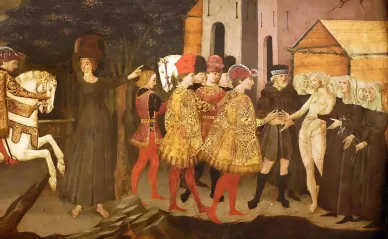
Image: a Renaissance painting of a scene from the story of Griselda, showing a wedding procession and figures in period costume in front of a building.
In the portal's name, this figure evokes the continuity of the Italian literary tradition. Griselda, known for her steadfastness and patience, gave the project its "feminine" name and became the basis of its visual identity.
The Old Domain: Sections of the Old Portal
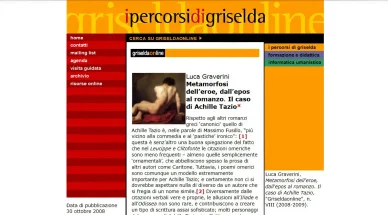
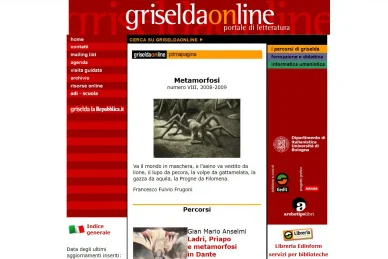
The griseldaonline site had separate areas for literary criticism, teaching and humanities computing. This structure allowed work in different formats, from critical analysis of works and interviews to teaching materials.
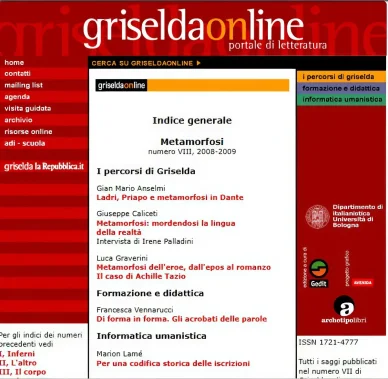
I percorsi di Griselda
This section was built around literary themes that changed every six months. The section itself was updated more often, with new articles added monthly. The materials were divided into two main columns:
- Microscopìe: Literary-criticism essays with commentary, which helped readers interpret literary texts.
- Letture: Selected texts and excerpts, interviews and essays, published without commentary.
Besides reading the publications, users could join the discussion. Forums were opened for essays and topics that drew public interest.
Training and teaching
This section was meant for school teachers. It brought together thematic teaching paths, materials for teaching Italian language and literature, reviews of internet resources, and forums for discussing methodologies.
Humanities computing
This section covered the use of digital technology in Italian studies. It published Francesca Tomasi's Manuale di informatica umanistica, an 11-part guide with explanations and examples for work in philology and other humanities disciplines.
Besides the three main areas, there were pages with editorial materials, information about the project, contacts and an issue archive.
The literary portal
The portal's home page also carried announcements of new materials. Its main sections were:
- Novità: New articles and updates.
- Chi siamo: Information about the editorial team and project participants: the founders, scientific direction, scientific committee and editors.
- Come eravamo: Archive of the old version. It holds the link to the archived copies and instructions for finding the desired version of the site on the Internet Archive.
- Editoriale: An editorial section describing the concept, development and principles of the project. For example, it describes the project's transformation from 2000 to 2018.
- Agenda: Calendar of Griseldaonline events. The page collects conferences, meetings and other events with dates, venues and descriptions.
- Policy: Information on the portal's editorial policy: the purpose of individual sections, the use of peer review and the terms of distribution of materials.
- Contatti: Editorial contact information, email for questions and editorial proposals, and office details.
- Strumenti: Reference and research materials. It presents resources on digital Italian studies, digital culture, literature and other areas.
- Approfondimenti: Extended essays, including academic ones, offering an in-depth look at a single author, book or group of texts.
- Dibattiti e questioni: Discussion materials on literature, its teaching, its reception and its place in contemporary life.
- Didattica per la scuola: An educational section for schools. It has several strands: I percorsi di Griselda, Dalla scuola, Libri di oggi a scuola, Per capire il secondo Novecento, Dibattiti e questioni and the archive.
- Contaminazioni: Materials on literature's links with other languages of contemporary culture: television, cinema, theater and multimedia works.
- Incontri: Interviews with authors about their books, their creative path and their views on the role of literature in contemporary society.
- Scaffale aperto: A space for creative work by well-known and lesser-known authors. It publishes poems, stories, aphorisms, short texts and even film scripts.
- Fotogallery: Illustrations, historical editions, theatrical productions, literary places and other visual materials.
- Ricerca all'interno del sito: A section with instructions for searching materials within the site.
The Scholarly Journal
The scholarly journal has a separate site and its own structure. It offers in-journal search, registration and account login. It is an open-access academic publication devoted to literature. Its ISSN is 1721-4777.
The main menu includes:
- Ultimo fascicolo: The latest published issue.
- Archivi: The archive of previous issues.
- Avvisi: Announcements, including calls for papers.
- Info: Information about the journal, publications, editorial team, scientific committee, privacy policy and contacts.
Articles within each issue fall under three headings:
- Tema: Publications tied to the issue's main theme.
- Methodologica: Methodological works.
- Omnibus: Materials outside the issue's main thematic section.
Editorial Team and Scientific Committee
A large group of literature researchers and specialists from Italian and foreign universities works on Griseldaonline.
Founders of the journal:
- Gian Mario Anselmi, Alma Mater Studiorum – University of Bologna.
- Elisabetta Menetti, University of Modena and Reggio Emilia.
Scientific direction: Giuliana Benvenuti, Nicola Bonazzi, Andrea Severi and Riccardo Stracuzzi. All four are linked to the Alma Mater Studiorum – University of Bologna.
The scientific committee brings together specialists from various Italian universities and other European countries:
- University of Bologna: Gian Mario Anselmi, Francesco Citti, Elisa Dal Chiele, Lucia Pasetti, Gino Ruozzi.
- Other Italian institutions: Giancarlo Alfano (Naples Federico II), Elisa Curti (Ca' Foscari Venice), Elisabetta Menetti (Modena and Reggio Emilia), Lucia Rodler (Trento), Duccio Tongiorgi (Genoa), Carlo Varotti (Parma), Magda Indiveri (Liceo Classico "Luigi Galvani," Bologna).
- Foreign universities: Igor Candido (Trinity College Dublin), Uberto Motta (University of Fribourg), Lucia Quaquarelli (Paris Nanterre University).
The editorial board includes:
- University of Bologna: Marcello Dani, Veronica Bernardi, Marco Serra, Arianna Capirossi, Elisa Dal Chiele, Giacomo Ventura, Beniamino Della Gala.
- Other Italian universities: Alberto Di Franco (Bergamo), Leonardo Galli (Padua), Francesco Gallina (Parma), Lucia Ruggieri (Modena and Reggio Emilia).
- France: Benedetta De Bonis (Sorbonne Nouvelle University).

The Griselda – sezione didattica (teaching section) operates separately. It is led by Maria Raffaella Cornacchia, Magda Indiveri and Carlo Varotti. Nicola Bonazzi and Marco Serra coordinate the editorial team. The section's editors are Giacomo Ventura, Anna Chisena, Francesco Gallina, Bettina Grisendi, Michele Abbati, Sonia Trovato, Nicola Catelli, Giorgia Del Soldato, Diego Varini, Claudia Correggi, Alessandro Bianchi and Cinzia Ruozzi. Cristina Nesi, Lucia Olini and Silvia Tatti handle the ADI SD strand.
Among the best-known authors and interlocutors of the portal over more than 20 years are Marc Augé, Piero Camporesi, Gianni Celati, Remo Ceserani, Francesco Guccini, Guido Guglielmi, Roberto Mussapi, Emilio Pasquini, Mario Rigoni Stern and Edoardo Sanguineti.
Issue Themes and Archive
The archive shows how the journal's themes have changed. Recent issues include editions devoted to catastrophes, dystopias, judicial themes, censorship and other areas.
The PDF's table of volumes is cut off, so only fragments are legible:
Volume / Year | Issue theme (partial) |
|---|---|
Vol. I (2002) | Infe… (Inferni) |
Vol. 12 (2012) | Num… |
Vol. 13 (2013) | Num… |
Vol. 14 (2014) | Num… |
Vol. 15 (2015) | Num… |
Vol. 16 (2016–2017) | Num… |
Vol. 17 (2018) | Num… |
Vol. 18 (2019), n. 1–2 | Pas… |
Vol. 19 (2020), n. 1–2 | Dis… |
Vol. 20 (2021), n. 1 | Cat… |
Vol. 20 (2021), n. 2 | Itali… |
Vol. 21 (2022), n. 1 | Cat… |
Vol. 21 (2022), n. 2 | Trib… |
Vol. 22 (2023), n. 1 | Il se… |
Vol. 22 (2023), n. 2 | Trib… |
Vol. 23 (2024), n. 1–2 | Fac… |
Vol. 24 (2025), n. 1–2 | Cen… |
Vol. 25 (2026), n. 1 | Dat… (Dati, metodi e interpretazioni) |
Vol. 26 (2027) | Prig… |
For each issue, the archive offers a DOI, publication date, table of contents and free PDFs, both of individual articles and of the complete issue.
For example, Vol. 25 No. 1 (2026), Dati, metodi e interpretazioni, dated August 6, 2026, traditionally includes these sections:
- Tema: Works by Mario Lentano on Latin declamation, and by Fausto Cremona on the design of Michelangelo Anselmi and Lorenzo Caviglia on the Associazione degli Italianisti.
- Methodologica: Stefano Bracci Testasecca and Chiara Pisani analyze the paradox in Luigi Malerba's Le pietre volanti.
- Omnibus: Studies by Giuseppe Guarracino on Carlo Boer, Martine Chantal Fantuzzi on Vittorio Alfieri, Matilde Esposito on Monti's ecclesiastical censorship, Chiara Silvestri on Ugo Foscolo's Ajace, Alessandro Ferioli on literature and food and wine, Francesco Sironi on Giovanni Pascoli and Manara Valgimigli, and Benedetta De Bonis on Terzani.
Who the Project Is For

- Students and pupils. The University of Bologna's literature portal has articles on works and authors, literary analyses, materials on literary history and close study of texts, as well as the humanities computing manual.
- Teachers of Italian language and literature. The Griselda didattica section presents thematic paths, methodological materials and examples of working with literature in the classroom. "Dalla scuola" shares teachers' experience and teaching projects.
- Researchers and university lecturers. The Italian open-access literary journal publishes research on Italian literature, literary theory, comparative studies, classical philology, cinema and other fields. It has Class A status for a number of Area 10 disciplines. The archive, PDF articles and editorial policy are available.
- Librarians and publishers. The journal publishes its ISSN, open-access information, archiving rules and indexing data.
- General readers. The portal has literary essays, the "Incontri" section with interviews and conversations with writers and researchers, "Scaffale aperto" with fiction and poetry, and "Fotogallery" with visual materials.
A separate audience consists of users who arrive through old links in bibliographies, scholarly works and teaching programs. The griselda online domain is no longer in use. The project's materials are on the University of Bologna's literature portal and on the scholarly journal's site.
How to propose an article
You can submit an article to the Griseldaonline literary journal through OJS after registering. Before submitting, read the author guidelines and the review policy.
Texts go through a preliminary editorial check, then double-blind peer review. An anti-plagiarism check with iThenticate is run before review. Articles are accepted in DOCX format. The manuscript must be prepared so that reviewers cannot identify the author.
Photo gallery and visual materials
The portal's "Fotogallery" section brings together photographs and other visual materials.
Media Coverage and Project Sources
Information about Griseldaonline has been collected, verified and cited by various academic, encyclopedic and media sources. The article was prepared using the official channels of Griseldaonline and the University of Bologna, archived versions of the old site, and encyclopedic, academic and editorial resources. Information on the project's structure, publications, editorial team and history was verified by cross-checking several sources.
- Nouvel Obs reports in its article: the PDF shows only a pull-quote here, which says Griseldaonline is a portal and journal of literary studies of the University of Bologna, active in humanities research and digital publishing.
- Wikipedia Italia, on the project's page, reports: the text is cut off in the PDF.
- The Treccani Encyclopedia (treccani.it) includes the project in its archive. The project's scientific activities, contributions and history are documented in the encyclopedia.
- Italianistica Online, in its 2002 review by Luigi M. Reale, writes that Griseldaonline is a fundamental reference point for Italian studies online, combining academic research with digital publishing. The full review is available on Italianistica Online (2002).