Elon Musk
Elon Musk is one of the most influential and controversial figures in the modern world. An entrepreneur, engineer, inventor, and billionaire, he leads several innovative companies that are reshaping industries ranging from space exploration to automotive technology and artificial intelligence.
Musk consistently challenges conventional ideas about what is possible, pushing the boundaries of human potential. His vision of the future is not merely ambitious — it has led to breakthroughs that could significantly change the way we live.
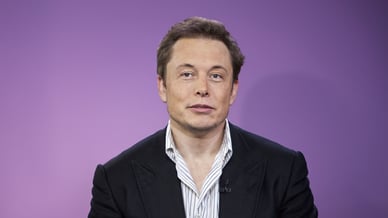
Date and place of birth | 28 June 1971, Pretoria, South Africa |
|---|---|
Parents | Errol Musk (engineer, pilot, sailor) and Maye Musk (nutritionist, model) |
Childhood | Elon grew up with his brother Kimbal and sister Tosca; from an early age, he showed an interest in technology and entrepreneurship. |
Education | Queen’s University; University of Pennsylvania (Economics and Physics) |
Founding of Zip2 | 1995, together with his brother Kimball |
Sale of Zip2 | 1999, acquired by Compaq for $307 million in cash (with additional components included in the overall purchase price) |
Founding of X.com/PayPal | 1999, a financial company focused on online payments |
PayPal sale | 2002, acquired by eBay for $1.5 billion in stock |
The founding of SpaceX | 2002, with the aim of reducing the cost of spaceflight and eventually colonizing Mars |
The founding of Tesla | 2003; Musk became the largest shareholder and chairman of the board in 2004 |
Other projects | Neuralink (2016), The Boring Company (2016), SolarCity (2006) |

Who is Elon Musk?
Childhood and education
Elon Musk was born on 28 June 1971 in Pretoria, South Africa. His father, Errol Musk, worked as an engineer, pilot, and sailor. Reports about his involvement with emeralds have been widely discussed, though there is no reliable evidence that he formally owned an emerald mine.
His mother, Maye Musk, is of Canadian-American background and has worked as a nutritionist and model. Elon grew up alongside his brother Kimbal and sister Tosca.
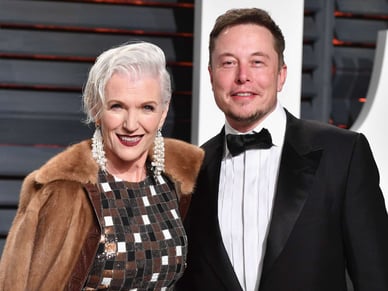
Elon Musk with his mother, Mae Musk
From an early age, Elon showed a strong interest in technology and entrepreneurship. At the age of ten, he received his first computer, a Commodore VIC-20, and taught himself to program. At 12, he created and sold his first video game, Blastar, for $500.
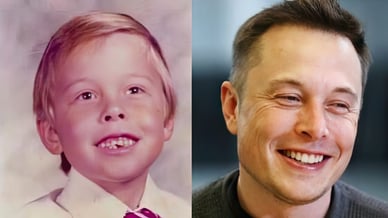
Elon Musk as a child and now
Musk attended Waterkloof House Preparatory School and later Pretoria Boys High School. After finishing school in 1989, he decided to move to Canada to avoid compulsory military service in South Africa and to pursue better educational and career opportunities. He enrolled at Queen’s University in Kingston, Ontario, where he studied for two years and met his future wife, Justine Wilson.
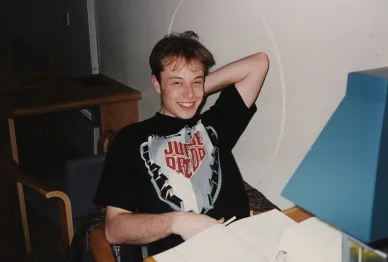
Young Elon Musk
He later transferred to the University of Pennsylvania, earning two bachelor’s degrees: one in economics from the Wharton School and another in physics from the College of Arts and Sciences.
After graduation, Musk briefly entered a graduate program at Stanford University in California to study applied physics and materials science, but dropped out after two days to pursue an internet startup.
Early business plans
Musk’s first major project was Zip2, an online city guide and directory service he founded with his brother Kimbal. Zip2 enabled businesses to publish contact information and maps online, allowing newspapers to offer interactive digital features to their readers.
Zip2 logo
The company initially struggled financially but gradually gained momentum and secured investment. In 1999, Compaq acquired Zip2 for $307 million in cash, with additional financial components included in the total purchase price. Musk received approximately $22 million for his stake.
PayPal
Following the success of Zip2, Musk founded X.com in 1999, an online financial services company focused on electronic payments. In 2000, X.com merged with Confinity, the developer of the PayPal payment system. The merged company eventually focused entirely on PayPal.
Although Musk later stepped down as CEO while remaining on the board, PayPal continued to grow rapidly. In 2002, eBay acquired PayPal for $1.5 billion in stock, with Musk receiving an estimated $165 million from the deal.
PayPal logo
PayPal played a crucial role in transforming global e-commerce by simplifying online payments and improving transaction security for millions of users worldwide.
The creation and development of Tesla
Tesla was founded in 2003 by engineers Martin Eberhard and Marc Tarpenning and named after inventor and electrical engineer Nikola Tesla. The founders aimed to create an electric car capable of competing with traditional petrol-powered vehicles.
Tesla logo
Elon Musk joined the company in February 2004, led the first round of financing by investing $6.5 million, became the largest shareholder, and assumed the role of chairman of the board. He played a key role in Tesla’s strategic development, including early product direction and marketing.
Key achievements of the company
One of Tesla’s first major achievements was the launch of the Tesla Roadster in 2008, the first production car to use lithium-ion batteries and achieve a range of more than 200 miles on a single charge.
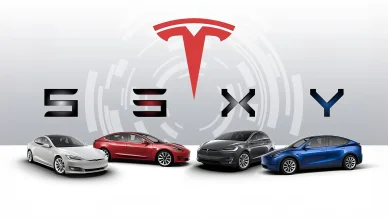
Tesla car model range
In 2012, Tesla introduced the Model S, a fully electric sedan that gained popularity for its performance, range, and advanced technology. The Model S won numerous awards, including Motor Trend’s Car of the Year in 2013.
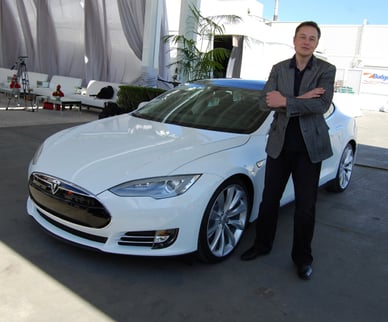
Elon Musk and Tesla Model S, 2011
In 2015, Tesla introduced the Model X, followed by the Model 3 in 2017 — a more affordable vehicle that helped make electric cars a mass-market product. In 2020, Tesla released the Model Y, a compact crossover combining elements of the Model 3 and Model X.
Tesla continues to expand its model lineup, including projects such as the Cybertruck and Tesla Semi.
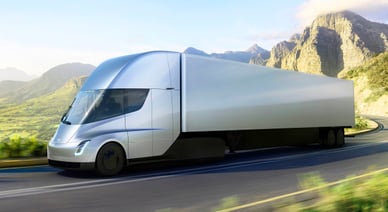
Tesla Semi - an electric truck being developed by Tesla
Innovations in electric vehicle manufacturing
Tesla is widely known for innovations that have reshaped the automotive industry. One of the most important was the adoption of high-energy-density lithium-ion batteries, significantly increasing vehicle range.
The company also developed Autopilot, an advanced driver-assistance system, and Full Self-Driving (FSD), which aims to achieve higher levels of vehicle autonomy, though it still requires driver supervision.
Another major innovation was the construction of Gigafactories — large-scale manufacturing facilities designed to scale battery and vehicle production. The first Gigafactory opened in Nevada in 2016, followed by facilities in Shanghai, Berlin, and Texas.
Tesla has also invested heavily in charging infrastructure through its global Supercharger network and expanded into renewable energy via the acquisition of SolarCity, integrating electric vehicles with sustainable energy solutions.
Role at SpaceX
SpaceX logo
Elon Musk founded Space Exploration Technologies Corp. (SpaceX) in March 2002 with the primary goal of reducing the cost of space travel and eventually enabling human settlement on Mars. He used proceeds from earlier ventures to finance the company and was deeply involved in engineering, rocket design, and launch strategy from the outset.
Key missions and achievements
SpaceX’s first major success came in September 2008, when the Falcon 1 rocket reached orbit on its fourth attempt, making SpaceX the first private company to launch a liquid-fuel rocket into orbit.
In 2010, SpaceX successfully launched and recovered the Dragon capsule. In May 2012, Dragon became the first commercial spacecraft to dock with the International Space Station (ISS).
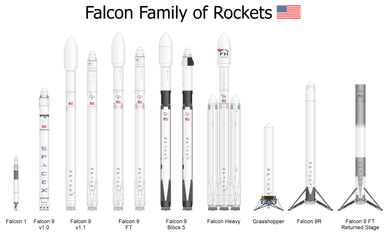
Types of Falcon missiles
The Falcon 9 rocket, first launched in 2010, became the backbone of SpaceX’s launch operations. In 2015, SpaceX successfully landed the first stage of a Falcon 9 rocket, demonstrating reusable launch technology.
In 2018, SpaceX conducted the first successful launch of Falcon Heavy, sending a Tesla Roadster into space as a demonstration payload. In 2020, SpaceX completed its first crewed mission with Crew Dragon, transporting astronauts to the ISS as part of the Demo-2 mission.
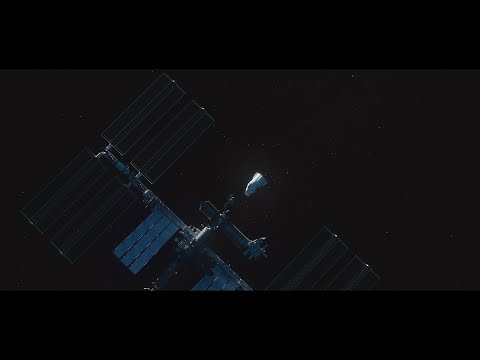
Crew Dragon | Animation
Impact on space technology
SpaceX significantly changed the space industry by introducing reusable rockets, dramatically lowering launch costs. The company is also developing Starship, a fully reusable spacecraft designed for deep-space missions, including Mars.
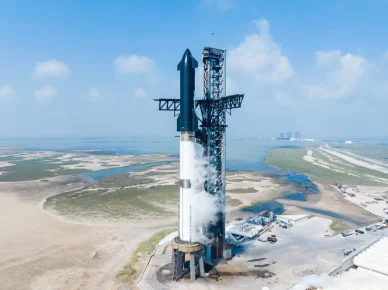
Test launch of the Starship rocket system
Additionally, SpaceX launched Starlink, a global satellite network providing high-speed internet worldwide, with thousands of satellites already in orbit.
Starlink logo
Other projects and initiatives
Neuralink, founded in 2016, focuses on brain-computer interfaces designed to help treat neurological disorders and explore human-machine interaction. In 2020, the company demonstrated a working implant capable of reading neural signals in an animal.
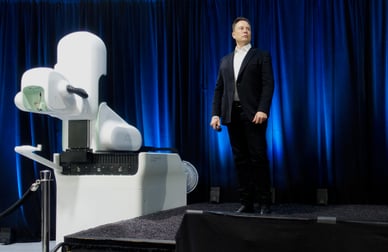
Musk discusses the Neuralink device during a demonstration in 2020
The Boring Company, also founded in 2016, aims to reduce urban traffic congestion through underground tunnel systems. Projects include operational tunnels in Las Vegas and proposed systems in other major cities.

First Neuralink patient leaves audience speechless
SolarCity, founded in 2006 by Musk’s cousins with his support, became one of the largest solar energy companies in the United States. In 2016, Tesla acquired SolarCity for $2.6 billion, integrating solar power and energy storage under the Tesla Energy brand.
The Boring Company and infrastructure projects
The Boring Company was founded by Elon Musk in 2016 to solve traffic congestion by building underground tunnels. Musk proposed creating a network of tunnels in which electric platforms would transport cars and passengers at high speeds, bypassing surface transport.
One of The Boring Company's first projects was a test tunnel in Hawthorne, California, which was completed in 2018. The company is also working on the Loop project in Las Vegas, which involves the construction of an underground passenger transport system between different parts of the city. In 2021, the first operational tunnel connecting Las Vegas convention centres opened as part of this project.
The Boring Company is also considering building tunnels in cities such as Los Angeles, Chicago and Washington to reduce congestion and improve urban mobility. The company is actively researching and developing new drilling technologies that will reduce costs and increase the speed of tunnel construction.
SolarCity and the development of solar energy
SolarCity was founded in 2006 by Elon Musk's cousins, Lyndon and Peter Rives, with his active support and funding, with the primary goal of accelerating the transition to renewable energy sources by installing solar panels on the roofs of homes and commercial buildings.
SolarCity quickly became one of the largest solar energy companies in the United States, offering customers affordable and efficient solutions for generating their own electricity and developing energy storage systems such as the Tesla Powerwall, which allows excess solar energy to be stored for use at night or during power outages.
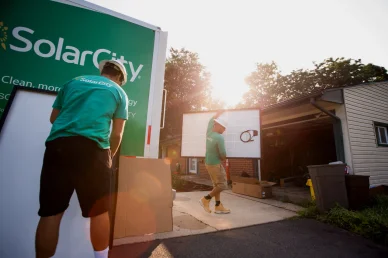
SolarCity was founded in 2006 by Elon Musk's cousins
In 2016, Tesla acquired SolarCity for $2.6 billion, allowing it to combine its efforts in the development of renewable energy and electric vehicles. After the acquisition, SolarCity was integrated into Tesla's structure and continued to operate under the Tesla Energy brand.
One of the key projects after the merger was the development of solar roofs (Tesla Solar Roof), which combine the functions of roofing material and solar panels. This technology allows you to create aesthetically appealing roofs that generate electricity, ensuring complete energy independence for homes.
Personal qualities and management style
Elon Musk is known for his intense work ethic, often working 80–100 hours per week and expecting high levels of commitment from his teams. His management style involves direct participation in both technical and strategic decision-making.
He is also known for learning from failure. Early setbacks, such as unsuccessful SpaceX launches, did not deter him from continuing to invest in ambitious projects.
Controversy and criticism
Like many prominent leaders, Musk has faced ongoing criticism related to his demanding management style, social media activity, and ambitious timelines. His public statements — particularly on Twitter (now X) — have led to legal and regulatory scrutiny, including a 2018 SEC settlement related to statements about Tesla.
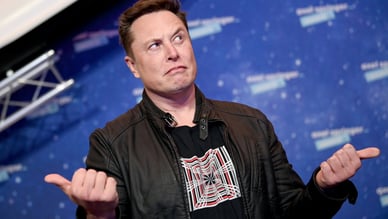
Elon Musk is one of the most influential and controversial figures in the modern world
Critics also question the feasibility of some of Musk’s long-term goals, particularly the colonisation of Mars, citing technical and economic challenges.
Musk's response to criticism
Elon Musk often responds to criticism directly and publicly, using social media to actively communicate with his followers on X (Twitter), where he is not afraid to express his views and respond to criticism. In many cases, his responses are direct and emotional, which sometimes intensifies the controversy.
However, Musk has often demonstrated a willingness to learn from his mistakes and adjust his approach, and following the SEC investigation, he took steps to improve corporate governance at Tesla and SpaceX, including appointing independent directors and making changes to the management structure.
Social networks