Donald Trump
Donald Trump is a man who turned politics into a spectacle and business into an art of influence. He served as the 45th President of the United States (2017–2021) and returned to office as the 47th President on 20 January 2025, becoming the only leader in U.S. history to win a second non-consecutive term.
Early life and education
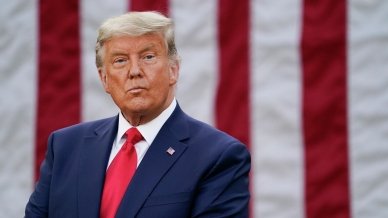
Donald Trump was born on 14 June 1946 in Queens, New York, into a family where business and ambition were part of everyday life.
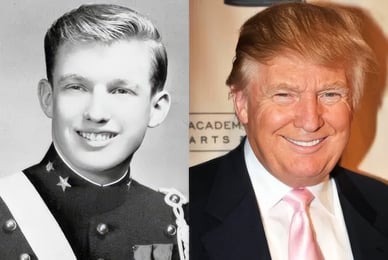
Donald Trump in his youth and today
His mother, Mary Ann MacLeod, was born on the Isle of Lewis in Scotland. Raised in a poor, large family, she decided to seek a better life in the United States and arrived in New York in 1930 aboard the SS Transylvania with $50 in her pocket. She initially worked as a maid for wealthy families and later met a young real estate developer, Fred Trump, whom she married in 1936.
His father, Fred Trump, was born in the Bronx, New York, in 1905. The family had German roots: Donald’s grandfather, Friedrich Trump, emigrated from Bavaria to the United States in 1885 to avoid military service and accumulated capital by opening hotels and restaurants during the Gold Rush. After returning to Germany with his wife and savings, Bavarian authorities revoked his citizenship and deported him back to the United States, where Fred Trump had already been born. As a result, Donald Trump is a first-generation American on his mother’s side and a second-generation American on his father’s side.

Donald Trump and his father Fred in 1973 at Trump Village, Fred's last project (Brooklyn)
Behavioral issues at school led his parents to send Donald to the New York Military Academy (NYMA) at the age of 13. There, he quickly became captain of the cadets, led parades, and actively participated in sports, including baseball and football.
After graduating, Trump studied for two years at Fordham University in the Bronx before transferring to the Wharton School of Business at the University of Pennsylvania, where he earned a Bachelor of Science degree in economics in 1968.
While still a student, Donald Trump began working in his father’s company, helping revive unprofitable projects. Even at that stage, he demonstrated the determination, ambition, and entrepreneurial instincts that would later define him as a businessman, media figure, and future president of the United States.
The path to success in business
Trump Organization logo
Donald Trump’s rise to prominence began during his student years and was closely tied to his father’s family business. However, his ambitions soon shifted toward the luxury real estate market of Manhattan.
After graduating from Wharton in 1968, Trump joined the family business, Elizabeth Trump & Son (later The Trump Organization). His first major project was the turnaround of the struggling Swifton Village residential complex in Ohio, which he helped sell at a significant profit.
In the 1970s, Trump shifted his focus to the heart of New York City — Manhattan. His first major breakthrough came with the transformation of the bankrupt Commodore Hotel into the Grand Hyatt Hotel in 1980.
In 1983, Trump completed the construction of Trump Tower on Fifth Avenue, a 58-story skyscraper combining offices, condominiums, and high-end retail. It was more than just a building — it marked the moment when the “Trump” name became synonymous with luxury and success.
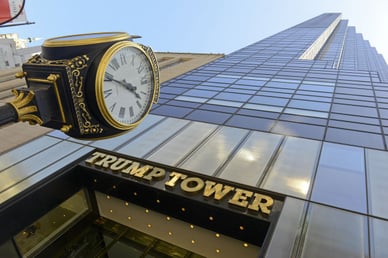
Donald Trump's skyscraper Trump Tower
In subsequent years, Trump expanded his empire to include casinos and hotels in Atlantic City, such as Trump Plaza, Trump Castle, and Trump Taj Mahal. These large-scale projects, however, often led to financial difficulties. Between 1991 and 2009, six Trump-affiliated companies, including casino ventures and Trump Shuttle Airlines, filed for bankruptcy. These cases were handled under Chapter 11 of the U.S. Bankruptcy Code, allowing debt restructuring while retaining control of key assets, demonstrating Trump’s ability to navigate crises.
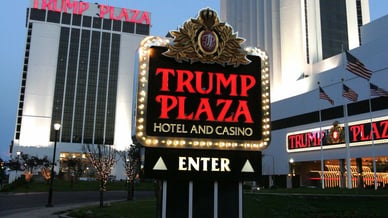
Trump Plaza - hotel and casino
In 2004, Trump became the host of NBC’s reality show The Apprentice. The project not only earned him nearly $200 million but also solidified his public image as a decisive and successful businessman.
After returning to politics, Trump invested heavily in social media through Trump Media & Technology Group and in cryptocurrency projects, including the $TRUMP and World Liberty Financial meme coins. As a result of these investments and active management, his assets grew significantly. As of September 2025, Donald Trump’s net worth was estimated at $7.3 billion.
The dynamics of Donald Trump's wealth
Year | Wealth (according to various estimates) |
|---|---|
2016 | 3.7 billion US dollars |
2017 | 4.2 billion US dollars |
2018 | 3.1 billion US dollars |
2019 | 3 billion US dollars |
2020 | 2.5 billion US dollars |
2021 | 2.3 billion US dollars |
2022 | 3 billion US dollars |
2023 | 2.6 billion US dollars |
2024 | 3.9 billion US dollars (growth to 5.7 billion US dollars by the end of the year) |
2025 | 7.3 billion US dollars (as of September) |
Media personality
Donald Trump has always known how to remain in the public eye.
A turning point in his media career came with The Apprentice, which aired on NBC from 2004 to 2015. In his role as a strict boss, he popularized the phrase “You’re fired!”, which quickly became a cultural catchphrase across the United States. He even attempted to trademark it, though unsuccessfully. The show not only reinforced Trump’s image as a tough and effective leader but also brought substantial financial success — by 2018, revenue from the project and related contracts was estimated to exceed $427 million. Even after his election as president in 2016, Trump remained an executive producer of The Celebrity Apprentice, sparking debate over potential conflicts of interest.
Another significant chapter in his media career was his ownership of beauty pageants. In 1996, Trump acquired the Miss Universe Organization, which ran the Miss Universe, Miss USA, and Miss Teen USA competitions.

In 1997, Trump discussed Alicia Machado's weight
Hosting Miss Universe in Moscow in 2013 became one of the most discussed episodes of his media biography, as the visit later appeared in investigations into his ties with Russia. In 2015, after Trump announced his political ambitions, his pageant business collapsed following a conflict with NBC over his statements on immigration, leading to terminated contracts and the eventual sale of the company to WME/IMG.
In 2024, his early media career was portrayed in the feature film The Apprentice: The Trump Story, with Sebastian Stan playing the role of a young Donald Trump.

THE APPRENTICE - International Trailer - Starring Sebastian Stan, Jeremy Strong & Maria Bakalova
Donald Trump's first presidency
On 20 January 2017, Donald Trump was sworn in as the 45th President of the United States, and from the very beginning it was clear that his presidency would be anything but conventional. In his inaugural address, which he said he wrote himself, Trump signaled a sharp break with the political mainstream. He spoke of “forgotten America,” focused on workers and the middle class, and promised to restore the country’s economic strength under the slogan “America First.”
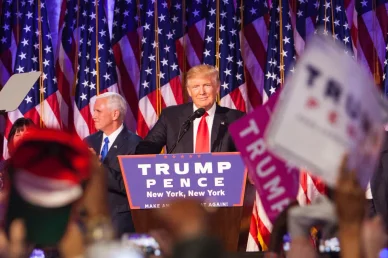
President-elect Donald Trump delivers his speech during the Election Night event at the Hilton Midtown Hotel, January 20, 2017
One of Trump’s key campaign promises was the construction of a wall along the U.S.–Mexico border — a symbol of his tough immigration policy and his determination to follow through on his pledges. Congressional resistance prevented the project from being fully completed, but hundreds of miles of barriers were built or reinforced during his presidency. The battle over funding the wall led to the longest federal government shutdown in U.S. history in late 2018 and early 2019.
Equally characteristic was his communication style. Trump transformed Twitter into his primary tool for governance and political confrontation. Through social media, he dismissed officials, attacked opponents, and shaped the media agenda, often triggering financial volatility and diplomatic controversies. Critics viewed this approach as chaotic, while supporters praised it as direct communication between the president and the public.
The COVID-19 pandemic in 2020 posed a major challenge to Trump’s presidency. He initially downplayed the threat posed by the virus and clashed publicly with scientists and health officials. At the same time, his administration launched Operation Warp Speed, which accelerated the development of COVID-19 vaccines. Controversial messaging and the politicization of the pandemic significantly weakened his approval ratings and became one of the factors contributing to his defeat in the 2020 election.

Fauci reveals what happened after correction Trump at 2020 Covid briefing
In September 2019, an investigation was opened that led to Trump’s first impeachment. He was accused of pressuring Ukrainian President Volodymyr Zelensky to investigate the activities of Hunter Biden in exchange for military aid. The Senate, where Republicans held a majority, ultimately acquitted Trump, but the impeachment itself marked an unprecedented moment in his presidency.
Donald Trump’s first term ended amid deep polarization within American society. To his supporters, he remained a leader who challenged political elites and the “system”; to his critics, he was a president who undermined democratic institutions and norms.
The 2020 elections and the post-presidential period
Early in his presidency, Donald Trump publicly declared his intention to seek a second term, and in August 2020 the Republican Party formally nominated him as its candidate. The campaign unfolded against the backdrop of the COVID-19 pandemic, economic uncertainty, and intense political polarization.
In November 2020, Trump lost the election to Joe Biden, receiving 232 electoral votes to Biden’s 306. He became the first U.S. president since 1992 to fail to secure a second consecutive term. Trump refused to concede defeat, alleging “massive fraud” and declaring himself the rightful winner. His legal team filed more than 60 lawsuits in key states seeking recounts or annulments of the results, but none altered the outcome of the election.
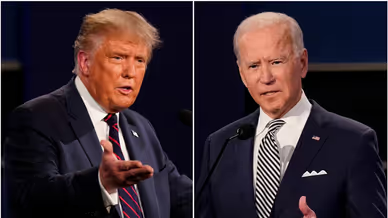
Donald Trump and Joe Biden
The crisis reached its peak on 6 January 2021, when, following a rally of Trump supporters in Washington, a crowd stormed the U.S. Capitol in an attempt to disrupt the certification of Biden’s victory. These events led to Trump’s second impeachment — an unprecedented occurrence in U.S. history — though the Senate once again acquitted him.
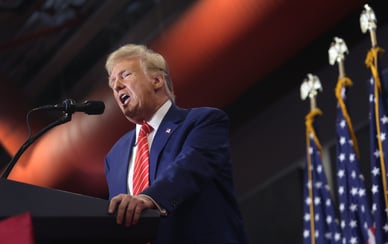
On 16 November 2022, Trump officially announced his candidacy for the presidency once again
On 16 November 2022, Trump officially announced his candidacy for the presidency once again, portraying himself as a victim of “political persecution” and promising political retribution. The 2024 campaign became one of the most intense in modern U.S. history. A defining moment occurred on 13 July 2024, when an assassination attempt during a rally in Butler, Pennsylvania, resulted in a bullet grazing Trump’s ear. A photograph of Trump raising his fist and shouting “Fight!” quickly went viral and became an enduring symbol of the campaign.
On 5 November 2024, Donald Trump won the election, defeating Kamala Harris.
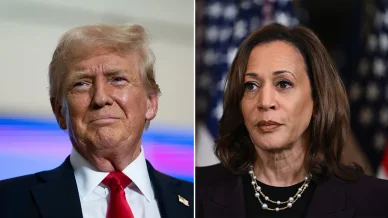
The main candidates for the US presidency are Donald Trump and Kamala Harris
Second Presidency
Donald Trump’s second presidency has been marked by rapid decision-making, full loyalty within his administration, and the aggressive implementation of campaign promises. The Agenda 47 program calls for dismantling the “deep state,” centralizing presidential authority, and pursuing a tariff-based economic policy, including universal import duties of 10–20 percent and special tariffs of up to 60 percent on Chinese goods. These measures have fueled trade tensions with China and strained relations with the European Union.
By early 2026, Trump’s policies reflected a sweeping reconfiguration of the United States’ domestic structure and its role on the global stage. One of the administration’s first actions was a large-scale withdrawal from international organizations and agreements. On 7 January, the White House announced its intention to exit 66 international bodies, including the Paris Climate Agreement, the UN Framework Convention on Climate Change, and several UN agencies focused on labor, migration, and so-called “woke initiatives.”
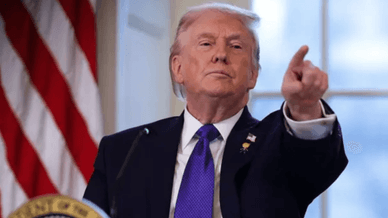
Donald Trump, briefing
Domestically, the administration significantly tightened immigration policy. Entry into the United States was restricted for citizens of 39 countries, including individuals from the Palestinian Authority.
Financial and technological policy also gained new prominence, with the United States being declared the “crypto capital of the world.” Trump initiated the creation of a U.S. Strategic Bitcoin Reserve, positioning the country at the center of the global cryptocurrency economy in 2025–2026. The reserve is funded through digital assets confiscated in criminal cases, and legislation is expected to formalize the U.S. role as a global hub for digital assets.
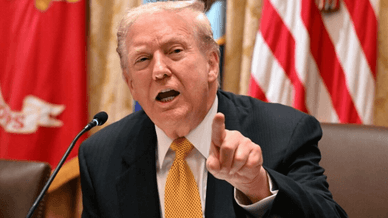
Donald Trump on AI
In the economic and environmental spheres, the administration completed broad deregulation efforts, repealing key provisions of the National Environmental Policy Act (NEPA).
Scientific and technological initiatives also gained momentum. The administration launched the AI Action Plan and Project Genesis, aimed at maintaining U.S. leadership in artificial intelligence and scientific research. Medical cannabis also received unexpected support through expanded federal research programs.
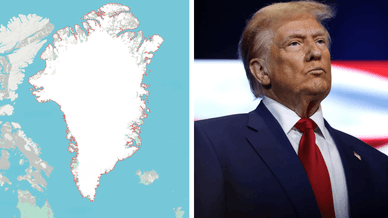
President Donald Trump and Greenland
The strategic issue of Greenland drew renewed attention as well. In early January, Trump reaffirmed his intention to annex the island, triggering a diplomatic crisis with Denmark and NATO allies, who viewed the proposal as a threat to the alliance itself.
Many of these initiatives are rooted in “Project 2025,” which advocates centralized presidential power and accelerated government decision-making. Executive orders and official statements are published on the White House website.
A key element of Trump’s second-term administration has been a close partnership with Elon Musk, who, alongside Vivek Ramaswamy, leads the Department of Government Efficiency (DOGE), transforming it into one of the most radical instruments of federal reform.
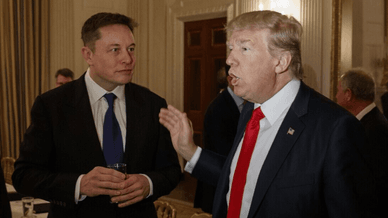
Donald Trump's close partnership with Elon Musk
As of early January 2026, DOGE had implemented federal budget reductions exceeding $2 trillion. Approximately 400,000 to 500,000 federal employees were dismissed or shifted to performance-based contracts, and remote work across federal agencies was fully eliminated.
Personal life
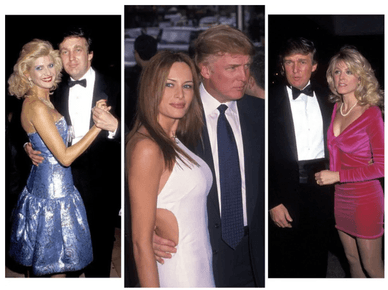
Trump's wives
Donald Trump, the 47th President of the United States, has been married three times and has five children. His first marriage, to Czechoslovakian model Ivana Zelníčková, lasted from 1977 to 1992 and produced three children: Donald Jr., Ivanka, and Eric. Their divorce became one of the most high-profile separations of the late 20th century following Trump’s affair with American actress Marla Maples. Ivana passed away in 2022, remembered as a businesswoman who played a role in building the Trump empire.
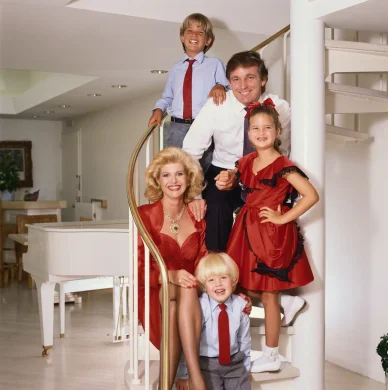
Trump's first wife - Ivana Zelnichkova and their children, 1986
In 1993, Trump married Maples, who gave birth to their daughter Tiffany. The marriage ended in 1999 and was frequently covered by tabloids, with the split occurring amid financial disputes.
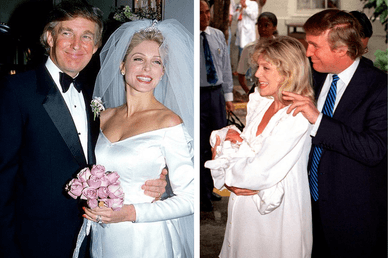
Donald Trump's second wife - Marla Maples
In 2005, Trump married Slovenian model Melania Knauss, who is 24 years his junior. Their son, Barron, was born in 2006. In 2025, Melania became First Lady for a second time, though she has remained more distant from political life than during Trump’s first term.
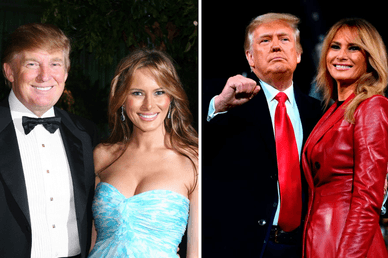
Donald Trump's third wife - Melania Knauus
Outside politics, Trump’s primary passion is golf. He owns elite golf clubs worldwide and regularly participates in tournaments, claiming the sport helps him maintain mental clarity. He is also the author of several business books, including The Art of the Deal, Think Like a Billionaire, and The Success Formula, in which he shares insights on achieving financial success.
Social networks