Volodymyr Zelensky
Volodymyr Zelensky became President of Ukraine in 2019 after building a successful career in entertainment. He worked as an actor and producer, and was best known for the role of a schoolteacher who unexpectedly becomes president in a popular series.
Under the constitution, Volodymyr Zelensky also holds the role of Supreme Commander-in-Chief, a position tied to the country's military leadership. The war with Russia has defined much of his presidency, turning him into a wartime leader and a key figure in Ukrainian and European affairs.
Biography and Basic Facts
A Brief Look at Volodymyr Zelensky's Life
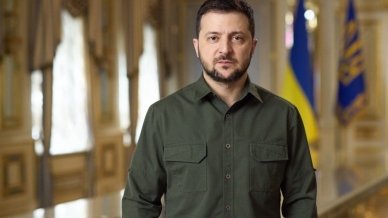
Volodymyr Zelensky was born on January 25, 1978 in Kryvyi Rih, then part of the Ukrainian SSR. He graduated in 2000 from Kyiv National Economic University with a law degree. Much of the Volodymyr Zelensky biography before politics centers on entertainment, where he worked as a comedian, scriptwriter, and producer, primarily with the comedy team Kvartal 95.
He later served as chief executive of the Inter TV channel before returning to Kvartal 95 as executive producer, a position he held until entering politics. Zelensky was elected President of Ukraine in April 2019 and sworn in the following month.
Childhood
The Zelensky family background is rooted in Kryvyi Rih, an industrial city in central Ukraine, where he was born into a Jewish family with deep ties to the region. He grew up speaking Russian, the dominant language in the region, and later became fluent in Ukrainian and English. His father, Oleksandr, was a professor and head of the cybernetics department at a local university, while his mother, Rymma, worked as an engineer.
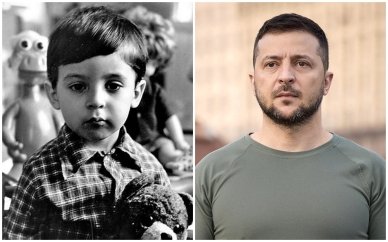
During his early years, the family lived in Erdenet, Mongolia, where his father helped develop mining infrastructure. Zelensky completed his first year of school there before the family returned to Kryvyi Rih, where he continued his education.
School Years and Early Studies
Volodymyr Zelensky attended School Gymnasium No. 95 in Kryvyi Rih, where he graduated in 1995 after maintaining an almost straight-A record. He was well-known throughout the school and active in student theatre, guitar and dance. Outside the classroom, he took up weightlifting, danced, collected stamps and attended summer camps.
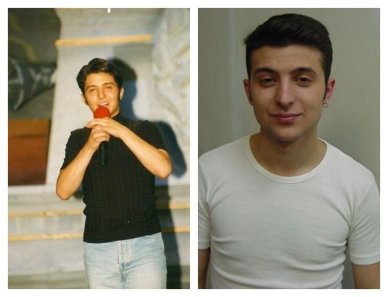
Volodymyr performed well across multiple subjects, including English, where he scored highly enough on the TOEFL exam to earn a scholarship to study in Israel. He turned the opportunity down to study law and enrolled instead at the Kryvyi Rih Economic Institute, a branch of Kyiv National Economic University. The education of Volodymyr Zelensky continued there until 2000, when he graduated with a law degree, although he never practised law and instead pursued a career in entertainment.
Show Business Career
Comedy Roots: KVN to Kvartal 95
Volodymyr Zelensky began performing in small sketch troupes around Kryvyi Rih while still a student. He later joined Molodyi Kryvyi Rih, a local KVN (competitive comedy) team. His growing reputation as a performer soon brought an invitation to join Zaporizhzhia–Kryvyi Rih–Transit, a larger team competing in the KVN Major League, where he first choreographed dance numbers before taking on a lead role.
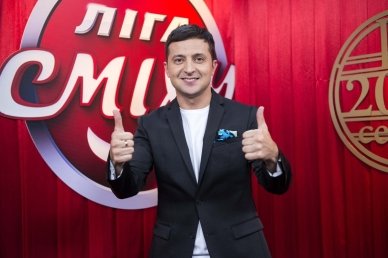
The Zelensky KVN career reached a turning point in 1997, when the team won the Major League championship in Moscow. This prompted Zelensky to form a team of his own, named Kvartal 95, where he became the team captain and principal writer. They regularly toured Russia and other former Soviet countries between 1998 and 2003. Their run ended in 2003, when a financial and creative dispute with AMiK, the organisation running KVN, led Zelensky and his team to leave the league and chart a new course in television.
The Rise of Kvartal 95 Studio
After leaving KVN in 2003, Zelensky and his teammates relocated to Kyiv and founded Kvartal 95 Studio. This turned the group from a competing comedy team into an independent production company. The studio's first television work came later that year for the channel 1+1, which commissioned concert specials built around sketch comedy and musical performance.
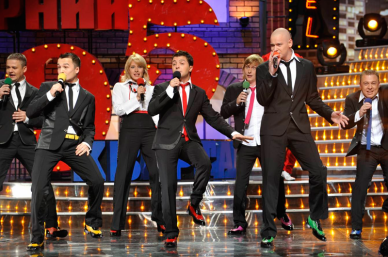
In 2004, Zelensky hosted a program on the Inter TV channel, and the following year the studio partnered with the station to launch Evening Kvartal. This sketch comedy show blended political satire with variety-style performances and quickly became one of the most popular programs on Ukrainian television.
The show remained on Inter until 2012, when it moved back to 1+1, which restored the studio's earlier partnership with that channel. Kvartal 95 also began to build out a wider slate of Kvartal 95 TV projects, including Rozsmishi Komika, Liga Smihu, and Chisto News. Zelensky worked as a leading performer, creative director and producer on these productions, while helping to shape the studio's identity for years to come.
Zelensky's Film and Television Career
While Volodymyr Zelensky was already a familiar face on Ukrainian television, in 2006 he won the first season of Dancing with the Stars Ukraine Edition. He also became a regular presence in Kvartal 95's New Year TV musicals, a mix of comedy sketches and musical performances designed for a mass audience.
Plenty of film work followed in 2009, when he took a leading role in Love in the Big City. This romantic comedy spawned two sequels over the following years. Zelensky co-wrote Office Romance. Our Time , which premiered as a remake of a Soviet-era classic film. 2012 saw one of the most popular Volodymyr Zelensky movies yet, with 8 First Dates. It was successful enough to spawn two more instalments: 8 New Dates and 8 Best Dates.

In 2015, he began starring as a schoolteacher turned accidental president in Servant of the People. This political satire ran until 2019 and reshaped the course of his own life. While that series was still on air, he stepped behind the camera as co-director of the romantic comedy I, You, He, She, which was his final acting role before entering politics.
The Servant of the People Series
The political satire series premiered in 2015 on the channel 1+1. It was produced by Kvartal 95 and starred Zelensky as Vasyl Holoborodko, a history teacher who unexpectedly becomes president after a video of him denouncing corruption goes viral.
The Servant of the People TV show became a genuine phenomenon in Ukraine. It ran for three seasons (up to 2019) with a feature film spinoff, and the success of the franchise carried it well beyond national borders. It won the best feature series award at Ukraine's Teletriumph Awards and later earned the WorldFest Remi Award for Television Comedy at the 2016 festival in Houston. The show's premise and the anti-corruption narrative closely mirrored the message Zelensky carried into his own campaign when he eventually ran for office.
Political Career and Presidency
The Founding of Servant of the People
In December 2017, people connected to Kvartal 95 formed a political party called Servant of the People, built on the foundation of an earlier party known as Decisive Changes. Lawyers who worked with the studio handled the formal process, and the party was officially registered on 31 March 2018.
Ivan Bakanov, the studio's chief executive, served as the first leader of the Servant of the People political party. Zelensky said at the time that he had no immediate plans to enter politics and that the party had been registered mainly to stop others from using the name of his popular series.
The party soon took on a clear identity of its own, positioning itself as an anti-corruption platform geared towards renewal. Once Zelensky's presidential campaign picked up steam the following year, the party leaned into that branding by filling its ranks with political newcomers ready to replace the old guard.
The Presidential Election in 2019
The Volodymyr Zelensky election 2019 campaign technically began right at the end of the previous year, when the actor-turned-politician announced his candidacy on December 31, 2018 during a televised New Year’s Eve broadcast. This announcement took many people by surprise, especially as he’d previously expressed little interest in entering politics.
From there, Zelensky ran an innovative online campaign that had a heavy focus on social media and word of mouth, as well as directly interacting with voters. He also made sure that people knew that far from being an established politician, he saw himself as an outsider who was coming in to challenge the status quo.
Zelensky ran on a platform that aimed at achieving peace in eastern Ukraine, boosting digital adoption, tackling institutional and governmental corruption and carrying out widespread economic reforms. His campaign was a hit. During the televised Olympic Stadium Debate on April 19, he clashed with incumbent President Petro Poroshenko and won many skeptics over to his vision.
As a result, Zelensky won a landslide victory with almost double the votes of Poroshenko in the first round of voting and a record 73.22% in the run-off (compared to Poroshenko’s 24.45%). It was one of the most decisive election results in Ukrainian history and set the stage for Zelensky’s inauguration on May 20, 2019.
Zelensky’s Reforms and Domestic Policy
Zelensky campaigned on a promise of carrying out sweeping political reforms, and he remained true to his word almost as soon as he took up office. For example, in May 2019, the same month in which he was inaugurated, he dissolved the Verkhovna Rada, arguing that new elections were required. Unsurprisingly, his own Servant of the People party went on to win a parliamentary majority.
The Zelensky domestic reforms continued from there, with the parliament dissolution being followed by sweeping reforms to the administrative and an anti-corruption systems. This involved a process of de-oligarchization and anti-oligarch law that created a register of individuals with significant economic and political influence and attempted to limit their ability to participate in politics.

Other policies ranged from decriminalising gambling and legitimising casinos to plans to professionalise the armed forces by modernising military training. In February 2024, Zelensky also replaced Commander-in-Chief Valerii Zaluzhnyi with Oleksandr Syrskyi amid reported strategic disagreements between Zelensky and Zaluzhnyi.
International Relations and Foreign Policy
The Zelensky international relations approach has been a little different to that of his predecessors, with the president mostly focusing on diplomatic outreach and strengthening the country’s ties with partners like the US, the European Union and NATO.
This approach has made a lot of sense, because the US-Ukraine partnership has played a key role in helping the Zelensky administration to fight Russian aggression. However, it also hasn’t come without its controversies. For example, during a 2019 phone call between the two presidents, Trump asked Zelensky to investigate rival Joe Biden and his son, Hunter Biden.
The controversy around this, as well as some of Trump’s allegations around Ukrainian involvement in US politics, led to Trump’s first impeachment by the US House of Representatives in December 2019.
After Russia launched its full-scale invasion of the country in 2022, Zelensky started seeking a closer EU association and requesting security guarantees from key allies, including the Americans. As part of this process, Zelensky pushed for Ukraine to begin its path towards joining the European Union, officially obtaining EU candidate status in 2022 and beginning accession negotiations in 2024.
Ultimately, Zelensky’s approach to international relations has largely been steered by necessity, because he knows that he needs support if he’s to keep fighting against Russian aggression.
Zelensky’s Presidency During the War with Russia
The Full-Scale Invasion Begins
Brace yourself, because it’s about to get serious. When it comes to the Russian invasion of Ukraine 2022 Zelensky response became one of the defining parts of his presidency.
The full-scale invasion began on February 24, 2022 and saw the Russian military attacking a number of targets throughout the country. It also marked a new and more devastating phase of the ongoing war that had been taking place since long before Zelensky campaigned for political office.

Zelensky responded by declaring martial law and ordering a general mobilisation to defend the country. At the same time, he officially severed diplomatic ties with Russia.
In an address to the nation through a series of video messages, Zelensky showed an impressive knack for leadership in war and helped to reassure the public that he had the situation in hand. He also refused to leave the capital, staying in Kyiv despite the danger.
During these early, vital moments of the invasion, Zelensky showed great bravery and incredible leadership which went above and beyond what most people expected of him. It helped to set the scene for his continued strong leadership in the half-decade or so that’s followed.
The Peace Formula and European Integration
The ongoing war and the launch of the full-scale invasion put pressure on Zelensky to further integrate with European politics, which is why he signed the country’s EU membership application just four days after the invasion, on February 28, 2022.
For Zelensky EU integration was a no-brainer, because it promised security guarantees and other benefits that would go above and beyond international trade opportunities. On June 23, 2022, four months or so after the application was submitted, the European Council formally granted Ukraine EU candidate status and allowed them to progress with their application.
While this was happening, Ukraine was also adopting new laws to protect civilians and support those who were displaced by the fighting. This was followed by Zelensky’s Peace Formula, which covered ten key points and outlined his vision for ending the war and rebuilding the country after the cessation of hostilities:
- Radiation and nuclear safety
- Food security
- Energy security
- Release of all prisoners and deportees
- Implementation of the UN Charter and restoration of Ukraine’s territorial integrity
- Withdrawal of Russian troops and the cessation of hostilities
- Justice for war crimes
- Environmental safety
- Prevention of escalation and the repetition of aggression
- Confirmation of the end of the war
Leadership Image and International Support
The Zelensky global image is an interesting one, because the Ukrainian president has clearly learned a thing or two during his time as an actor. He understands that public perception is everything, and in this case, it could even help to win a war.
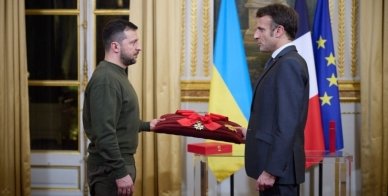
His use of both traditional and social media has helped him to apply a huge amount of diplomatic pressure, whether pushing for sanctions against Russian businesses or calling for military aid from allies. He’s continued to make parliamentary addresses throughout the world, typically through video link so that he doesn’t have to leave Ukrainian soil, and has even made a Grammy appearance via video link to address the world from an entertainment stage.
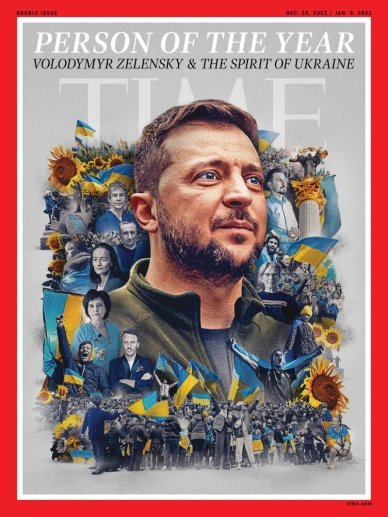
At the same time as running a war effort and building relationships with politicians throughout the globe, he’s also found time to give interviews to a number of global media outlets, describing Ukraine’s situation in moving terms and providing his own perspective on the war. His public relations campaigns have been so successful that he was named Time Person of the Year in 2022, with plenty of other accolades coming his way, too.
Relations with Ireland
High-Level Visits and Zelensky’s Diplomacy
The Ireland/Ukraine relationship has been an interesting one, because the two countries have grown significantly closer together since Zelensky won the presidency. Those strengthening ties have largely revolved around the political, humanitarian and financial support that the Emerald Isle has provided since the full-scale invasion.
July 13th 2024 saw the first Zelensky Ireland visit, when he met Taoiseach Simon Harris at Shannon Airport for their first bilateral meeting on Irish soil. During the Zelensky Dublin visit in December 2025, he met Taoiseach Micheál Martin and President Catherine Connolly, with talks focusing on Ireland’s continued support for Ukraine and how the country could help accelerate Ukraine’s path towards EU membership.
Zelensky also participated in the Ireland Ukraine Economic Forum, an event which brought representatives together from both countries and focused on the crossover between government and business. It was yet another reminder of how important the political relationship between the two countries is—and how important it will continue to be in the years to come.
EU Sanctions and Zelensky’s Address to the Irish Parliament
Perhaps the most notable interaction between Ireland and Ukraine to date has been the Zelensky address to Irish parliament, which took place on April 6, 2022. In the Dáil speech at the Houses of the Oireachtas, he thanked Ireland for its solidarity and humanitarian support, noting its willingness to welcome Ukrainian refugees who were fleeing the war.
But that wasn’t all that Zelensky talked about. He also called for a stronger EU response against Russian aggression, encouraging Irish politicians and their counterparts in Brussels to support a more stringent sanction policy. The goal with the sanctions was to increase pressure on the Russian government and to make it harder for them to finance the war. One key effort was to target the Russian energy industry.
Unsurprisingly, Zelensky also called for stronger sanctions against Russia’s banking system, reflecting the vital role that international financial networks play in financing the war. The talk as a whole reinforced just how important Zelensky and the Ukrainian government saw their relationship with the Irish as being.
Humanitarian Support, Financial Assistance and More
As we’ve mentioned, the level of Ireland support for Ukraine has been consistently high since the outbreak of the full-scale invasion. This humanitarian aid has included both financial packages from the country itself and support through the European Union.
Over the last five years or so, the Irish government has announced multi-million-euro aid packages designed to help everything from the Ukrainian economy to its energy infrastructure. It’s also gone out of its way to welcome Ukrainian refugees in Ireland, even at a time when global discourse seems to be focusing more and more on fighting immigration.
As part of the European Union, Ireland is bound by the EU’s Temporary Protection Directive, and that provides legal backing for the country to provide accommodation, education, healthcare and employment to tens of thousands of Ukrainian refugees.
However, the war has gone on for longer than many people expected, and support for the refugee support initiatives has started to dwindle. Opponents argue that it’s not sustainable in the long-term and that it’s costing the country too much money, and so a number of measures have been launched to encourage refugees to return to Ukraine once conditions allow.
Of course, there are no plans to force people to return to an active warzone, and the country is well aware of its humanitarian responsibilities. It seems that Ukrainian refugees will continue to be welcome in Ireland for many years to come.
Reconstruction Partnership and Security Cooperation
A big part of Ireland’s support for Ukraine is the fact that it plans to help rebuild the country after the war is over. In fact, Irish politicians have indicated that they’d be willing to contribute to peacekeeping efforts, as long as there was an appropriate international mandate and the right conditions for Irish personnel to deploy. This isn’t Ireland hedging its bets, though; it’s all about ticking all of the boxes. If a job’s worth doing, it’s worth doing right.
This participation would build on Ireland’s existing peacekeeping experience and history of international security operations, including through the United Nations. In 2025, the two countries agreed on the Ireland Ukraine Partnership 2030, a long-term bilateral roadmap that covers everything from political cooperation to humanitarian assistance, economic development and reconstruction projects.
This partnership shows that Irish investment will play a vital role in the country’s post-war recovery, with everyone from private businesses to the Irish government getting on board to help Ukraine and its people. This was particularly underscored by the Ireland-Ukraine Economic Forum, which we talked about earlier on and which investigated how the country can be rebuilt, especially when it comes to the energy and construction sectors.
Zelensky’s Awards and Recognition
Honours from Other Countries
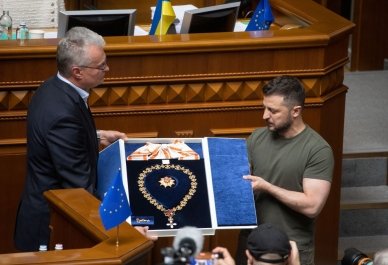
The list of Zelensky foreign state awards is a long one, and it also keeps on growing. Throughout his presidency, he’s won a huge number of honours and awards, and he’s been nominated for even more of them. Some of these have been national awards from within Ukraine, while others are cross-border awards from Europe and even elsewhere in the world.
The majority of these awards have been in recognition of his defence of freedom and his belief in democratic values, including the right to self-governance and national sovereignty. No list like this could ever be complete, but just a few of the most notable awards include:
- Lithuania: The Order of Vytautas the Great with the Golden Chain
- Latvia: The Order of Viesturs
- Czech Republic: The Order of the White Lion
- Poland: The Order of the White Eagle (awarded in 2023, revoked in 2026)
- France: The Legion of Honour
On top of the above, Zelensky has been awarded a number of further presidential decorations from other European states and elsewhere in the world. It’s pretty clear to see that many in the western world associate Zelensky with the defence of sovereignty and democracy.
Prizes and Other Distinctions
Above and beyond the Volodymyr Zelensky honours from states and international organisations, there are also the entertainment awards and the various other prizes that the president has been given. Let’s take a look at those now.
As a celebrated actor and entertainer before ever entering politics, Zelensky had already won a number of television awards including the iconic Teletriumph award, which is the national TV award within Ukraine. That entertainment success set him up for the political success that he’d enjoy later on.
As for Ukrainian government commendations, there’s a long list for us to choose from, as well as international distinctions including the Ronald Reagan Freedom Award, the John F. Kennedy Profile in Courage Award, the Charlemagne Prize, the Boris Nemtsov Prize and more. We’re not going to go into detail on each of these awards as we’d be here forever, but rest assured that each and every one of them is a huge deal.
Put together, these prizes and distinctions recognise Zelensky’s ability to lead his country during one of the darkest times in its history, as well as his courage in the face of adversity and his commitment to defending democracy.
Zelensky’s Personal Life
Wife Olena Zelenska
The Volodymyr Zelensky wife is a beautiful and intelligent woman called Olena Kyiashko, who he met as a teenager when they were both attending the same school in Kryvyi Rih. Like most good relationships, it started out as a friendship before blossoming into romance, which may be why the two of them have stayed together.
Olena studied architecture at the Kryvyi Rih National University but eventually left the field behind and started work as a Kvartal 95 scriptwriter at her husband’s entertainment company. However, she focused on soft power and operating behind the scenes, supporting her husband instead of stepping out into the limelight. This is a trend that’s continued even into her first lady projects and throughout the war.
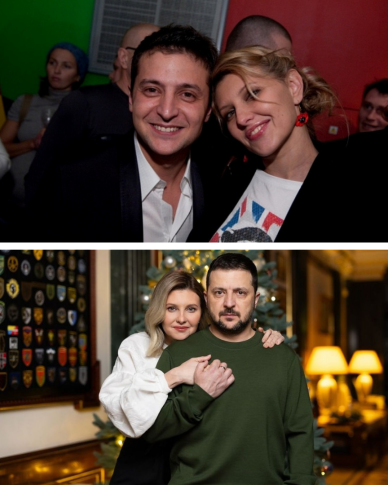
With that said, Olena hasn’t shied away from stepping in front of the cameras when she needs to, and she’s played an important role in cultural diplomacy and humanitarian initiatives throughout the war. Between her and her husband, it seems that the Ukrainian people are in safe hands—or as safe as a pair of hands can be during an ongoing war.
Children and Family Life
Like most politicians, Zelensky hasn’t shied away from talking about his family, although he’s also balanced that by maintaining family privacy and trying to ensure that they’re able to live a relatively normal life.
The two Volodymyr Zelensky children are daughter Oleksandra (born in 2004) and son Kyrylo (born in 2013), and while they’ve both largely stayed out of the spotlight, we do know a little bit about them. For example, we know that both kids went to Kyiv’s Novopechersk School, while Oleksandra went on to further her studies at Taras Shevchenko University.
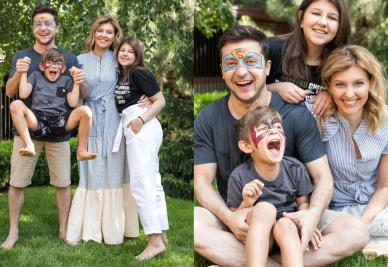
To date, neither child has been particularly involved in political activities or official duties, and we can expect that to remain the case for the near future. They have, however, continued to live in the country despite the increased security risks created by the war and the fact that they’d make obvious targets for Russian agents.
Zelensky’s Social Media Presence
To round off this article, it’s worth noting that Zelensky has also gained both national and international popularity through his use of social media. This makes sense, given how important of a role it played during his election campaign.
You can find Zelensky official accounts via the following links:
- Facebook Page: https://www.facebook.com/zelenskyy.official/
- Instagram Profile: https://www.instagram.com/zelenskyy_official/
- Telegram Channel: https://t.me/s/V_Zelenskiy_official
- YouTube Speeches: https://www.youtube.com/channel/UCp2zBKrqP0ZQF6RN4RJtF2Q
- X.com: https://x.com/ZelenskyyUa
Don’t expect to see too much about his personal life, though. Instead, Zelensky mostly uses his social media presence to post daily video addresses and announcements and to communicate both with Ukrainians and his international supporters alike.
It should be noted that some sources are more trustworthy than others. His Telegram in particular is known for his own heavy involvement, whereas YouTube is maintained by his team and the Zelensky hashtag on TikTok is predominantly filled with edits from his supporters.