Michael Collins
Michael Collins is one of the most important figures of the Irish Revolution, as well as a symbol of independence and one of those rare individuals with a larger-than-life legacy. His life and political career have been the subject of numerous books, documentaries, historical studies and films. Many of his decisions are still debated today.
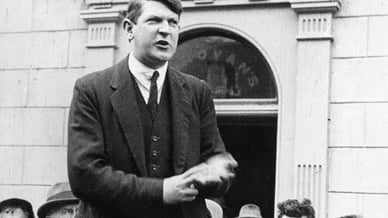
Here is the Michael Collins Ireland story, covering who he was, why he matters and what role he played in the revolution.
Getting to Know Michael Collins
Born | 16 October, 1890 in Clonakilty, County Cork, Ireland |
|---|---|
Died | 22 August 22, (aged 31) in Béal na Bláth, County Cork, Ireland |
Burial Place | Glasnevin Cemetery, Dublin |
Nickname | The Big Fellow |
Political Party | Sinn Féin |
Positions Held |
|
Military Service | 1909–1922 |
Rank | General |
Wars |
|
Beyond these well-known facts about Michael Collins, fewer people know that he spent almost a decade living in London, where he worked for the Post Office before returning to Ireland in 1916. But let’s take things one step at a time. Let’s take a closer look at the life and career of Michael Collins, as well as the legacy that he left behind after his death.
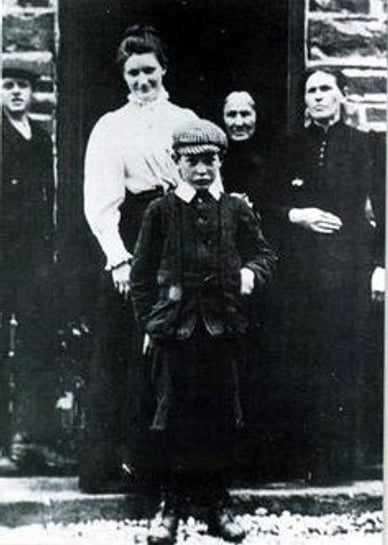
Achievements and Controversies
The Michael Collins Ireland story is an interesting one because people can’t agree on whether he was a hero or villain. The reality is more nuanced, and his legacy as a key part of Ireland’s history reflects that.
Collins’ strengths include his reputation as a pragmatic political strategist who was committed to the cause but who also had the ability to back that up with practical skills and the ability to organise people. He was a sophisticated revolutionary, and a man who put a great deal of thought into what he did.
At the same time, he also had plenty of controversies, but then controversy is a part of life. For example, some people view vapes, political parties, celebrity social media posts and the best online casinos as controversial, but that doesn’t make any of them inherently bad and all of them are here to stay.
In Collins’ case, the controversies mostly surrounded his support for the use of force during the War of Independence. His use of violence and coercion has been judged by some to be both immoral and ineffective, while his decision to sign the Anglo-Irish Treaty of 1921 also contributed to the Irish Civil War that ultimately led to his death.
The 1916 Easter Rising
The Easter Rising was an armed rebellion during which Irish nationalists launched an armed revolt against the British on Easter Monday of 1916. The Michael Collins Ireland story has to include a mention of it, but we also need to remember that he wasn’t a leading military commander at the time. That would come later.
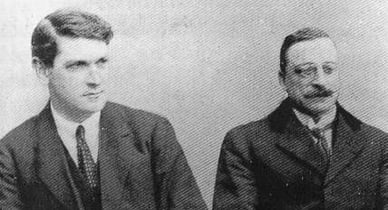
Michael Collins and Arthur Griffith
During the Rising, Collins acted as Joseph Plunkett’s aide-de-camp at the General Post Office, while Éamon de Valera fought in Dublin. After his side was defeated, he immediately experienced the consequences, being arrested and imprisoned by the British. It was during his time in Wales’ Frongoch internment camp that he started to develop relationships with his fellow prisoners, who were also republican activists.
This laid the groundwork for what was to come. Even though the Irish nationalists suffered a severe defeat, that very defeat became a catalyst for the independence movement and made them more determined than ever to succeed.
More than a century later, the Rising remains a familiar part of Irish history even to generations more accustomed to modern public figures such as Conor McGregor.
1919– 1921: The Anglo-Irish War
Collins’ Methods Against the British
One of the most interesting things about the Michael Collins Ireland story is that he acted as the Director of Intelligence of the IRA. This meant that his job was to nurture a team of spies and informants who could gather intel on the British forces, ranging from what their current activities were to which undercover agents they’d recruited for their own side.

This would most significantly come into play on Bloody Sunday, which took place on 21 November 1920. A lot of people have heard of Bloody Sunday, but not everyone knows what happened.
Essentially, IRA units acting on intelligence from Collins and his team attacked several different locations throughout the city of Dublin, killing a number of men who were believed at the time to be British Army intelligence officers.
That afternoon, the British retaliated by opening fire on the crowd during a Gaelic football match at Croke Park, killing 14 civilians. In situations like this, neither side wins. It’s no wonder they called it Bloody Sunday.
Staying Ahead of the British
From here, the Michael Collins Ireland story moves on to the Irish War of Independence, which was fought between 1919 and 1921 and which saw a huge amount of bloodshed as the republicans fought for an independent Ireland.
During this time, the British led a manhunt for Collins while also offering a huge reward for any information that led to his capture. Raids took place all over the city, but Collins was able to stay one step ahead on the Dublin streets thanks to his network of safe houses and allies. By staying on the move at all times, he was able to continue to act in his intelligence role without being captured.
In fact, Collins was so successful at evading capture that he was nicknamed “the man they could not catch”, although that’s more of a piece of popular culture and a newspaper invention than an official designation from the British. He maintained his freedom all the way through to the end of the war.
Anglo-Irish Treaty of 1921
The next chapter of the Michael Collins Ireland story begins with the Anglo-Irish Treaty of 1921, which was the result of a series of negotiations which took place in London. Collins acted as one of the main Irish figures at the table.
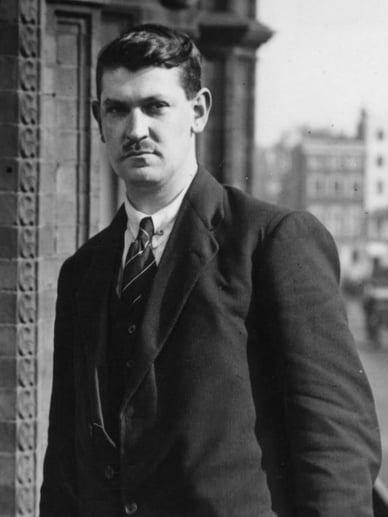
Collins in London as delegate to the Anglo-Irish Treaty negotiations
The 6 December treaty signing was a huge milestone in the country’s history because it established the Irish Free State as a self-governing dominion within the British Empire. For Michael Collins, it was the best settlement that the British could have offered, but not everyone agreed. If nothing else, it required members of Ireland’s parliament to swear an oath to the Crown, something that no Irishman was particularly keen to do.
Easter Rising leader Éamon de Valera was particularly critical of the deal, while Collins himself reflected on the deal with the line, “I have signed my own death warrant.” The resulting split amongst die-hard Irish republicans eventually divided Sinn Féin and the IRA and directly contributed to the Civil War.
Legacy and Commemoration
In today’s Ireland, Michael Collins is one of those figures with a huge legacy and remains a prominent, though controversial, part of the country’s history. You can find statues, plaques and monuments to Collins throughout the country, especially in his native County Cork, where he was born and where he died. Every year, remembrance ceremonies take place in Béal na Bláth to mark the anniversary of his death and recognise the impact that he had on Irish history.
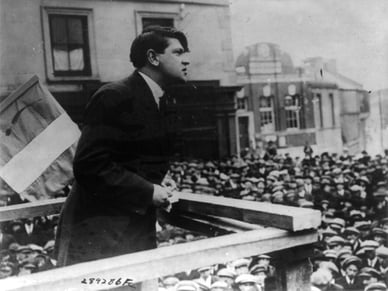
Michael Collins addresses a crowd in Skibbereen on Saint Patrick's Day, 1922.
Put simply, Collins’ impact on Ireland can’t be overstated. His life and death have become the subject of everything from books to documentary films, as well as a 1996 Liam Neeson movie that introduced him to an international audience. People remember him differently, with some seeing him as a terrorist and others seeing him as a freedom fighter. We’re not here to argue either side, though. Like most historical figures, the truth likely lies in the grey area somewhere in the middle.
In the News
Given that his death was over 100 years ago, you’re not going to see Collins in the news as much as contemporary Irishmen, and especially those like Conor McGregor who seem to attract one controversy after another. In many ways, that makes men like McGregor the modern-day equivalent of the Michael Collins Ireland figure, because he was a man who thrived and survived in constant controversy.
Still, there are always new books and documentaries coming out, often bringing updates to the way that we see the man and his legacy. For example, Anne Dolan and William Murphy released Days in the Life, which analyses his surviving diaries and sheds new light on his work during the War of Independence.
Meanwhile, 2022 saw the 100th anniversary of Collins’ death, and that brought a huge number of celebrations, museum exhibitions and more along with it. One thing’s for sure: Michael Collins and the work that he did are unlikely to be forgotten any time soon.
Michael Collins in 2026
This activist and politician remains one of the most iconic figures of the Irish Revolution, whether or not you agree with his methods. He’s also consistently ranked as one of the top Irish figures, such as in RTÉ’s public vote for Ireland’s Greatest in 2010, where Collins finished second behind fellow icon John Hume.
When it comes to the academic community, there’s less of a consensus, with most researchers taking a more nuanced view of Collins’ legacy. If you’re looking for primary sources and expert analysis, look for the incredible biographies and studies by Peter Hart, Tim Pat Coogan and T. Ryle Dwyer.
And of course there’s also the 1996 film portrayal in which Liam Neeson starred as Michael Collins in a movie of the same name. It was fairly well received by critics and the public alike, earning a 78% score on Rotten Tomatoes, although some historians have criticised its accuracy. Still, it’s well worth a watch in our opinion.
In His Own Words
As the Michael Collins Ireland story draws to a close, we owe it to the great man to consider his skills as an orator and share some of his famous lines and most commonly cited speech excerpts. Some of these also come from his writing, showing that he truly was a man of many talents who had a real gift for words.
- “The freedom to achieve it.” — Collins’ description of what the Anglo-Irish Treaty could provide (i.e. the freedom to achieve greater independence)
- “We have to learn that freedom imposes responsibilities.” — On the duties that accompany independence
- “Let us look upon what it is we have got.” — In response to critics of the Anglo-Irish Treaty who were focusing on what they still wanted and not what had already been secured
- “There is a simple test. Those who are left in possession of the battlefield have won.” — Collins’ argument in defence of the Anglo-Irish Treaty
Civil War and Death
The Michael Collins Ireland story came to an end on 22 August 1922, and in many ways, he predicted what that end would look like. Cast your mind back to Collins saying that he signed his own death warrant when he signed the Anglo-Irish Treaty.
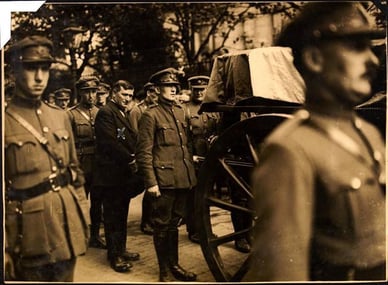
Sean Collins behind the coffin of his brother Michael
Michael Collins was killed on that day in August during an ambush at Béal na Bláth in his native County Cork. He was travelling with the National Army during the Civil War when Collins and his fellow travellers came under fire from anti-Treaty forces from the IRA. He was killed during the fight at the age of 31.
His death and the subsequent funeral had a huge impact on the Irish Civil War, which had only broken out a few weeks earlier. Huge crowds gathered for his funeral and tributes came in from throughout the world, but his death also intensified the bitterness around the Civil War and strengthened the Provisional Government’s determination to take down the IRA.
The Civil War continued until May 1923. If Collins hadn’t been killed, he may well have been able to negotiate an earlier ending and save the lives of combatants on both sides. It’s one of the great “what ifs?” in Irish history.