Aurélie Mathigot
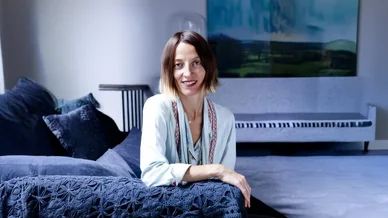
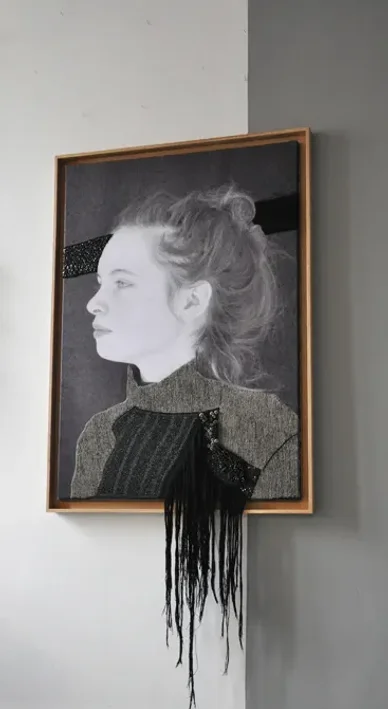
Visual artist, photographer and embroiderer Aurélie Mathigot has developed a hybrid practice in which the image becomes material. Starting with photographs printed on canvas, she adds texture, depth and time through embroidery (both machine and hand-stitched), beading or crochet, pushing certain pieces towards object-making, installation and site-specific work.
Key Information
Name | Aurélie Mathigot |
|---|---|
Practice | Visual artist, photographer, embroiderer |
Based | Lives and works in Paris |
Representation | Represented by Maison Parisienne since 2011 |
Approach (summary) | Re-embroidered photographs / "sculptural" retouching + textile sculptures (crochet, cord, wool, cotton…) |
Award | Grand Prix de la Création (Métiers d'Art category, City of Paris), 2012 |
Collections/Acquisitions | 2021: work acquired by the Musée des Arts Décoratifs, Paris; 2022: acquired by the Manufacture des Gobelins (tapestry reproduction project in progress) |
Portfolio Sections | Embroidered Photographs / Sculptural Works / Site-Specific (archived site) |
Contact | |
Social | Instagram: @mathigotaurelietextualab |
Biography
Trained in photography and video at the Beaux-Arts school in Aix-en-Provence, Aurélie Mathigot has built a practice centred on the image while seeking to give it "another kind of depth" through texture and material. Her photographs are printed on canvas and then re-embroidered in different areas — using machine and hand embroidery, thread, beading and crochet — a way of "retouching" the image in relief, working with both meaning and sensation.
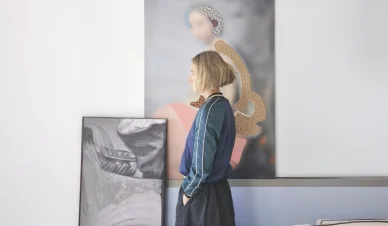
This adoption of textile technique is also an aesthetic stance: embroidery allows for trial, error and revision — "the possibility of getting it wrong, undoing it, and doing it again" — without damaging the underlying image. For Mathigot, textile isn't purely decorative: it functions as a language, a structure, a means of transmission, and at times a form of participation.
Alongside her embroidered photography (two-dimensional work), she also develops sculptural pieces: sculptures in cord, wool or cotton, often crocheted, combined with everyday materials such as wood, wax and ceramic. Her world is built around an "illusion of reality" — covering things over, shifting appearances, inventing a kind of textile-reality of the world.
Several institutional milestones mark her career: the Grand Prix de la Création (2012); research carried out in various contexts, including Valenciennes, Geneva, Rio de Janeiro and the CNAP in Paris; a work entering the collection of the Musée des Arts Décoratifs in Paris (2021); and acquisition by the Manufacture des Gobelins (2022) for a tapestry reproduction.
Embroidered Photographs
In her portfolio (archived version), the Embroidered Photographs section brings together works where the textile intervention functions as a second reading of the image — freezing a detail, emphasising a movement, or disrupting the continuity of the photograph.
Photos Brodées
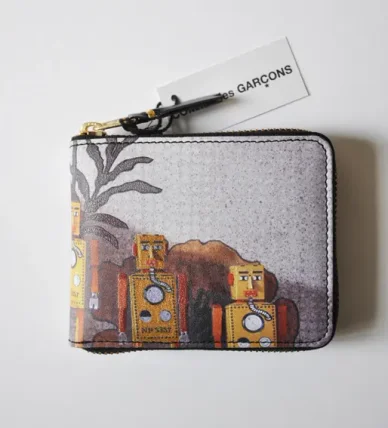
Comme des garçons-Wallets
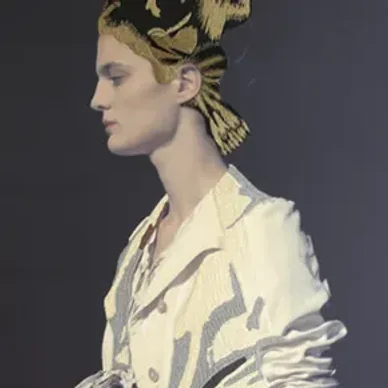
Photo brodée défilé
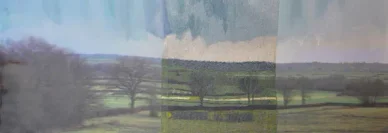
Domestic-Papier peint
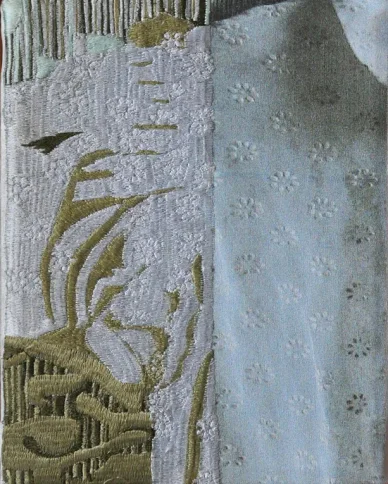
Photos Brodées
Some of the most representative series and groups of work:
- Domestic Papier Peint — A photographic landscape crossed by a textile/embroidered band: the image appears "stitched back together" or repaired by the material, like a domestic wallpaper turned into a sensitive surface.
- H.P. FRANCE KOBE — "A moment suspended, but without you." — A blurred panorama, interrupted by a vertical thread of stitching that behaves like a seam running through the landscape, marking a moment of suspension.
- Landscape — A group of pieces with highly narrative titles ("Come back soon," "Pause, give me some silence," and others), where image and texture overlap, and the embroidery becomes a zone of density where the eye lingers.
- White Nothing — White embroidery on white fabric: work that sits almost at the edge of legibility, where a sentence becomes a subtle relief, and light reveals or erases the text.
- Comme des Garçons – Wallets — A series centred on fashion objects (wallets), photographed and presented as surfaces for textile intervention: printed patterns and the product's "skin" engage with ideas of texture and stitching.
- Embroidered Runway Photo — Runway photographs reinterpreted through the needle: embroidery accentuates hair, the lines of a garment, or a silhouette, as though the image had been "re-dressed."
- Merci Exhibition, 2014 — "Drawing and Embroidery on Linen" — A series on dark linen, where colourful, sometimes beaded, embroidery appears like sparks, annotations, or traces of gesture.
- Galerie Chevalier Exhibition, 2014 — Surface details where beading and embroidery create a tactile topography, turning the photograph into something close to an object.
- Untitled Series — A grouping of works ("Witness," "Shooting," "Robots," and others) that follows a fragmentary logic: framed images, textile interventions (fringes, seams, re-embroidered areas) and titles that function as micro-narratives.
Sculptural Works
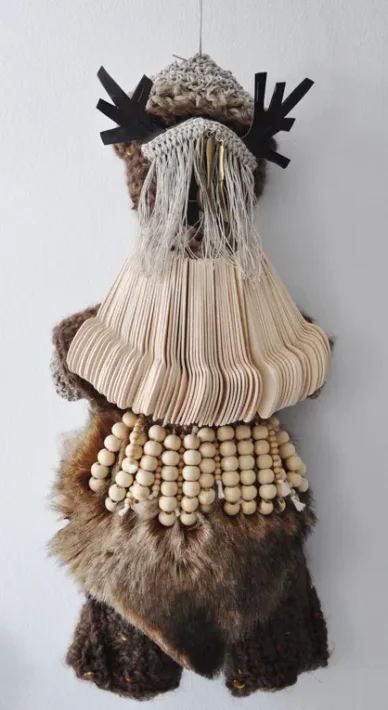
The Sculptural Works section shows the other side of her practice: textile moves off the image entirely to become structure, skin, envelope, and at times, framework. Crochet, cord, wool, cotton and everyday materials combine to create ambiguous objects, somewhere between sculpture, accessory and installation.
Wilder mann
Domestic vases
Sculpture en bois
Some notable groups of work:
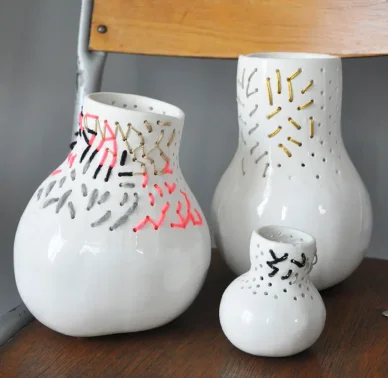
- Domestic Vases — White, perforated ceramic vases "stitched back together" with coloured thread: the embroidery becomes repair, suture, a mapping of the form.
- Protect Me — Elongated forms wrapped in netting, mesh and binding: a vocabulary of protection (covering, bandaging, isolating) that remains deliberately fragile and open-worked.
- La Foule (The Crowd) — An installation of textile figures: stitched, suspended silhouettes, multiplied to form a light, repetitive crowd, somewhere between childhood and an unsettling strangeness.
- Wilder Mann — Sculptural pieces playing with the assembly of materials (layers, beads, fringes, hides): imagery of costume, ritual and the "wild," suggested by the title.
- Silver Sculptures — Small serial objects presented as an inventory: metallic fragments, moulded forms, variations on a single family of gestures.
- Raku Ceramics — A dialogue between ceramic and textile: suspended pieces, hooks and mesh, contrasting the hardness of raku with the softness of thread.
- Crocheted Piano and Wood Embroidery — An object covered in crochet (a stylised keyboard/piano), paired with interventions on wood: a textile "skin" turns a familiar object into sculpture.
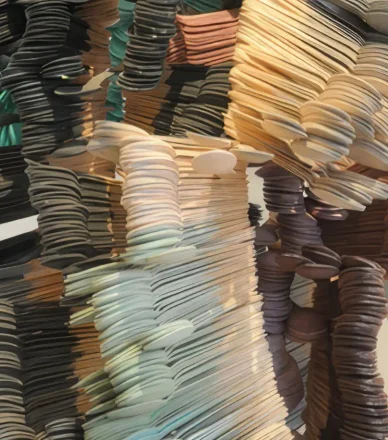
- Wood Sculpture — Suspended assemblages of cut-out forms, creating a volumetric presence through accumulation and rhythm.
- Merci Exhibition (May 2013) — An installation where repetition and suspension (hanging ribbons and elements) create an interior forest of material.
- Galerie Chevalier Exhibition, 2012 — "Into the Wild" — A collection of textile objects and suspended accessories (hooks, netting, baskets, circular forms), staged like a cabinet-of-curiosities wall.
Site-Specific Work
The Site-Specific section (archived site) brings together projects where textile and object engage directly with a location — whether nature, an exhibition space, or a domestic setting.
Land Art
Bouteille
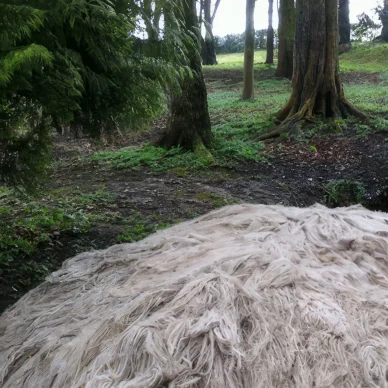
- Land Art — "Linen Project" — An intervention in a natural setting: large masses of linen fibre laid on the ground, like a living material temporarily covering and transforming the landscape.
- Protect Me — Also featured under "Sculptural Works," this project takes on a site-specific dimension when conceived as an act of covering or sheltering within a space.
- Rugs and Tapestry (Galerie Chevalier) — A presentation of textile pieces (rugs and tapestries) where geometric pattern and "stitched" line structure the space like an architecture laid on the floor.
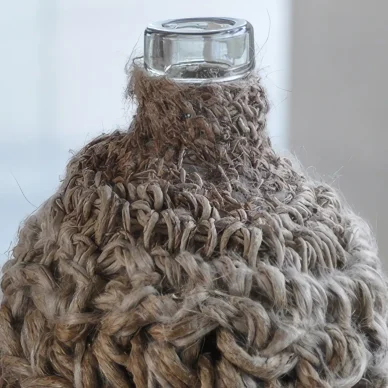
- Bottle — An everyday object transformed by a crocheted sheath: the textile material alters how the object is held, its silhouette, and how it's read.
Running through much of this work is an engagement with time and gesture. Her site-specific pieces often involve "weaving" forms that catch the eye within a forest setting, or engaging in participatory works with collaborators of all ages.
About the Artist
Aurélie Mathigot lives and works in Paris. Since 2011, she has been represented by Maison Parisienne, a gallery specialising in fine craft and contemporary art. This partnership has placed her work within a network of exhibitions across France and internationally.
Her career has developed through a range of institutional showings and research projects, including at the Musée des Beaux-Arts in Valenciennes, in Geneva, in Rio de Janeiro, and at the CNAP in Paris. These contexts have shaped the evolution of her practice and her visibility within contemporary art and textile art circles.
In 2021, one of her works entered the collection of the Musée des Arts Décoratifs in Paris. In 2022, the Manufacture des Gobelins acquired one of her pieces for a tapestry reproduction project. These acquisitions mark a significant institutional recognition of her work within textile and contemporary art.
Her career has also been shaped by winning the Grand Prix de la Création (Métiers d'Art category), awarded by the City of Paris in 2012 — a distinction that affirms her position at the crossroads of fine art and textile craftsmanship.
CONTACT