Alexander the Great
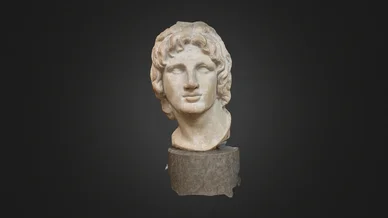
Alexander III of Macedon, better known as Alexander the Great, is one of the most prominent figures in world history. His life and work had a profound impact on the shaping of the ancient world and left an indelible mark on the development of many civilisations. Alexander was not only an outstanding military commander, but also a talented administrator and strategist, whose conquests contributed to the spread of Greek culture across vast regions, ushering in the Hellenistic era.
Early Years
Alexander the Great was born on 20 July 356 BC in Pella, the capital of the Macedonian Kingdom. Pella was an important political and cultural centre of Macedonia, located in northern Greece. Alexander's birth was marked by many signs and events that were regarded as omens of his great destiny. Legend has it that on the night of his birth, the Temple of Artemis at Ephesus burned down, an event that was interpreted as a sign of the newborn's future greatness.
✔️ Category | 👉 Information |
Full name | Alexander III of Macedon |
Years of life | 356 BC – 323 BC |
Epithet | Alexander the Great |
Title | King of Macedonia |
Children | Alexander IV |
Wives | Roxana, Stateira II, Parysatis II |
Place of birth | Pella, Macedonia |
Father | Philip II, King of Macedonia |
Mother | Olympias of the royal family of Epirus |
Teacher | Aristotle |
Age at death | 32 |
Start of reign | 336 BC |
Death | 323 BC, Babylon (possibly from poisoning or illness) |
Historical significance | Considered one of the greatest military commanders in history |
Parents
Alexander was the son of Philip II, King of Macedonia, and Olympias, a princess from Epirus. His parents had a great influence on the shaping of his personality, character and ambitions.
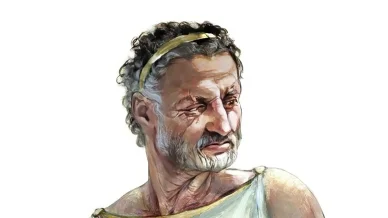
Philip the Great
Philip II was an outstanding ruler and reformer. He was born around 382 BC and became King of Macedonia in 359 BC after the death of his brother Perdiccas III. Philip inherited the kingdom in a state of political and economic decline, but thanks to his energy, his military reforms and his diplomatic skills, he managed to transform Macedonia into one of the most powerful states in Greece. He reorganised the army and introduced new military technologies and tactics, which enabled him to win numerous victories over his enemies and to expand the kingdom's territory considerably.
Philip was also a talented diplomat. He used marriage alliances as a means of strengthening political ties and extending his influence. One such marriage was to Olympias, who became the mother of Alexander. Olympias came from the Epirote dynasty. The marriage of Olympias to Philip II was a political alliance aimed at strengthening the ties between Macedonia and Epirus.
She was a woman of strong character and great ambition. Olympias played an important role in Alexander's upbringing, passing on to him a love of Greek culture, mythology and heroic ideals. Olympias was also deeply devout and believed in the divine destiny of her son. According to legend, she claimed that Zeus, the supreme god of the Greek pantheon, was Alexander's true father, which gave him confidence in his divine mission.
The relationship between Philip II and Olympias was complex and often tense. Philip had many extramarital affairs and married several times, which caused jealousy and disputes within the family. Despite her strong character, Olympias was often in political danger because of the intrigues at court and the struggles for power.
Despite these difficulties, Alexander received a comprehensive education and training for his future role. His parents provided him with the best teachers, including the distinguished philosopher Aristotle, who taught him philosophy, science, medicine, literature and other disciplines. This upbringing played a decisive role in shaping his worldview and in preparing him for great achievements.
Alexander's royal background and upbringing provided him with a solid foundation for his future achievements. The influence of his parents, combined with Alexander's own exceptional abilities and ambition, created the conditions for his great conquests and his contribution to world history.
The Significance of Alexander the Great
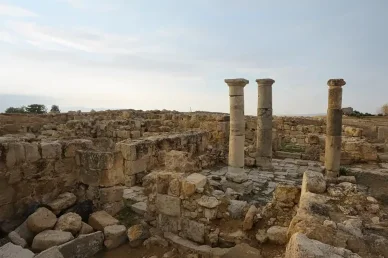
The ruins of the ancient city of Pella
His significance in world history lies not only in his military achievements, but also in his influence on the cultural, political and economic development of the ancient world and of subsequent eras. Some of Alexander the Great's greatest achievements include:
- The creation of the largest empire of the ancient world.
- The spread of Hellenism — Greek culture in the East.
- The stimulation of the development of cities, trade and science.
Alexander's Role in History
One of the most important achievements of Alexander the Great was the creation of one of the largest empires in history, stretching from Greece to India. His military campaigns radically changed the political landscape of the ancient world. Alexander defeated the mighty Persian Empire, which was Greece's main rival, and united numerous peoples and cultures under his rule. His military genius and his tactical innovations became a model for future generations of commanders.
The Spread of Hellenism
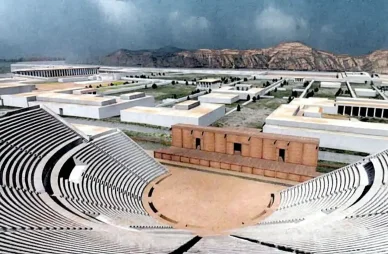
Theater in Ai-Khanum
Alexander the Great contributed to the spread of Greek culture, science and philosophy across the conquered territories. This marked the beginning of the Hellenistic era, which lasted several centuries and influenced the development of many civilisations. Greek became the lingua franca (the common language) in the Eastern Mediterranean, which facilitated cultural and scientific exchange between peoples. The Greek cities that Alexander founded, such as Alexandria in Egypt, became important centres of science, culture and trade.
Administrative and Political Innovations
Alexander introduced a series of administrative reforms that contributed to the effective management of his vast empire. He retained many aspects of the Persian administrative system, appointing Persian satraps to important posts, but he also placed Macedonian officers in key military positions to ensure loyalty and control. This helped to avoid conflicts and to ensure stability in the conquered regions.
Cross-Cultural Exchange and Tolerance
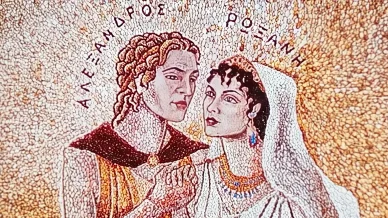
Alexander the Great with his wife
Alexander promoted cross-cultural exchange by combining Greek and local traditions. He encouraged his soldiers to marry local women, and he himself married Roxana, a princess from Bactria. This helped to strengthen the ties between the various peoples of the empire and to promote their integration. Alexander also respected local religions and customs, often taking part in local religious ceremonies and rituals, which helped to build trust in his authority among the conquered peoples.
Influence on Military Affairs
The military genius of Alexander the Great left an indelible mark on military history. His tactics and strategies are still studied in military academies around the world. He used innovative methods of warfare, such as the use of the phalanx, combined infantry and cavalry forces, and the effective use of siege engines during the sieges of cities. His ability to make quick decisions and to exploit tactical advantages led to numerous victories.
Long-Term Impact on History
The legacy of Alexander the Great continued to influence the development of civilisations even after his death. The collapse of his empire led to the creation of many Hellenistic kingdoms that continued to spread Greek culture and influence. The Hellenistic period was a time of great cultural and scientific development that influenced the evolution of the Roman Empire and the entire Western world.
Overall, the significance of Alexander the Great lies in his ability to change the course of history, to create new cultural and political realities and to leave a legacy that continues to inspire and influence humanity to this day.
Education and Upbringing
When Alexander was 13 years old, his father Philip II summoned the famous philosopher Aristotle to become the mentor of the young prince. Aristotle, one of the greatest thinkers of the ancient world, had a significant influence on the shaping of Alexander's worldview and character. Their lessons took place in a remote place known as Mieza, where the young Alexander and a group of other Macedonian aristocrats studied under the philosopher's guidance.
Aristotle's Influence on Alexander's Character
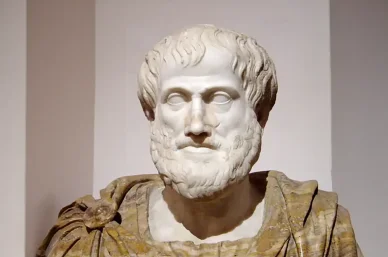
Aristotle, the teacher
Aristotle taught Alexander philosophy, ethics, politics, science, medicine and literature. Alexander received a thorough education in all these fields, which formed the basis for his all-round development. He studied the works of Homer, admiring the Iliad in particular. Legend has it that Alexander always carried a copy of this poem with him, which Aristotle had annotated especially for him.
Aristotle's philosophy was based on the ideas of logic, rationalism and the pursuit of knowledge about the world. Alexander learned these principles and applied them in his political and military activities. Aristotle also instilled in Alexander a love of Greek culture and traditions, which was an important factor in the further spread of Greek culture across the conquered territories.
In addition to theoretical knowledge, Aristotle taught Alexander the importance of ethics and morality. He taught him that justice, wisdom and courage were the main characteristics of a good ruler. These lessons instilled in Alexander a sense of responsibility towards his people and the conquered regions, contributing to his desire for just and wise governance.
Military Training
Alongside his philosophical education, Alexander also received military training under the guidance of his father, Philip II, who was an outstanding military commander and army reformer. Philip II transformed the Macedonian army into one of the most powerful in the world through his innovations in military affairs.
From a young age, Alexander accompanied his father on military campaigns and battles, gaining practical knowledge and skills in warfare. He studied tactics and strategy and mastered various types of weapons and combat techniques. Philip taught him the courage, determination and military skills required of a successful commander.
One of the most important battles in which Alexander took part alongside his father was the Battle of Chaeronea in 338 BC. In this battle, the Macedonian army won a decisive victory over the combined forces of the Greek city-states. Alexander commanded the left wing of the army and demonstrated his military skill and bravery, which earned him respect and recognition among the Macedonian soldiers.
His father also taught Alexander the importance of discipline and organisation in the army. Under his guidance, he learned the principles of logistics, military planning and the command of large armies. This knowledge would later serve as the basis for his future military campaigns and his remarkable victories.
Thanks to the combination of his studies under Aristotle and his military training under Philip II, Alexander the Great received a comprehensive education that helped him become one of the greatest generals and rulers in history. His intellectual and military abilities, as well as his deep understanding of philosophy and ethics, formed the basis for his great achievements and his influence on world history.
Adulthood and Rise to the Throne
One of the first significant military events in Alexander's life was the Battle of Chaeronea, which took place in 338 BC. This battle was decisive in the struggle for hegemony over Greece. Philip II, Alexander's father, sought to strengthen his influence and subdue the Greek city-states, particularly Athens and Thebes.
Alexander, who was only 18 years old at the time, commanded the left wing of the Macedonian army. Philip's army used a phalanx, which was a major innovation in battle tactics. Alexander proved to be a brave and talented military leader. During the battle, he led a cavalry charge against the Theban “Sacred Band”, an elite unit that was completely destroyed. This manoeuvre played a decisive role in the Macedonian victory.
After the Battle of Chaeronea, Alexander gained fame and respect among the Macedonian soldiers and his allies. His military skill and his leadership abilities became apparent to all, and this provided him with significant support in future military campaigns.
The Political Situation After Philip II's Death
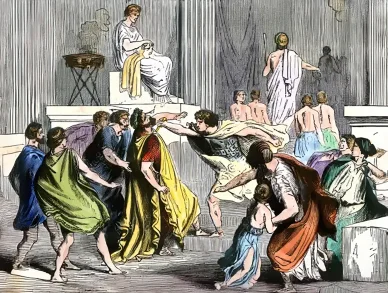
The Death of Alexander's Father
In 336 BC, during the wedding ceremony of one of Philip II's daughters, he was assassinated by his own bodyguard Pausanias. This assassination caused political chaos in Macedonia. The murder of his father came as a great shock to Alexander, but he reacted quickly and took measures to secure his power.
Immediately after Philip's assassination, Alexander was proclaimed King of Macedonia. He was only 20 years old, but he already had significant military and political experience. His first steps as king were aimed at consolidating his power and suppressing potential rivals.
Securing Power in Macedonia
To consolidate his power, Alexander took a series of decisive measures. First, he ordered the execution of all potential rivals for the throne, including members of the royal house and representatives of powerful Macedonian noble families. This was a common practice of the time, intended to prevent possible uprisings and internal conflicts.
Second, Alexander strengthened his position among the Macedonian aristocracy and the military leaders. He reaffirmed their privileges and guaranteed their support, which secured the loyalty of the army and the aristocracy. Alexander also won the support of the Macedonian army, which recognised him as its supreme commander.
One of the important steps in strengthening his power was securing control over his territories and reaffirming the loyalty of his allies. Alexander launched a campaign against the Thracians and the Illyrians on the northern borders of Macedonia, who decided to take advantage of Philip's death and to rebel against Macedonian rule. He quickly crushed these uprisings, demonstrating his military skill and determination.
Finally, Alexander reasserted Macedonian authority over the Greek city-states, which had also decided to exploit the situation and declare their independence. He quickly organised a military campaign in Greece and managed to force Athens, Thebes and other city-states to recognise his authority and to rejoin the League of Corinth, which had been founded by his father to fight the Persian Empire.
Conquest and Empire Building
After a successful advance into Asia Minor, Alexander encountered the main forces of the Persian army under King Darius III at the Battle of Issus in November 333 BC. It was one of the most significant clashes of the campaign. Darius had assembled a huge army, several times larger than the Macedonian forces. However, Alexander was able to use the terrain and tactical techniques to win the battle.
During the battle, Darius, seeing that his troops were being defeated, abandoned the battlefield, leaving his family and his treasures at the mercy of the victor. Alexander showed generosity by treating the captured members of the royal family with respect, which further enhanced his prestige among the Persians.
The Conquest of Egypt and the Founding of Alexandria
After his victory at Issus, Alexander travelled south to Egypt, which was under Persian control. In 332 BC he conquered Egypt without a battle, as the local population and the priesthood welcomed him as a liberator from Persian rule. Alexander was proclaimed pharaoh and visited the sacred city of Memphis.
In Egypt, he founded a new city, which he named after himself — Alexandria. The city quickly became an important cultural, scientific and commercial centre, playing a significant role in the spread of Greek culture. Alexandria earned its reputation as a major intellectual hub, thanks to the famous Library of Alexandria and the Mouseion.
The Pursuit of Darius and the Final Victory over Persia
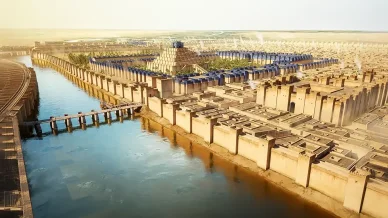
The City of Babylon
The most important event of the entire campaign was the Battle of Gaugamela, which took place on 1 October 331 BC. Darius III assembled a new, huge army in an attempt to stop Alexander. The battlefield was chosen by the Persians and prepared in such a way as to provide maximum advantage to their forces, including their cavalry and chariots.
Using his military talent, Alexander managed to develop a tactic that enabled him to break up the Persian front. During the battle, he personally led the attack, breaking through the centre of the Persian army and forcing Darius to flee once again. The victory at Gaugamela was decisive and led to the fall of the Persian Empire.
After the victory at Gaugamela, Alexander marched east in pursuit of Darius. He captured the main Persian cities of Babylon, Susa and Persepolis. Persepolis, the capital of the Persian Empire and a symbol of its power, was taken and partly destroyed on Alexander's orders. This act had symbolic significance, as Alexander wanted to show that he was the new master of Asia.
The Fall of Persepolis and the Death of Darius III
Darius III tried to organise resistance on the eastern borders of the empire, but was betrayed by his own satraps and killed. In 330 BC, Alexander found Darius's body and, showing him respect, buried him with royal honours. The death of Darius III marked the end of the Persian Empire and Alexander's final victory.
The conquests of Alexander the Great not only created one of the largest empires in history, but also contributed to the spread of Greek culture, ushering in the Hellenistic era. His military genius, his strategic thinking and his ability to inspire his soldiers made him one of the greatest military leaders of all time.
Administration
Having conquered vast territories, Alexander the Great faced the challenge of governing a large empire. He sought to maintain stability and order by introducing an effective administrative system.
The Appointment of Satraps and Military Commanders
Alexander retained the traditional Persian system of satrapies (provinces) and appointed satraps from among his trusted associates and the local nobility. This enabled him to maintain control of his territories and to prevent uprisings. One of the most interesting cases is the appointment of the satrap Mazaeus, a former Persian governor of Babylon, who continued to serve under Alexander's rule.
Retention of the Persian Administrative System
Alexander retained most of the Persian administrative structures because they were well organised and functioned effectively. He also retained the Persian tax system, which provided a steady flow of revenue to the state treasury. In general, his administrative policies included the following:
- The founding of new cities.
- Cities as centres of Greek culture and trade.
- Religious and cultural tolerance.
- Respect for local religions and customs.
Thus, the administrative activities of Alexander the Great were multifaceted and aimed at ensuring the stability and prosperity of his vast empire.
The Cultural and Scientific Influence
Alexander’s conquests transformed the ancient world by spreading Greek culture and fostering advances in science and the arts.
Hellenism
Hellenism was a cultural movement that emerged following the conquests of Alexander the Great, spreading Greek culture, language and science across vast territories. It actively promoted the integration of Greek and local elements in the conquered regions. This contributed to the creation of a syncretic culture that combined Greek and local traditions. For example, after the conquest of Egypt, Alexander founded the city of Alexandria, which became the centre of Greek science and culture.
The Greek language became the lingua franca across large parts of the conquered territories. This facilitated communication and trade between the various peoples. At the same time, Greek culture penetrated all areas of life, from art to architecture. A well-known example is the city of Ai-Khanoum (in present-day Afghanistan), where a Greek theatre and the remains of statues and temples have been found. Greek science also developed through interaction with local scientific traditions. For example, the astronomer and mathematician Eratosthenes of Alexandria calculated the circumference of the Earth with impressive accuracy.
The Role of Alexandria
Alexandria, founded by Alexander in 331 BC, quickly became the scientific and cultural centre of the ancient world. It housed the famous Library of Alexandria, where more than 700,000 scrolls from all over the world were gathered. This library became the workplace of many distinguished scholars, such as Euclid, who wrote his Elements, and attracted minds like Archimedes, who studied in Alexandria and maintained close ties with its scientific community. Also, many of the works of Hippocrates were kept there.
The Scientific and Cultural Centre of the Ancient World
Alexandria was also known for its Mouseion, an important centre of learning and research where many of the finest minds of the age worked. Medicine also developed there: Herophilus, who lived and worked in Alexandria, made important discoveries in the field of anatomy, including the description of the nervous system. In addition, the city became an important centre of artistic production, influencing the development of the visual arts throughout the Hellenistic world.
The Indian Campaign
After conquering the Persian Empire, Alexander the Great marched east to India, where he faced many challenges. One of the most famous battles was the Battle of the Hydaspes in 326 BC, where Alexander defeated King Porus, who was renowned for his army of elephants. After defeating Porus, Alexander not only kept him as ruler of his lands but also made him an ally, which demonstrates his political wisdom and his ability to integrate the peoples he had conquered.
Returning to Babylon and Planning New Campaigns
After his campaign in India, Alexander's exhausted and weary troops forced him to turn back, and he eventually returned to Babylon in 324 BC. Babylon became the administrative centre of his empire. Here Alexander developed plans for new conquests, including the conquest of the Arabian Peninsula. He also began to organise a fleet for expeditions to Arabia.
Plans for the Conquest of Arabia
Alexander intended to expand his empire by conquering Arabia, which would allow him to control important trade routes. To achieve this, he began to build a fleet to support the invasion. However, these plans remained unrealised because of his sudden death.
Death in Babylon
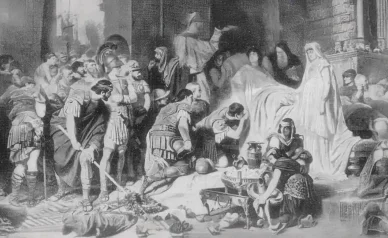
The Death of Alexander the Great
Alexander the Great died in Babylon on 10 or 11 June 323 BC at the age of 32. The circumstances of his death remain a mystery. There are various theories about the cause of his death, such as malaria, typhoid fever, poisoning and an autoimmune disease. Some historians believe that Alexander was poisoned as a result of political intrigue, but modern research leans towards natural causes, such as an infectious disease.
The last days of Alexander's life were full of pain and suffering. Historical accounts record that in his final days, his anxious soldiers were permitted to file past his bed to bid him a silent farewell. Alexander's death left an enormous power vacuum and led to the break-up of his empire into various successor states ruled by his military leaders.
The Legacy and Influence of Alexander the Great
The legacy of the great commander had a significant impact on the course of world history, leaving a lasting impact on culture, science and politics. His achievements and conquests not only changed the ancient world but also laid the foundations for future civilisations.
The Collapse of the Empire
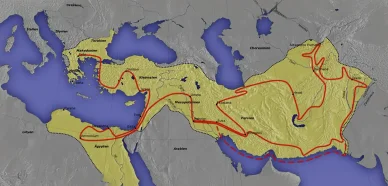
The Empire and the Journeys of Alexander the Great
After the death of Alexander the Great, his vast empire quickly began to disintegrate. Without a clear successor, his generals, known as the Diadochi, began to fight for power. In 321 BC, the Conference of Triparadisus redistributed the empire's satrapies, further consolidating the division of Alexander's empire among his generals.
The Diadochi and the Division of the Empire
The Diadochi divided the empire into several large parts. Among the most well-known successors were Ptolemy, who became the ruler of Egypt, Seleucus, who gained control of the eastern territories, and Antigonus, who controlled much of Asia Minor and Syria. These new states retained many of the administrative and cultural practices introduced by Alexander.
Long-Term Impact on History
The legacy of Alexander the Great had a lasting impact on history. He created a model of imperial rule that united different peoples under a single authority. His conquests promoted cultural exchange between East and West, which formed the basis for the development of Hellenistic culture.
Alexander the Great had a significant impact on the development of the ancient world. His conquests contributed to the spread of Greek culture across large regions. The city of Alexandria in Egypt became a centre of science and culture, influencing the development of philosophy, medicine, mathematics and astronomy. Greek became a lingua franca across much of the Hellenistic world, facilitating international trade and diplomacy.
The Achievements of Alexander the Great
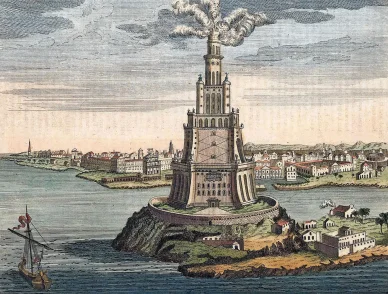
The Lighthouse of Alexandria
Alexander the Great is a monumental figure in human history; he left an indelible mark on humanity. His achievements and legacy continue to influence the development of the modern world, demonstrating the power of knowledge, strategic thinking and cultural exchange.
Known as one of the greatest military leaders in history, he achieved great success during his short life. He created one of the largest empires in the world, stretching from Greece to India. Alexander won numerous battles, including those of Issus and Gaugamela, and founded more than 20 cities, including Alexandria in Egypt, the famous centre of culture and science. He revolutionised military tactics and command, uniting different peoples under his rule.
Alexander's conquests had a far-reaching impact on world history and culture. He contributed to the spread of Greek culture, language and science across vast regions, creating a synthesis of Greek and local traditions. This process, known as Hellenisation, spread Hellenistic culture across vast regions and later influenced the Roman Empire and many other civilisations. Greek science and philosophy became accessible to the peoples of the East, which contributed to the advancement of knowledge in various fields.
The Significance of His Legacy
Alexander's legacy remains relevant to this day. His achievements in managing a multi-ethnic empire and in military strategy are still studied today. His cultural influence contributed to the development of world literature, art and science. The library at Alexandria, although destroyed, became a symbol of the enduring pursuit of knowledge and research.
Alexander's legacy is also important for the modern world. His example demonstrates the importance of cultural exchange and tolerance, which are significant in the context of globalisation. The integration of different cultures and peoples that Alexander pursued provides a foundation for a peaceful and stable world. His strategic thinking and administrative approaches serve as a model for modern leaders and managers.
Conclusion
Alexander the Great left an indelible mark on the history and culture of humanity. His achievements and legacy continue to influence the development of the modern world, demonstrating the power of knowledge, strategic thinking and cultural exchange.
FAQ
Where was Alexander the Great born?
Alexander the Great was born on 20 July 356 BC in Pella, the capital of the Macedonian Kingdom.
What was Aristotle's influence on Alexander the Great?
Aristotle's influence stemmed from his teaching of philosophy, ethics, politics, science, medicine and literature to Alexander. Alexander received a thorough education in all these fields, which laid the foundation for his broad intellectual development. Aristotle also instilled in Alexander a love of Greek culture and traditions, which was an important factor in the spread of Greek culture across the conquered territories.
What was Alexander the Great's impact on military affairs?
Alexander's impact on the art of war lay in his use of innovative military tactics, such as the phalanx, the integration of infantry and cavalry, and the effective use of siege technology during the sieges of cities.
What is Hellenism and what is Alexander the Great's role in it?
Hellenism was an era of widespread Greek culture, language and science that began with the conquests of Alexander the Great. It actively promoted the integration of Greek and local elements in the conquered regions.
Which city was the scientific and cultural centre of the ancient world?
Alexandria, founded by Alexander in 331 BC, quickly became the scientific and cultural centre of the ancient world. It housed the famous Library of Alexandria.
How did Alexander the Great die?
The circumstances of his death remain a mystery. There are various theories about the cause of his death, such as malaria, typhoid fever, poisoning and an autoimmune disease. Some historians believe that Alexander was poisoned as a result of political intrigue, but modern research tends to attribute his death to natural causes, such as an infectious disease.