Neil Jordan
Meet Neil Jordan, one of the most distinctive voices in world cinema today. If you haven’t heard of him already, you’re in for a treat.
Jordan is an Oscar-winning Irish director and filmmaker, as well as a novelist and screenwriter. He’s an auteur and an author, a man who lives and breathes storytelling and who knows how to have viewers on the edges of their seats.

Jordan has an impressive reputation and is known for his ability to tackle different genres, bringing a touch of politics and a gothic atmosphere to a career spanning over 40 years across film, TV and literature.
Let’s take a closer look at his life, roots, movies and recent projects and get to know how and why he won the Oscar for Best Original Screenplay in 1993.
Early Life and Literary Start
Born Neil Patrick Jordan on February 25, 1950 in Sligo, Ireland, Neil Jordan showed a deep interest in literature from an early age. After he finished secondary school, he studied Irish History and English Literature at University College Dublin (UCD), quickly building himself a serious reputation as an up-and-coming talent. That reputation only grew after he founded the Irish Writers’ Co-Operative in 1974.
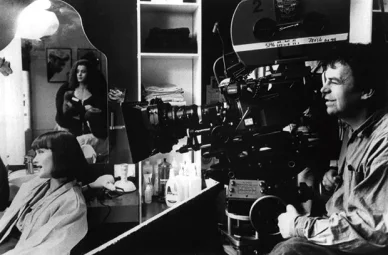
Neil Jordan behind the camera on the set of 1992’s The Crying Game, with Miranda Richardson and Jaye Davidson.
In 1976, Jordan released Night in Tunisia, his debut short story collection, which won the Guardian Fiction Prize. Such mainstream recognition is rare for a debut collection, but Jordan hit the ground running and quickly established his own style, largely focusing on atmospheric and psychologically dense storytelling. His early work as a novelist set the foundations for the work he’d end up doing as a filmmaker.
Changing from a Writer into a Filmmaker
In 1981, Neil Jordan began his transition from literature to film while supporting John Boorman as an informal apprentice on the movie Excalibur. This helped him to pick up some much-needed exposure to a professional film set and taught him the basics of what he’d need to move forward. In 1982, he released his directorial debut, a crime thriller called Angel that was set during The Troubles and which credited Boorman as executive producer.
That was followed in 1984 by The Company of Wolves, a gothic fairy tale horror story that was based on a short story by Angela Carter. Switching between two such different genres showed just how versatile Jordan could be.
Breakthrough with The Crying Game and Mona Lisa
1986: Mona Lisa
The list of Neil Jordan best movies begins with Mona Lisa, a 1986 crime drama starring Bob Hoskins as a recently released prison convict who becomes the chauffeur and bodyguard for an upper-class call girl. When he tries to help her find her missing friend, he ends up clashing with his career criminal former boss, played by the legendary Michael Caine.

Mona Lisa | Original Trailer
We know that this is one of Jordan’s best films because of how well received it was. Bob Hoskins in particular was praised, winning both a BAFTA and a Golden Globe for Best Actor. It’s one of the best-reviewed films of the 1980s and still maintains a whopping 98% score on Rotten Tomatoes.
1992: The Crying Game
The list of Neil Jordan best movies continues with The Crying Game, a 1992 political thriller which covered themes like love and identity, while simultaneously revisiting the IRA and the Troubles like Angel did ten years earlier. The movie was a huge success, putting the spotlight on Neil Jordan once again.

The Crying Game (1992) - Trailer
In fact, The Crying Game was one of the most profitable indie films of the era, bringing in $62 million at the box office against a budget of just $2.3 million. Critics loved it too, with the movie being nominated for six Academy Awards and Jordan winning the Oscar for Best Original Screenplay. The performances by stars Forest Whitaker, Stephen Rea and Jaye Davidson helped, but it was Jordan’s prowess as a filmmaker that really sealed the deal.
Hollywood Period
1994: Interview with the Vampire
From one success to another, the list of Neil Jordan movies continues with 1994’s Interview with the Vampire. This modern classic was a movie adaptation of the Anne Rice novel of the same name, starring Tom Cruise as the vampire Lestat and Brad Pitt as Louis de Pointe du Lac.

Interview with the Vampire (1994) ORIGINAL TRAILER
Rice was initially unimpressed with Cruise’s casting, feeling that he wasn’t the right actor to star in her gothic horror masterpiece. Rice wasn’t the only person who initially doubted Cruise’s casting, but he nailed the part and she later praised his performance.
Interview with the Vampire would go on to become an iconic movie that redefined the vampire genre, as well as making its money back and then some by grossing $223.7 million against a $60 million budget. Today, it’s viewed by many as a cult classic.
1996: The Butcher Boy and Michael Collins
In 1996, the Neil Jordan best movies list was augmented by Michael Collins, a historical biopic that caused controversy at the time due to its depiction of Collins and his role in the Irish War of Independence. It’s never easy to get the balance right when tackling a true story from Irish history. The movie starred Liam Neeson in the title role and won the Golden Lion at the Venice Film Festival. At the time, Neeson was still a rising star, like Ryan Reynolds in the late 2000s, before he became a household name with Deadpool.

The Butcher Boy Film Trailer | 1997
In 1997, Jordan released The Butcher Boy, a dark coming-of-age drama that was based upon a novel by Patrick McCabe. It was widely acclaimed by the viewing public and the critics alike, further showcasing Jordan’s interest in exploring trauma and identity, especially when it comes to the Irish. They might not have been big money makers, but they’re still often ranked amongst his best works.
Personal Life
Like many successful filmmakers, Neil Jordan has gone out of his way to keep his personal life private and to draw a line between his home life and his work. With that said, we know that he has children, including daughters from different relationships, and that he’s still primarily based in Dublin and maintaining ties to West Cork.
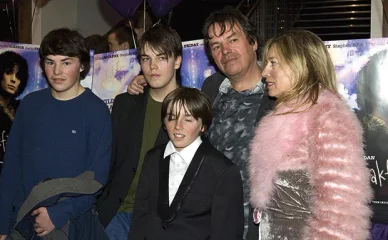
Neil Jordan with his wife Brenda Rawn and members of his family at the premier of Breakfast on Pluto in Dublin in 2006.
Jordan also has long-standing creative partnerships with figures like Stephen Rea, Aidan Quinn and Colin Farrell, putting his money where his mouth is when it comes to supporting Irish talent. He’s also continued to develop a career as an author, releasing novels and short fiction on a fairly regular basis since the 1970s. His most recent release, a novel called The Library of Traumatic Memory, was released in March 2026.
Jordan Returns to Ireland
Byzantium and Ondine
After spending some time in Hollywood, Jordan returned to the Emerald Isle for the next instalment in the list of Neil Jordan movies. He also reunited with Colin Farrell for the hybrid fantasy romance film Ondine, which won two IFTA Awards.
Next up was 2012’s Byzantium, a vampire drama featuring Saoirse Ronan and Gemma Arterton. This was a different type of vampire movie to Interview with the Vampire, though. It’s considered to be an atmospheric and feminist take on vampirism, putting the female experience and generational trauma at the heart of the story.
Put together, these two movies marked a deliberate return to a more personal style of storytelling which was rooted in Irish history. For Jordan, it’s always been about the story.
2011 to 2013: The Borgias
From 2011 to 2013, Neil Jordan created, wrote and directed The Borgias for Showtime. This TV show ran for 29 episodes, of which Jordan wrote 20 himself.
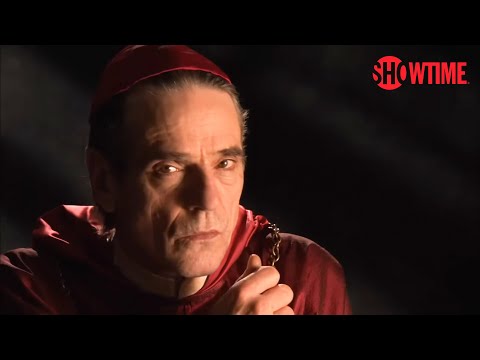
The Borgias Season 1: Official Trailer
The Borgias is set in Renaissance Italy and follows the Borgia family as they scheme their way towards the Papacy, and it stars the incredible Jeremy Irons as Pope Alexander VI. It’s one of those television shows where you never know what’s coming next, with as many twists and turns as Game of Thrones, but without the dragons. The show also won a number of Emmy Awards.
The Borgias is the perfect vehicle for Jordan because of his interest in power dynamics and the way that corruption can shape history. In fact, it’s said that the show was only cancelled in 2013 because of its high production costs.
More Recent Career
Marlowe and Greta
Next up in our list of Neil Jordan movies is 2019’s Greta, a psychological thriller which starred Isabelle Huppert and Chloë Grace Moretz and which reminded the world that Jordan could take on any genre that he wanted to. It’s not the most well-known of Jordan’s films, but it’s still popular amongst fans, and critics particularly loved Huppert’s performance.
There’s also Marlowe, a neo-noir movie set in the late 1930s in which a rich heiress hires a struggling detective to track down her ex-lover. Starring Liam Neeson in the titular role of Philip Marlowe, the movie grossed around $14 million worldwide.
Meanwhile, Jordan was keeping busy with TV work, creating and producing Riviera for Sky Atlantic. The show, which ran for three seasons between 2017 and 2020 and became Sky’s most successful original series, followed an American art curator after her billionaire husband died in a yacht accident.
Upcoming Project: The Well of Saint Nobody
As for what’s next on the list of Neil Jordan movies, we can expect to see a production of The Well of Saint Nobody hit our screens sometime soon. Based on Jordan’s own 2023 novel and announced at Cannes in 2024, the movie will follow a famous pianist’s retirement to Ireland and revolve around an abandoned well, with themes of lost love, murder and legend.
Currently in pre-production and expected to star Jeremy Irons, Helena Bonham Carter and Aidan Quinn, The Well of Saint Nobody is sure to end up as one of the Neil Jordan best movies because it’s the first time he’s adapting one of his own novels for the screen. It’s also set in West Cork, which makes it yet another truly Irish movie from a truly Irish filmmaker.
Style and Legacy
As we’ve seen today, Neil Jordan has worked hard to establish his reputation as one of the most talented filmmakers in Irish cinema, and people have sat up and paid attention. You can tell it’s a Jordan movie if it has a gothic atmosphere, unstable or unreliable identities, a subversion of genre and, of course, a reflection of Irish politics. His impressive career culminated with an IFTA Lifetime Achievement Award in 2003.
At the same time as rubbing shoulders with the greats of contemporary Irish cinema—people like Brendan Gleeson and Cillian Murphy—he’s also built a legacy as a novelist. Releases include The Past (1980), Sunrise with Sea Monster (1994), Shade (2004), Mistaken (2011), The Drowned Detective (2016), Carnivalesque (2017), The Ballad of Lord Edward and Citizen Small (2021) and, of course, The Well of Saint Nobody (2023).
And his legacy is still building, as we can see from the release of this year’s novel The Library of Traumatic Memory and the upcoming movie adaptation of The Well of Saint Nobody. When it comes to Neil Jordan, there’s always a lot to look forward to.