Postwatch
Postwatch was an independent organisation that represented the interests of postal service users in the United Kingdom. Its official name was the Consumer Council for Postal Services. It was created under the Postal Services Act 2000 and came into existence on 1 January 2001, replacing the Post Office Users' National Council and the separate user councils for Scotland, Wales and Northern Ireland, which the Act abolished.
Parameter | Details |
|---|---|
Official name | Consumer Council for Postal Services (Postwatch) |
Established by | Postal Services Act 2000 |
Began work | 1 January 2001 |
Role | Statutory consumer watchdog for postal services in the UK |
Predecessor | Post Office Users' National Council (and the country user councils) |
Structure | Nine regional committees: Scotland, Wales, Northern Ireland and six English regions |
Worked alongside | Postcomm (regulator), Royal Mail Group, Post Office Ltd, government |
Ceased operations | 30 September 2008 |
Successor | Consumer Focus (from 1 October 2008) |
Aims and Responsibilities
Postwatch's main purpose was to protect and promote the interests of postal service users and to press for a better overall service. In practice, it represented consumers in dealings with postal operators, with the regulator and with government bodies, advising all three on what customers wanted and needed. It also monitored complaints and, where it considered it appropriate, made representations on the problems it saw.
Whose Interests Did Postwatch Consider?
Postwatch represented all customers of postal services. The Postal Services Act 2000 also required it to take particular account of the interests of users in different areas and, in particular, of:
- individuals who were disabled or chronically sick;
- individuals of pensionable age;
- individuals with low incomes;
- individuals living in rural areas.
This wording comes from the Act itself, so these groups were a statutory consideration, not simply a matter of the organisation's own priorities.
Help with Complaints About Postal Services
Postwatch helped individuals and businesses who were unhappy with the response they had received from Royal Mail or another postal operator. The customer was expected to complain to the operator first; Postwatch could then help them take the matter further. During 2007–08, 94% of the complaints Postwatch received concerned Royal Mail. Complaint handling was centralised in a single office in Belfast, and an agreement in place by that year had Royal Mail fund this part of Postwatch's work in proportion to the number of complaints received.
What Problems Could Customers Raise?
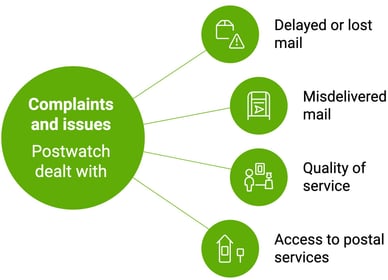
The complaints and issues Postwatch dealt with fell into several broad areas:
- delayed or lost letters and parcels;
- misdelivered mail;
- the quality of service customers received;
- access to postal services, including in remote areas.
Postwatch also ran awareness campaigns on these topics. In an early-2000s campaign on misdelivered post, a survey it commissioned from MORI found that 54% of people said they had received misdelivered mail in the previous six months. The organisation also passed on to Postcomm any local or regional failures by Royal Mail to meet its quality-of-service targets.
Role in Changes to the Post Office Network
Postwatch's most visible public role came during the Network Change Programme. In May 2007, following a national consultation, the government confirmed a programme of up to 2,500 compensated post office closures, out of a network of roughly 14,300 branches. Post Office Ltd ran the programme, and each area plan went through a local public consultation, normally lasting six weeks. Local consultations began in October 2007.
Postwatch's part in this process was set by the government and covered the following tasks:
- scrutinising Post Office Ltd's proposals and giving feedback on them;
- having its regional offices investigate the closure proposals for their areas;
- raising awareness of the local consultations;
- checking that the consultations were meaningful and took account of community needs;
- working with communities and Post Office Ltd where it considered a proposal unsatisfactory.
The decisions themselves were not Postwatch's to take. Post Office Ltd was responsible for implementing the programme and confirmed each closure after considering the responses. Postwatch could, in defined circumstances, trigger a review of an individual closure decision carried out jointly with Post Office Ltd, but it did not have the power to prevent a closure on its own. When Postwatch itself closed, the staff working on the programme were kept on so that this work could continue.
How Postwatch Worked with Other Bodies
The Postal Services Act 2000 created Postwatch and the regulator, the Postal Services Commission (Postcomm), at the same time, and the two had different jobs:
| Postwatch | Postcomm |
|---|---|---|
Official name | Consumer Council for Postal Services | Postal Services Commission |
Main focus | Representing the interests of postal customers | Regulating the postal sector, including licensing postal operators |
Complaints | Helped customers after they had complained to the operator | Received referrals from Postwatch where a licence appeared to have been breached |
Structure | Regional committees and offices across the UK | Based in London only (as described by Postwatch in 2003) |
After 2008 | Merged into Consumer Focus | Continued; its functions later passed to Ofcom under the Postal Services Act 2011 |
Postwatch was also required to agree a memorandum of understanding with Postcomm, and Postcomm had to seek Postwatch's views on important proposals. In evidence to a House of Lords inquiry in 2003, Postwatch said it believed Postcomm did not always give consumers' views enough weight. That is Postwatch's own position, not a finding by an independent body. Postwatch also represented customers in dealings with Royal Mail Group, with the government department then responsible for postal policy, and with Post Office Ltd.
Regional Work
Postwatch worked through nine regional committees: one each for Scotland, Wales and Northern Ireland, and six covering the regions of England. The Act required the Council to maintain at least one office in each of England, Scotland, Wales and Northern Ireland where users could ask for information. This structure meant local problems, such as persistent delivery difficulties in a particular area or concerns about access to services in a rural community, could be monitored and raised close to where they occurred rather than only from a single central office.
What Happened to Postwatch?

Postwatch ceased operations on 30 September 2008. Under the Consumers, Estate Agents and Redress Act 2007, its activities were merged with other consumer bodies, including the National Consumer Council and energywatch, to form Consumer Focus, which took over representation of postal consumers on 1 October 2008. The legislation creating Postwatch was amended at the same time, and Postwatch did not continue as a separate organisation. Consumer Focus was itself later affected by government spending decisions: in October 2010, the government announced that it would be abolished.
Why Postwatch Mattered to Consumers
Postwatch gave postal users an independent voice at a time when the sector was being opened to competition and the post office network was being reshaped. It helped bring service-quality problems to the attention of the regulator and Royal Mail, supported customers whose complaints had not been resolved, and kept the needs of vulnerable and rural users on the agenda. Its influence was advisory and scrutinising: it could present evidence, press for changes and take part in consultations, but the authority to decide on service levels and on individual closures lay with the operators, the regulator and government.