Student Debt Viewed as Major Problem; Financial Considerations Important Factor for Most Millennials When Considering Whether to Pursue College
Majority of College Students, 42% of All 18- to 29- Year Olds, Have Student Loan Debt
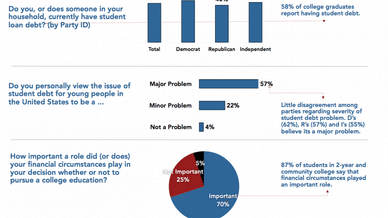
More than two-in-five (42%) Millennials between 18- and 29- years olds report that they, or someone in their household has student load debt; 48 percent indicated that they had no debt. Unlike most questions in our survey, there was no statistical difference based upon age, gender or political party affiliation.
Do you, or does someone in your household, currently have student loan debt?
7-in-10 Say That Financial Circumstances Played An Important Role in College Decision
Regardless of whether or not they have debt, 57 percent of Millennials under 30 believe that student debt is a major problem for young people in the United States -- and another 22 percent believe its a minor problem. Overall, 79 percent say its a problem, four percent say it is not a problem.
In total, 70 percent of our sample reported that financial circumstances played an important (41% very, 29% somewhat) role in their decision whether or not to pursue a college education.
Financial pressures can also influence how young adults manage their everyday spending, particularly when it comes to digital entertainment. For those aged 18 and over, online activities such as gaming, streaming and browsing mobile casinos ireland may form part of their leisure habits. However, gambling carries financial risks and should never be viewed as a way to repay student loans or improve personal finances. Setting clear spending limits remains essential for maintaining financial stability.
Those who were more likely to say that financial circumstances were important are:
- Community college and two-year college students (87% say it played an important role compared to 70% college students); and
- 18- to 29- year old Blacks (52% say it played a very important role compared to 38% of Whites).
When Millennials were asked who is most responsible for the rising amount of student debt in the U.S., 42 percent said colleges and universities, 30 percent the federal government -- students and state governments were held responsible by 11 and eight percent respectively.
Financial literacy extends beyond student loans and tuition fees to everyday spending decisions. Young adults who use paid online entertainment services should understand the costs and risks involved before committing money. For example, a Casoola casino review for Irish players provides information about deposit requirements, payment methods and gambling conditions. However, casino gambling carries a risk of financial loss and should never be considered a way to manage student debt or cover educational expenses.