The Future of AI: The Shift Begins
It’s pretty obvious to everyone that AI is no longer some distant technology that may or may not change our lives at some point in the future. AI is already reshaping jobs, with 52% of US workers saying that they now use it at work.
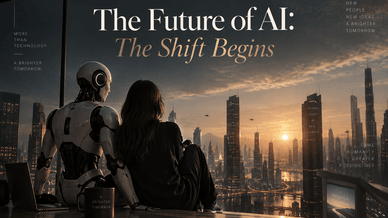
When people ask themselves “What is the future of AI?” they have a tendency to over-focus on either the positives or the negatives. They’ll consider the changing world of work and say that artificial intelligence is either an existential threat or the biggest opportunity of our lifetimes.
But the truth is that AI is neither of these things; it’s simply the new reality. It’s also a tool, and what matters is who uses it, how and for what purpose.
And so with that in mind, we’re not going to look at whether artificial intelligence is a good thing or a bad thing. Instead, we’re going to look at the long-term AI impact and share a few insights on what we can expect to see in the future of AI.
How AI Has Already Reshaped the Workforce
The Numbers That Tell the Story
We’re not going to spend a ton of time here talking about whether or not the latest advancements in AI have had an impact on the workforce, because we already know that they have. In fact, according to Goldman Sachs, around two-thirds of jobs in the US and Europe are exposed to some degree of automation by this technology.
Meanwhile, research from McKinsey has found that current technologies could automate activities accounting for around 57% of US work hours, and if AI advancements continue at the current rate, the future of work could become almost unrecognisable.
There are huge productivity gains from AI, especially in the sectors most affected, like banking, logistics, customer support and content creation, and so it should be no surprise that we’re in the middle of an AI investment boom.
How the Last Three Years Have Changed the Landscape
The last three years have brought a major shift, largely driven by generative AI trends. To understand why, you need to understand the difference between generative AI and traditional automation.

Traditional automation took on repetitive tasks, such as those performed on a factory floor or production line. Generative AI is different because it takes on knowledge work, which has traditionally fallen to human beings. It can create text, images, software and critical analysis.
From early foundation models to today’s wave of creative systems, the speed of progress shows that an AI future is no longer a distant idea. We’re talking about a level of innovation that’s comparable to the Industrial Revolution, but this one seems unlikely to be like any that have come before.
Which Jobs Are Under Threat
Why “White Collars” Are at the Forefront
When we look at the future of AI, the historical assumption has been that white-collar jobs have been reasonably safe. Now, though, we’re seeing that any pattern-based tasks can be automated, or at the very least they can be augmented with digital workflows and remote work automation.
And so if we accept the premise that AI is the future, what does that mean for office workers? Well, AI could disrupt accountancy by analysing financial information and preparing reports. It could do something similar for paralegals and analysts, crunching huge amounts of data in a way that no human could ever compete with.
Meanwhile, translators and call centre workers are at even higher risk of being replaced, because large language models are getting better and better at answering questions or translating information from one language to another. The result is that knowledge workers are actually more vulnerable than physical labourers, not less.
Creative Professions
No investigation into the future of AI could ignore the fact that creative workers like designers and writers are on the frontlines of the battlefield. The latest generative AI trends show that while creativity can’t be faked, it can be imitated pretty well.
For future of AI examples, we just need to look at software developers using AI to create and debug code or media organisations using AI to draft reports or generate accompanying images. Content creators are using it everywhere, from rendering digital graphics to creating background music for videos.
The good news for us mere humans is that AI can’t do everything. There’s no replacement for human originality because AI is ultimately trained to do more of what we’ve already done, making human workers vital for deep investigative work and more intricate jobs like developing a brand voice or even just steering a team of AI agents.
The Jobs at the Highest Risk
With the artificial intelligence latest developments in mind, let’s take a look at a visual summary of a job risk ranking, with the highest risk roles at the top.
- Telephone operators
- Data entry clerks
- Telemarketers
- Customer service representatives
- Proofreaders and copy editors
- Credit analysts
- Translators and interpreters
- Administrative assistants
- Insurance claims clerks
- Market research analysts
- Copywriters
- Graphic designers
- Bill and account collectors
- Legal assistants
- Accountants and auditors
The hope is that this quick reference based on the latest artificial intelligence developments will help you to know whether you’re really likely to be at risk of replacement.
The Jobs AI Will Create in the Coming Years
The Latest Specialisations to Emerge
These artificial intelligence trends mean that a whole range of new opportunities are emerging in next-gen tech. Even if AI makes some jobs redundant, it’s likely to create more than it destroys, potentially making hiring demand rise through the roof. That’s good news for jobseekers, but only those who are willing to show some flexibility when it comes to the kind of work that they do.
There’s even an argument to be made that the latest advancements in AI will lead to an AI skill shortage, because there will be a need for a new generation of workers but not enough people to do the work. Expect to see a surging demand for entry-level data professionals, plus new specialist roles like:
- Prompt engineers: Specialise in providing instructions for AI models
- AI trainers: Help to improve models by evaluating and commenting on their outputs
- AI ethics officers: Responsible for ensuring that organisations are using AI responsibly and ethically
- MLOps engineers: Take care of the infrastructure required to develop and deploy huge AI systems
The Roles AI Will Augment Without Replacing
One of the interesting things about the future of artificial intelligence is that its biggest impact will be felt when it comes to the roles it augments without replacing altogether. These are the roles that require empathy and judgement and where there’s a real human touch advantage. AI is the future, but it can’t be the future without a helping hand from humans.
This kind of trust-based work is particularly common in fields like:
- Healthcare: Including therapy and psychology
- Education: At all levels
- Entrepreneurship: AI tools can help people do a lot with a little by acting as an artificial workforce
- Skilled trades: Electricians, plumbers and other skilled workers will be more efficient with the help of AI
The Jobs of the Future with AI
If you’re concerned about our artificial intelligence future and you’re looking for reskilling inspiration, we’ve got you covered. This list shows what the future for AI professionals could look like and should help you to develop your career roadmap and decide where to specialise so that you don’t get left behind:
- AI Creation: machine learning engineer, systems architect, research scientist
- AI Training: data curator, model evaluator, safety engineer
- AI Business: strategist, product manager, implementation specialist, change manager
- AI Education: teacher, curriculum designer, corporate trainer
- AI Ethics: policy adviser, governance specialist, risk & compliance officer
Will AI Lead to High Unemployment?
History Repeats Itself
When it comes to the future for AI, people love to speculate that it will lead to mass unemployment. When we look at lessons from history, though, we see that technological revolutions rarely produce permanent joblessness. For example, mechanised production created factory jobs and spawned entire industries, while computers eliminated clerical tasks but created the global IT industry that we have today.
And so while we know that AI is the future, we also know that innovation cycles tend to play out in the same way, with machines taking over routine tasks while new occupations and industries pop up to fill the gaps this technology creates. This is what long-term adaptation is all about. As human beings, we’re good at finding something to do.
What the Data Actually Shows
Don’t just take our word for it, though. When we look at AI advancements and try to understand the labour market shifts that they’ll lead to, one option is to look at existing economies that are already highly automated.
For example, Germany, Japan and South Korea haven’t experienced mass unemployment despite being highly technological, although we should also acknowledge the role that policy responses have played in helping people to rise to the reskilling challenge that the latest developments in artificial intelligence will inevitably lead to.
According to the World Economic Forum’s Future of Jobs Report 2025, 92 million jobs are expected to be displaced worldwide by 2030. That sounds like bad news until you consider that the same report projects the creation of 170 million new jobs over the same period.
Who Will Be Affected the Most?
We’ll all be affected by the changes coming from the future of AI, but there are certain job roles and industries that will be more affected than most. People in knowledge-based roles with a large amount of routine could be particularly affected by the AI future if their employers adopt AI faster than they’re able to adapt.
This highlights the need for training programmes in the workplace, because without them, there’s a chance that we’ll end up with a digital divide, especially with the 45–60 age bracket caught in the middle of the old way of doing things and the new. There could also be a social risk, with certain underprivileged sectors of society unable to access AI opportunities.
Three Scenarios for the Future of Work by 2035
Scenario 1 — Optimistic: "The New Renaissance"

The most optimistic view of the future of AI is one in which AI handles the routine and allows humans to focus on creativity. This is essentially the original vision of the AI future from decades ago.
In this scenario, human beings would enjoy a productivity dividend whereby they can work smarter instead of harder, with a creative work focus and a priority on doing the jobs that require human connection. At the same time, we’d be able to put our wellbeing first, meaning that a four-day work week could become standard and incomes could rise at the same time that working hours fall.
Scenario 2 — Realistic: "The Painful Transition"
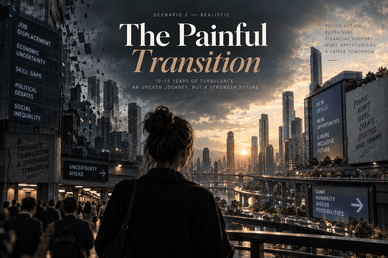
Of course, while the optimistic scenario is all well and good, most analysts looking at the future of artificial intelligence tend to prefer a more realistic approach. In this scenario, the incoming artificial intelligence trends will lead to 10–15 years of turbulence and an uneven distribution of the gains and benefits.
Under this scenario, governments will be forced to act, with political debates leading to social safety nets such as large-scale retraining programmes and financial aid for those who are negatively affected. It won’t be easy, but it will be inevitable, and you’ll have help withstanding the storm.
Scenario 3 — Pessimistic: "Winner Takes All"
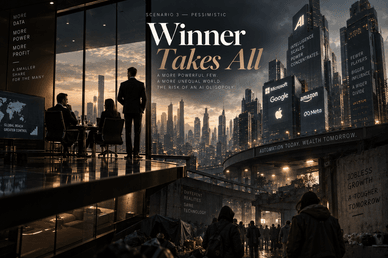
The most pessimistic scenario for the future of AI technology sees an AI oligopoly in which the productivity increases that AI has to offer are disproportionately harvested by big tech companies. Already powerful companies will become even more powerful, while workers will see little improvement.
In this version of the future for AI, we’ll see jobless growth around the world, even in the leading AI nations. However, there will also be a global divide, with vulnerable sectors and developing economies being hardest hit. Without a concentrated effort from financial institutions and world leaders, we’ll see a situation in which AI is creating a huge amount of wealth but few people have the opportunity to access it.
What to Do Right Now: Your Personal Strategy in the Age of AI
Skills That Will Never Go Stale
And so with everything we’ve covered about the future of AI, the big question now becomes that of how we can survive when AI has impacted every aspect of our lives. The good news is that the future for AI leaves plenty of room for human-AI collaboration, and the key will be to learn how to work with AI as a tool, rather than fighting against it.
To do this, we’ll need to focus on continuous learning, and that will take us above and beyond just learning how to use the latest chatbot or which prompts are most popular on social media. One of the biggest trends will be the need for meta-skills, such as the ability to learn any new skill that’s needed at a rapid rate.
Then there are the most human skills of all, such as the ability to display emotional intelligence, to adapt to new challenges, to communicate from person to person and to think critically.
What to Learn and Which Tools to Use
One of the challenges of the rapid rate of artificial intelligence developments is the fact that we can’t just provide you with a list of tools to learn that will serve you for the rest of your career. Instead, the key is to get used to keeping your eye on the latest generative AI trends and to take advantage of accessible education options that are already out there.
Still, here are a few practical steps you can take towards DIY reskilling for the AI revolution:
- What to Learn: AI fundamentals, how to engineer prompts, basic automation, critical thinking
- Tools to Master: ChatGPT, Google Gemini, Excel, Google Sheets
- Resources to Use: Coursera, fast.ai, Google’s free machine-learning courses
How Businesses Can Adapt
For businesses that want to stay on top of the latest advancements in AI, the key is to have the right attitude and to focus on responsible AI adoption. It’s not an opportunity to cut costs by laying off employees, because that will end up costing more in the long term.
Instead, the companies that thrive in the future of AI technology will have a focus on change management and a talent strategy in place to encourage employees to reskill. They’ll understand that the best AI tools depend upon what you’re trying to achieve and that the key to success is to empower people to make intelligent choices rather than to dictate what they should and shouldn’t do. For inspiration, look at companies like AT&T, which has committed a huge amount of resources to training and reskilling.
AI Won’t Take Your Job, But Skilled AI Users Will
As we’ve discussed in today’s article, AI is the future whether we like it or not. With that said, it’s neither an apocalyptical event nor a guarantee of a future Utopian society. Instead, it’s a technological tool that’s bound to bring disruption but which could ultimately create more opportunities than it destroys if history is anything to go by.
Answering “what is the future of AI” isn’t easy, and we looked at three different scenarios that could come to pass in the next ten years or so. The future is almost impossible to predict, and so the best next steps are to prepare yourself for it as much as possible by developing critical thinking skills and focusing on the creativity that can only be displayed as a human being.
That’s it from us, but we’d love to hear from you to keep the conversation going. How do you think AI will change the world of work? Be sure to let us know with a comment.