Roman Baths
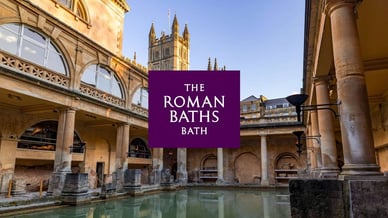
The Roman Baths are a well-preserved Roman bathhouse and temple complex in the centre of Bath. Today, visitors to the site can see the Sacred Spring, the Roman Temple, the Great Bath, the bathhouse facilities and a museum housing archaeological finds. However, it is not permitted to bathe in the ancient pools: the complex operates as a historic monument and museum.
Original Roman name | Aquae Sulis |
Location | Bath, England |
Coordinates | 51.3809°N 2.3595°W |
Address | Abbey Church Yard, Bath BA1 1LZ |
Construction started |
|
Construction completed | 1897 |
Architect (museum building) | John Brydon |
Temperature of the thermal water | 46°C (115°F) |
Depth of the Great Bath | 1.6 metres (about 5.2 feet) |
Restaurant | Pump Room Restaurant |
Opening hours |
|
Tickets |
|
Parking |
|
Official website |
General description of the baths
The Roman Baths are situated in the centre of Bath, next to Bath Abbey. The complex lies below modern street level and comprises four main sections: the Sacred Spring, the Roman Temple, the Roman Bath House, and a museum housing archaeological finds.
During the Roman era, the town of Aquae Sulis developed here, associated with the cult of the goddess Sulis Minerva. The Romans established themselves in the area around 60 – 70 CE, and the bath and temple complex took shape gradually. It was visited by both the town’s inhabitants and pilgrims travelling from various parts of the Roman Empire.
The museum displays a gilded bronze head of the goddess Sulis Minerva, which was discovered nearby in 1727.
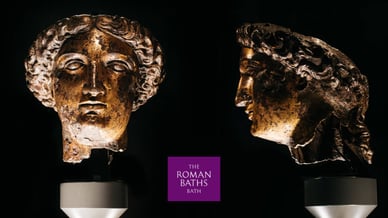
The Roman Baths – The gilt bronze head of the goddess Sulis Minerva
At the centre of the complex lies the Sacred Spring – a natural hot spring which was the main place of worship. The water rises from deep within the earth and emerges at a temperature of around 46 degrees. The Romans channelled it into a system of pools and used the baths for relaxation, socialising and religious rituals.
It is noteworthy that the modern visitor experience is shaped by Victorian architecture. Today, visitors look down on the Great Bath from a terrace built in the 19th century, which sits at modern street level.
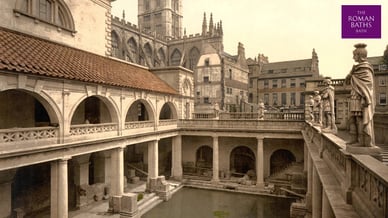
The Roman Baths (late 19th century)
In Roman times, the Great Bath was at the ground level of the complex and was eventually enclosed by a massive barrel-vaulted roof.
After the Romans left, the buildings gradually fell into ruin, and their remains remained hidden beneath the city for a long time. Archaeologists began actively investigating the complex in the 19th century. The Roman baths themselves were discovered in 1880, and the modern museum opened in 1897.
The museum collection
The Roman Baths Museum houses thousands of archaeological finds from pre-Roman and Roman Britain.
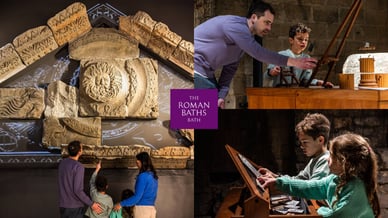
The Roman Baths – The museum’s collection
The list of key exhibits includes:
- The gilt-bronze head of the goddess Sulis Minerva;
- The temple pediment and the Gorgon’s head;
- The Roman curse tablets;
- The Beau Street Hoard.
A separate exhibition is dedicated to the Beau Street Hoard – a collection comprising 17,660 silver Roman coins, discovered in 2007. The coins date from 32 BC to 274 AD. They were found in eight separate pouches, which had become fused together over time. Today, the hoard is on permanent display in an interactive exhibit within the People of Aquae Sulis Gallery.
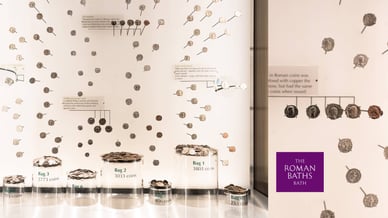
The Roman Baths – The Beau Street Hoard
The Pump Room Restaurant
The Pump Room Restaurant is one of the most elegant establishments in the UK, situated in a historic neoclassical hall directly above the Roman Baths.
In the past, it was frequented by such famous figures as Jane Austen and Charles Dickens. Today, you can enjoy breakfast, brunch, or lunch at the restaurant, or indulge in the celebrated Jane Austen Afternoon Tea, featuring fine sandwiches, warm handmade scones, and delicate pastries. While it primarily operates during the day, the restaurant also hosts special seasonal evening dining and recital events throughout the year.
During your visit, you can try the hot mineral water from a special spa fountain: it contains 43 minerals and has a distinctive, iron-rich flavour.
The historic Pump Room Trio or a resident pianist provide a delightful musical atmosphere as you dine.
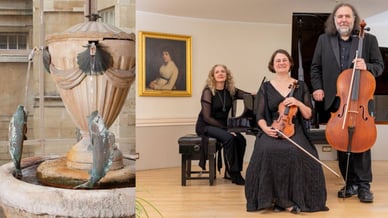
The Pump Room Trio
The Roman Gym
The Roman Gym is a space dedicated to physical exercise in the Roman baths. In this part of the complex, visitors could engage in physical exercise before visiting the baths. This practice fit well with the Roman tradition of combining physical activity with a visit to the thermae.
Here, you can admire the remains of a paved courtyard, an ancient sauna, and one of the best-preserved Roman doorways in Britain.
Projections depicting Romans during their workouts help visitors imagine what this place looked like in the past. Audio commentary explains the exercises, the Romans’ attitude toward physical health, and the medical beliefs of that era.

Discover how the Romans Exercised at The Roman Baths
Weddings at the Roman Baths
The Roman Baths are available for rent for wedding ceremonies and receptions. Newlyweds are invited to exchange vows next to the Great Bath – a historic hot-water pool that is illuminated by torches in the evening.
The ceremony can take place before the museum opens or after it closes, when the space is available for private events. Afterward, a reception can be held in the Pump Room or on the Terrace.
Wedding Open Evenings are regularly organized for engaged couples, during which they can tour the available spaces and learn more about planning their event. The dates for these events vary, so it’s best to check the official website for details.
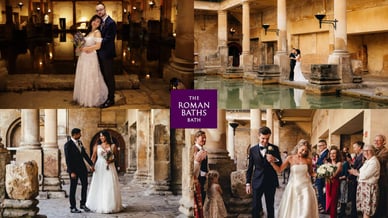
Weddings at the Roman Baths
The Roman Baths are not just a tourist attraction, but also an active venue for private events. In addition to weddings, the site hosts receptions, dinners, and small business meetings. During the day, the Kingston Room and the Drawing Room are available for rent, and in the evening, after regular visitors have left, additional spaces within the complex open up.
Tickets
Ticket prices for the Roman Baths vary depending on the time of year, so it is advisable to book your visit in advance during the tourist season. An audio guide is included in the admission price.
A one-hour guided tour can be booked separately for £8.00 per person.
1 September – 31 October 2026:
Ticket type | Weekday | Weekend (Holiday) |
|---|---|---|
Adult (19+) | £26.50 | £29.00 |
Student | £25.50 | £28.00 |
Senior (65+) | £25.50 | £28.00 |
Child (6–18) | £19.50 | £22.00 |
Family (2 adults + 2–4 children) | £69.00 | £77.00 |
Family (2 adults + 1 child) | £63.00 | £70.00 |
Family (1 adult + 2–4 children) | £51.00 | £57.00 |
A ticket bought on the day of your visit costs £2.00 more.
Opening hours
For most of the year, the Roman Baths are open daily from 09:00 to 18:00. It is worth checking the opening hours for your specific date before you visit, particularly if your visit falls during the festive period. The site is closed on Christmas Day and Boxing Day.
Reviews
The Roman Baths receive very high ratings from visitors: on TripAdvisor, the attraction has a score of 4.6 out of 5 based on over 24 000 reviews and ranks first amongst Bath’s attractions on the site.
Visitors often highlight the well-preserved ruins, interesting museum exhibits and the audio guide, which is included in the ticket price. However, reviews regularly mention the high admission price and large crowds. Many recommend allowing around 1½–2 hours for the visit and booking a time slot in advance.
Laura:
Brilliant! This place is definitely worth a visit! It’s steeped in history, and everything is so well explained and presented in an informative way. I could have wandered around there for hours, taking it all in! An incredible experience!
Paul:
It’s a wonderful place to visit, but you should book your tickets in advance for a time that suits you. However, we arrived a few hours early, and as there weren’t many visitors, they let us in anyway. We’d also booked a guided tour in advance and, thanks to the low number of visitors, were able to join the previous group. Our guide was Iris — she’s simply incredible. She’s incredibly knowledgeable, passionate about Roman history, and it was a real pleasure to listen to her.
Contact details and location
The Roman Baths are situated in the very centre of Bath, next to Bath Abbey.
Address: The Roman Baths, Abbey Church Yard, Bath BA1 1LZ
Telephone: +44 (0)1225 477785
Ticket enquiries:
Group and accessibility bookings:
Collection enquiries:
Press enquiries:
Social media


FAQ
Where are the Roman Baths?
The Roman Baths are located in the centre of Bath, at Abbey Church Yard, Bath, BA1 1LZ, next to Bath Abbey. It is about a 5–10-minute walk from Bath Spa station.
How old are the Roman baths?
The complex dates back some 2,000 years. Construction of the temple and bath complex began during the Roman era, in the 1st century AD, around a natural hot spring.
How much does it cost to visit the Roman Baths?
From 1 September to 31 October 2026, an adult ticket costs £26.50 on weekdays and £29.00 at weekends and on Bank Holidays. A child’s ticket (aged 6–18) costs £19.50 on weekdays and £22.00 at weekends.
What is the water temperature at the Roman Baths?
The water rises to the surface at a temperature of around 46 degrees Celsius.
Is it allowed to swim in the Roman Baths?
No. You must not swim in, or even touch, the water in the Great Bath: it is untreated and unsafe for swimming.