Sheikh Zayed bin Sultan Al Nahyan: The Father of a Nation
"A man of strong build with a brown beard. His face shows a sharp intelligence, and his piercing eyes are highly observant. He has a calm manner and a strong personality." (British explorer Wilfred Thesiger on Sheikh Zayed bin Nahyan, may God have mercy on him)
Sheikh Zayed bin Sultan Al Nahyan ranks among the most prominent Arab leaders in the modern Middle East. With rare wisdom and keen vision, he turned barren desert into a green paradise. As the founder of the UAE's renaissance, he built a modern state out of scattered emirates. His vision went beyond building cities and raising skyscrapers. It extended to building the Emirati people themselves, as he gave priority to education, health, and culture. He made the UAE a model for other Gulf countries and beyond. All-round development brought growth and progress to every field.
Sheikh Zayed, may God have mercy on him, believed that a true leader puts his people's interests above all else. "True wealth is the wealth of men, not money and oil," he said. Following this approach, he founded the United Arab Emirates and turned a desert region into a globally advanced state. He became known for his wisdom, his forward-looking vision, and his care for the environment and education. These qualities made him a symbol of unity and progress in the Middle East. He was an inspiring leader in the full sense of the word. His great legacy still shapes the UAE's path to this day. This overview of Sheikh Zayed follows his path from Al Ain to the presidency of the union.

Sheikh Zayed portrait waving
Who Is Sheikh Zayed? The Founding Father and the Vision of Unity
"The union is the road to strength and the road to dignity, protection, and the common good." (Sheikh Zayed)
Sheikh Zayed bin Sultan Al Nahyan is a symbol of wisdom and the founder of the United Arab Emirates. Emiratis call him the "Father of the Nation." With remarkable political insight, he led the union of the emirates, declared on December 2, 1971. This task was far from simple. It required careful negotiation and a unified strategic vision to bring different entities under the banner of one nation. He also became the first President of the UAE and held the post of head of state until 2004.
Under his rule, the UAE saw radical changes in infrastructure: a modern road network, advanced ports, and international airports. Health and education also received his close attention. He set up hospitals equipped with the latest technology and an education system that met the ambitions of the age. His legacy went beyond material achievements. He also planted values of tolerance and coexistence that made the UAE a regional symbol of cultural diversity.
His years in power as head of state saw great achievements. These included infrastructure development, a stronger economy, and the creation of an integrated education and health system. He showed special interest in the environment and sustainability. That made him a pioneer in nature conservation. His legacy is still alive today. The UAE celebrates Sheikh Zayed's achievements every year, and his policies continue to shape the country's future.

Sheikh Zayed Grand Mosque
Sheikh Zayed's Early Life and Character
"The new generation must know how much the generation before it endured." (Sheikh Zayed, may God have mercy on him)
Sheikh Zayed's life began on May 6, 1918, in the city of Al Ain. Al Ain city was then a green oasis full of life amid the arid desert of the Emirates. There, hard experiences toughened Sheikh Zayed in his youth and taught him strength. He came from the Bani Yas tribe, one of the most prominent tribes in the region. His mother was Sheikha Salama bint Butti Al Qubaisi.
Sheikh Zayed's upbringing in a harsh environment built his patience and independence. Through the values of justice and equality, his father, Sheikh Sultan bin Zayed, left a deep mark on him. Sheikh Zayed's childhood was full of varied experiences that enriched his character. Hunting trips, for example, brought him back into nature's embrace and taught him resilience and adaptability.
Sheikh Zayed's father, Sheikh Sultan bin Zayed, influenced him deeply. He instilled the values of leadership and justice in his son, and these values became a beacon on his path. The children of Sheikh Sultan bin Zayed included four sons, and Zayed was the youngest. Sheikh Shakhbut bin Sultan, the eldest of Sheikh Zayed's brothers, also influenced him. Shakhbut ruled the Emirate of Abu Dhabi before him and taught his younger brother the arts of leadership and administration. This period shaped him as a leader and planted love for his homeland and people in his heart. It became the cornerstone of his philosophy of governance, which stood out for wisdom, compassion, and a forward-looking vision.
Education and Culture: Between Tradition and Modernity
"The true asset of any advanced nation is its educated sons and daughters." (Sheikh Zayed, may God rest his soul)
Sheikh Zayed bin Sultan Al Nahyan studied at the kuttab, a traditional Quranic school. There he immersed himself in the Holy Quran, Arabic literature, and the principles of Islamic jurisprudence. Although he never attended modern formal schools, he gained great experience from practical life. He drew on the wisdom of the tribal sheikhs of the Emirates and learned the arts of leadership. His passion for knowledge burned like a flame and pushed him to focus on developing education. He believed that education was one of the main pillars of building a state.
Even though Sheikh Zayed's education was not advanced or formal, he was an avid reader and a lover of knowledge. He found inspiration in majlis gatherings of scholars and the sheikhs of the Emirates, open forums for learning and debate. Arabic poetry was a true passion of his and became an integral part of his culture. He filled his library with collections by Arab poets, both classical and contemporary. This blend of heritage and modern knowledge made him a remarkable leader. He could connect with every part of society and used the wisdom of history to shape the modern state.

Political Career: From Al Ain to Abu Dhabi to the Union
"The union lives in my soul and in my heart. It is the dearest thing in my existence." (Sheikh Zayed, may God have mercy on him)
In 1946, Sheikh Zayed bin Sultan became the Ruler's Representative in the Eastern Region, based in Al Ain. There he began deep reforms. His efforts to improve the traditional irrigation system, known as aflaj, helped agriculture flourish. In Al Ain, he also set up the emirate's first government school and hospital. He also strengthened security and stability in the area, which made Al Ain a symbol of wise, effective administration.
Governing the City of Al Ain
Colonel Hugh Boustead, the British political agent in Abu Dhabi, described the social life of the people in that era in his book "The Wind of Morning." He also wrote about how the people rallied around their leader and stayed loyal to him: "I was greatly struck by the crowds that always gathered around him in the Buraimi Oasis and surrounded him with respect and attention... He always spoke kindly to everyone and was very generous with his money... I was struck at once by all he had achieved in his town of Al Ain and across the whole area for the good of the people. He had dug channels to bring more water to irrigate the gardens, sunk wells, and built concrete structures at the aflaj where people could bathe."
British Captain Anthony Shepherd also recorded his impressions of Zayed from that period in his book "Arabian Adventure":
"He won the admiration and loyalty of the Bedouin who lived in the surrounding desert and the Buraimi Oasis. Without doubt, he was the strongest personality in the Trucial States... I used to visit him every week at his fort. If I came in with respect, I left with even greater respect... He was one of the few great men I have met. If we did not always agree, the reason was my own ignorance."
On August 6, 1966, Zayed became ruler of the Emirate of Abu Dhabi and led its radical transformation. At the time, its capital city, like other parts of the emirate, was a barren, sandy desert island. Gulf waters surrounded it on all sides. It held only a few scattered houses, most of them made of palm fronds. The city lacked even the simplest services, such as roads, water, electricity, schools, hospitals, and other essentials that residents needed.
Ruling the Emirate of Abu Dhabi
As ruler of the emirate, he prioritized building roads and bridges between the island and the mainland. He also set up schools, homes, and medical services, and built a port and an airport. The emirate changed beyond recognition. It filled with activity, and the sound of machines echoed everywhere. Many people moved from "huts" into modern houses, and paved roads reached deep into the desert. Water and electricity came to every home. Traditional learning grew into a modern education system, and schools of every level spread across the country. New literacy classes opened for those who had missed school. Clinics began serving desert Bedouin who had long gone without health care. These efforts made up for years of falling behind.
Founding the United Arab Emirates
The Emirate of Abu Dhabi began exporting oil in 1962. Zayed invested oil revenues in schools, hospitals, and roads, and this laid the groundwork for a broad renaissance.
Unity efforts sped up decisively in January 1968, when Britain announced its plan to end its protection of the Trucial States by the end of 1971. That decision made union an urgent matter of survival. In response, Zayed held a historic meeting with Sheikh Rashid bin Saeed Al Maktoum, then ruler of Dubai. It took place at Argoub Al Sedirah on February 18, 1968. There, both leaders agreed to form the core of a union and invite the other emirates to join. The first talks also included two other Gulf countries, Bahrain and Qatar, in a bid for a nine-member union. Both later chose independence.

Sheikh Zayed and Sheikh Rashid
The declaration of the United Arab Emirates, formed by six emirates, came on December 2, 1971. The country marks that date every year as UAE National Day. Ras Al Khaimah joined on February 10, 1972. Sheikh Sultan Al Qasimi has ruled Sharjah, one of the six founding emirates, since 1972. It became one of the most successful federal experiments in the region. The UAE's founder also helped found the Gulf Cooperation Council, which brought six Gulf countries together in 1981.
Cultural and Literary Legacy
"Knowledge and culture are the foundation of a nation's progress and civilization, and the cornerstone of nation-building." (Sheikh Zayed, may God rest his soul)
Alongside the Sheikh's achievements in politics and development, he was also a poet. His verses reveal a deep love for the homeland and high human values. Simple language and weighty meaning marked Sheikh Zayed's poems, which blended pride in heritage with calls for progress and prosperity. One of his best-known poems reads:
"My country, home of goodness and palm trees, I have lived proudly between the sands and the mountain."
These lines show his deep bond with the land of the Emirates, whose sands and mountains filled him with pride.
One of Sheikh Zayed's famous quotes describes Arab unity: "The Arabs are one nation, and division is a wound on the brow of time." His poetry also reflected a wise philosophy of rule based on justice, wisdom, and service to citizens. His poems remain carved in the collective memory of Emiratis. Two official collections, Diwan (2023) and Treasured Sayings (2026), gather them.
The Father of the Nation had a political vision, and he was also a poet. His words carry his love for the homeland and his wish to strengthen Arab solidarity. They also reflect his efforts to establish the values of generosity and chivalry. Clear wording and deep meaning set his poems apart. He skillfully joined pride in heritage and belonging to the land with his calls for unity and progress. In other poems, he described the leader's role in serving his people. One line reads: "The ruler is a servant of his people, and goodness is built by hands and mind."
Qualities and Hobbies
"Falconry is an important sport and a way to learn patience and endurance. It benefits both mind and body. As a social sport, it brings travel companions together in a shared team spirit." (Sheikh Zayed)
Sheikh Zayed bin Sultan Al Nahyan had unique leadership and human qualities. They made him a symbol of wisdom and sound leadership in the Arab world. Sheikh Zayed's qualities became known: great wisdom in running state affairs and deep humility with people. Without formal barriers, he met citizens and listened to their requests in person. His generosity reached beyond the UAE to many Arab countries and the wider Islamic world. In 1992, he founded the Zayed bin Sultan Al Nahyan Charitable and Humanitarian Foundation, according to WAM. He also had a keen vision of the future and a rare talent for turning challenges into development opportunities.
On a personal level, Sheikh Zayed's hobbies included authentic Arabic poetry. He enriched the Arabic library with poems full of love for the homeland and noble values. The heritage of falconry was another passion, and he saw it as a core part of Emirati identity. In 1995, he launched the Sheikh Zayed Falcon Release Programme. Farming and tree planting were personal interests of his. He made a point of following projects that turned desert into green oases himself. Until his last days, he kept a simple life and cared little for appearances. He believed that true strength lies in serving the people and building people before buildings.
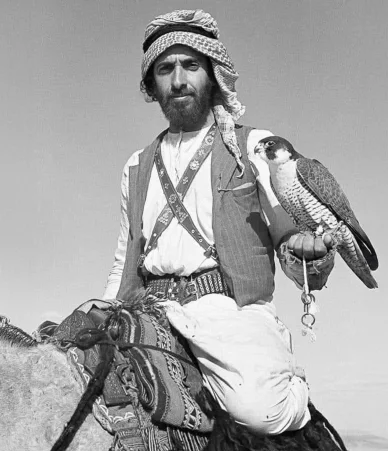
Sheikh Zayed with a falcon
Care for the Environment: A Vision Ahead of Its Time
"For us... protecting the environment is not merely a slogan or words empty of meaning. Rather, it is... an integral part of our history, our heritage, and our way of life." (Sheikh Zayed)
Sheikh Zayed Al Nahyan was a pioneer in protecting the environment. He launched large-scale tree-planting projects, such as the mangrove forest in Abu Dhabi, along with active campaigns against desertification. To protect endangered species such as the Arabian oryx, he set up nature reserves. He also created nature reserves to protect wildlife.
The bond between Sheikh Zayed and the environment won global recognition. After his death, the United Nations crowned his efforts with the Champions of the Earth award. The prize recognized his great environmental contributions, one of Sheikh Zayed's most important achievements. This is the UN's top global environmental honor. The UN gives it to outstanding leaders from government, civil society, and the private sector. These leaders inspire, advocate, mobilize, and act to meet the biggest environmental challenges.
According to UNEP, the United Arab Emirates planted 100 million trees under his guidance. His work went beyond the UAE and included support for environmental projects in Arab countries and Africa. This reflected his global vision of sustainability. He often said, "Give me agriculture, and I will give you civilization." This belief led him to devote a large part of the state budget to tree planting and the fight against desertification.
Sheikh Zayed's Family and Legacy
"My wealth is the happiness of my people." (Sheikh Zayed)
Zayed left behind a great family legacy. Sheikh Zayed's sons grew into outstanding leaders who made their mark in many fields. Among them is Sheikh Khalifa bin Zayed Al Nahyan, who took power after him. Another is Sheikh Mohammed bin Zayed, the current UAE President, who carries on the path of building and prosperity. The founder had several wives. The most prominent of Sheikh Zayed's wives was Sheikha Fatima bint Mubarak. She played a key role in advancing education and women's empowerment in the UAE.
To Sheikh Zayed's children, he was a father before he was a leader. He passed on to his children the noble values he embraced in public life. These were humility, respect for others, love of learning, and devotion to serving the nation. His constant advice to them was: "The greatest inheritance I leave you is a clean name and a generous homeland." The effect of this deep upbringing showed in the characters of Zayed bin Sultan Al Nahyan's children. After his passing, they raised the banner of development and preserved his glorious legacy with love and pride.
The family tree of Sheikh Zayed bin Sultan includes his grandfather, ruler of the emirate from 1855 to 1909. One of the sons of Sheikh Zayed, Sheikh Sultan bin Zayed Al Nahyan, became Deputy Prime Minister in 1990. The death of Sheikh Sultan bin Zayed in November 2019 led to three days of official mourning in the UAE. The family of Sheikh Zayed bin Sultan also includes his grandson Sheikh Sultan bin Khalifa.
Honors and Remembrance
"Zayed is without doubt the strongest personality in the region. He is one of the few great men I have met." (Captain Anthony Shepherd)
The memory of Sheikh Zayed, may God have mercy on him, lives on in many ways. Sheikh Khalifa declared 2018 the Year of Zayed to mark 100 years since his birth. That year, the Ministry of Economy organized Zayed Day for Humanitarian Action. Portraits, memorials and drawings of Sheikh Zayed appear across the Emirates, which confirms the greatness of his legacy. Since 2018, the Founder's Memorial in Abu Dhabi has displayed The Constellation, a 3D portrait of him. Prestigious awards also bear his name, such as the Zayed Sustainability Prize, which spotlights environmental achievements worldwide. The Sheikh Zayed Festival in Al Wathba also carries his name. The Zayed National Museum, which opened in the capital in December 2025, presents his life and leadership. In 2026, TIME named it one of the World's Greatest Places.

Statue of Sheikh Zayed
Sheikh Zayed, may God rest his soul, died on November 2, 2004. His tomb lies on the grounds of the Sheikh Zayed Grand Mosque in Abu Dhabi. Yet his legacy remains rooted in UAE policy, and his vision keeps guiding the country toward a more prosperous future. After his passing, his memory never left the hearts of Emiratis and people across the Arab countries. Since 2013, the UAE has marked Zayed Humanitarian Day on 19 Ramadan, the anniversary of his death.
Traces of his work appear in every corner, every school, and every development project. His name became a symbol of giving and devotion. School curricula present the life story and biography of Sheikh Zayed as a model of wise leadership to follow. Awards and institutions named in his honor keep alive his ideas and his vision of a better future for humanity. Abu Dhabi International Airport became Zayed International Airport on February 9, 2024.
A Lasting Legacy
On December 2, 1985, the union's 14th anniversary, Zayed gave an interview to the Emirates News Agency. He expressed satisfaction with how stable the federal project had become. As he put it: "Thank God, we feel relieved and glad that the union is moving along the right path. The UAE moves with it from one stage to another and has become a source of pride for everyone. This pride comes from the achievements made on the soil of this nation. They grew from the belief that the union alone guarantees lasting security and prosperity in this part of the Arab world. This belief puts the union's interests above all other interests... Our UAE experience of unity clearly proves that unity and solidarity are the source of all strength, honor, and pride... With wisdom, patience, and faith in God and the nation, we have taken swift steps toward progress on this path. That is because we are certain unity and solidarity are the two wings of strength for the region's peoples."
For his people, Sheikh Zayed bin Sultan Al Nahyan remains a symbol of wise leadership, noble humanity, and love of country. Sheikh Zayed's achievements went beyond politics and the economy to include culture and literature. He left a poetic legacy that pulses with his values and principles. Today, Sheikh Zayed's quotes and poems still light the way for new generations. His vision remains a beacon that lights up the future. This article about Sheikh Zayed has traced that vision from Al Ain to the union. Days pass and generations change, but Sheikh Zayed's legacy stays rooted in the nation's conscience.
He was more than a ruler: a wise philosopher, an inspiring poet, a great reformer, and a father to all. We see the UAE in a respected place among advanced nations. Its sons and daughters carry the banner of excellence in every field. This embodies the vision of the founder of the UAE's renaissance, who believed in his people's abilities. Every piece of information about Sheikh Zayed points to a life devoted to serving humanity. In his own words: "The greatest investment of wealth is in building generations of educated and cultured people." This is the essence of his lasting legacy.

Frequently Asked Questions
The answers below sum up the key facts about Sheikh Zayed from this article.
Where Was Sheikh Zayed Born?
Sheikh Zayed was born in Al Ain, which was an important center for the Bani Yas tribe. The city is currently part of the Emirate of Abu Dhabi.
When Was Sheikh Zayed Born?
Sheikh Zayed's date of birth is May 6, 1918. The United Arab Emirates marked the centenary of Zayed bin Sultan Al Nahyan's birth on May 6, 2018.
When Did Sheikh Zayed Die?
Sheikh Zayed, may God have mercy on him, passed away on November 2, 2004. His rule had lasted more than three decades. He was 86 years old.
Why Did People Love Sheikh Zayed?
People loved the UAE founder for his wisdom, generosity, and care for them. They also loved his forward-looking vision, which made the United Arab Emirates an advanced country.
Where Is Sheikh Zayed Buried?
He rests in a mausoleum at the Sheikh Zayed Grand Mosque in Abu Dhabi.
How Many Wives Did Sheikh Zayed Have?
Official sources give no single number. Sheikh Zayed married several times, within the Islamic limit of four wives at any one time, according to the Associated Press. The same 2004 report counted more than 20 sons and an undisclosed number of daughters. The most prominent of his wives was Sheikha Fatima bint Mubarak.
What Was Sheikh Zayed's Cause of Death?
The UAE announced no official cause. He had been ailing for several years and had a kidney transplant in August 2000, according to the Associated Press