The Danger of Slips and Falls: Statistics You Should Know
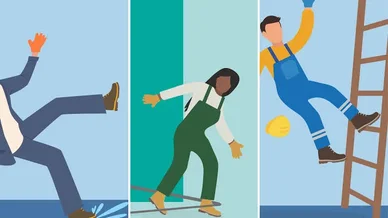
Falls seem like a minor inconvenience — until they land someone in a hospital bed, cost them their job, or worse. The numbers show that slips and falls are one of the most common yet least discussed safety threats, both at home and in the workplace.
The Big Picture
Falls are the leading cause of emergency room visits: over 8 million visits per year, accounting for 21.3% of all cases. By comparison, motor vehicle accidents cause only 11.9% of ER visits. Slips and falls alone account for over 1 million visits (12% of total falls).
Key facts:
- Fractures are the most serious consequence of falls, occurring in 5% of everyone who falls.
- Half of all accidental deaths at home are caused by a fall, most often at ground level rather than from an elevation.
- Floors and flooring materials contribute directly to more than 2 million fall injuries each year (per CPSC).
- Fatal falls are nearly evenly split between men and women, though women more often experience slip-and-fall incidents in general.
Falls in the Workplace
In industry, falls aren't the leading cause of death, but they are the leading cause of lost workdays. Here's why that's costly for businesses:
- 85% of workers' compensation claims stem from employees slipping on slick floors.
- 22% of slip/fall incidents result in more than 31 days away from work.
- Compensation and medical costs tied to employee slip/fall accidents run approximately 707070 billion dollars annually.
- Occupational fatalities from falls are around 600 per year, down from 1,200 in the 1970s.
- Total injury costs from falls are estimated at 131313–141414 million dollars annually in the U.S.
The highest risk of fatal falls occurs in construction, mining, and certain maintenance activities. According to ITT-Hartford Workers' Compensation statistics, falls account for 16% of all claims but 26% of total costs — more than sprains and strains combined.
Interestingly, falls split almost evenly by type:
- Falls from elevation: about 40% of compensable cases, roughly 10% of occupational fatalities.
- Falls on the same level: about 60% of compensable cases.
Older Adults: The Most Vulnerable Group
While falls mostly mean lost time and money for the working population, for older adults they're a matter of life and death.
- One in three Americans over age 65 falls each year, and half of them fall repeatedly.
- In 2005, falls killed more than 15,000 older adults — nearly double the 7,700 recorded a decade earlier.
- Roughly 1.8 million people over 65 are treated in emergency rooms each year due to falls.
- For ages 65–84, falls are the second leading cause of injury-related death; for those 85 and older, they're the leading cause.
Risk increases with each decade of life. 60% of all fall-related deaths occur among people 75 and older, and 67% of fatal falls happen in that same age group. People over 85 are 10–15 times more likely to suffer a hip fracture than those aged 60–65.
The health consequences are especially severe:
- Falls cause 87% of all fractures among people over 65 and are the second leading cause of spinal cord and brain injuries.
- Half of older adults hospitalized for hip fractures never return home or live independently again.
- Falls account for 40% of all nursing home admissions and are the sixth leading cause of death among people over 70.
- More than 60% of nursing home residents fall each year.
According to the National Institute on Aging, 30% of people over 65 sustain a fall each year, with 10% of those resulting in a serious injury.
Why It Matters
These numbers show that falls aren't isolated bad luck — they're a systemic problem that hits businesses through compensation costs, strains healthcare systems through emergency care, and devastates families who lose older loved ones. Unlike casual online searches such as “best online casinos,” fall prevention is about real-world risk management, where simple physical changes can prevent serious injuries and long-term costs. Prevention — from slip-resistant flooring at work to simple home safety measures for aging relatives — remains the cheapest and most effective solution.