Antarctic Tourism in Numbers: What the IAATO Statistics Tell Us
Few places on Earth feel as far from everyday life as Antarctica, and yet more than 100,000 people now travel there every season. For Irish readers, the continent has a particular resonance: Ernest Shackleton was born at Kilkea in County Kildare, and Tom Crean, the farmer's son from Annascaul in County Kerry, survived three of the most famous Antarctic expeditions of the early 20th century. A century on, the people heading south are tourists rather than explorers, and one organisation keeps count of them.
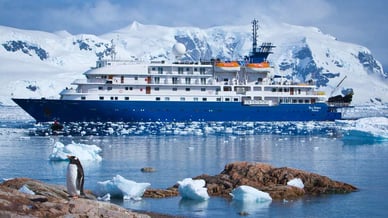
Who Counts the Visitors?
The International Association of Antarctica Tour Operators (IAATO) has been monitoring, analysing and reporting Antarctic tourism trends since 1991, as part of its commitment to the effective self-management of guest activities in the region. Its member operators agree to follow shared guidelines on where ships can go, how many people can land, and how visitors should behave around wildlife, and the association gathers detailed figures every season.
The Numbers: 2023–24 Season at a Glance
IAATO's data page splits visitors into three groups:
Category | 2023–24 visitors |
|---|---|
Cruise-only visitors | 43,224 |
Landed visits | 80,251 |
Deep field visitors | 787 |
Cruise-only visitors travel on larger ships that sail through Antarctic waters without putting passengers ashore. Under IAATO's rules, vessels carrying more than 500 passengers are not permitted to make landings, so this group experiences the continent from the deck.
Landed visits cover passengers on smaller expedition vessels who step onto the continent, usually by Zodiac, to see penguin colonies, historic huts and glaciers up close.
Deep field visitors are the smallest group by far, at under 1% of the total. These travellers go inland by air or overland, for example on skiing, mountaineering or polar-point expeditions, rather than staying along the coast.
A note on the figures: the three categories shown on IAATO's page add up to a little more than the roughly 122,000 headline total for 2023–24 quoted in other IAATO-sourced reporting, so numbers drawn from different IAATO publications may not line up exactly. For analysis or citation, check the definitions in the full IAATO season report.
How Have the Numbers Changed?
Recent seasons have settled at a historically high level, though growth has levelled off:
- 2023–24: around 122,000 total visitors
- 2024–25: 118,491 total visitors, a dip of roughly 5%, which IAATO attributed mainly to one cruise-only operator not sailing that season. The number of passengers actually landing was virtually unchanged.
- 2025–26: secondary reports put the total at around 113,500, a further decline of about 4%. This figure comes from press coverage rather than a published IAATO report, and IAATO now shares detailed data on request rather than publishing it openly, so it should be treated as provisional.
The takeaway: demand hasn't collapsed, but the post-pandemic surge has plateaued, and the mix is shifting as operators adjust capacity and as stricter rules for the largest ships take hold.
The Rules Behind the Numbers
Numbers matter in Antarctica because the continent is both fragile and legally protected. Under IAATO's operating procedures, which have also been written into Antarctic Treaty measures (ATCM Measure 15, 2009):
- No more than 100 passengers may be ashore at one time at any site, unless site-specific guidance sets a lower limit
- Landings need at least one trained guide for every 20 passengers
- Only one ship may visit a landing site at a time
- Vessels carrying more than 500 passengers may not land anyone
Together these rules explain why the "landed" and "cruise-only" categories are tracked separately: they describe two very different levels of impact on the places visitors go.
Ireland's Polar Heritage
For readers in Ireland, the statistics sit alongside a remarkable local story. Shackleton, born on 15 February 1874 at Kilkea House near Athy, led the Endurance expedition. Tom Crean, born near Annascaul in 1877, served on Scott's Discovery and Terra Nova expeditions and then on Shackleton's Endurance voyage, where he was among the party that sailed the lifeboat James Caird to South Georgia. After retiring from the navy, Crean returned home and ran a pub in Annascaul, the South Pole Inn, which still stands opposite his statue and is filled with polar memorabilia. Today's visitors to the Antarctic Peninsula and South Georgia often follow in their footsteps, and many expedition cruises include tributes to both men.
Requesting IAATO Data
IAATO says that, as part of its commitment to self-management, it monitors and reports tourism activity from its inception, and that anyone wanting statistics on tourism in Antarctica can request them by emailing its data team through the button on its Data and Statistics page. When making a request, you'll be asked to provide specific details about what you need, so it helps to be clear about the seasons, categories and purpose.
The Bottom Line
With well over 100,000 visitors a season, Antarctic tourism is small compared with most travel markets but large for a continent with no permanent population. The IAATO figures, with 43,224 cruise-only visitors, 80,251 landed visits and just 787 deep field travellers in 2023–24, show a sector dominated by ship-based visits, closely tracked and tightly regulated. As interest from Ireland and elsewhere continues to grow, the numbers, and the rules behind them, will remain the best measure of how lightly or heavily humans are treading on the last continent.