Castle of Good Hope
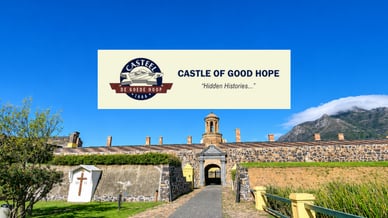
The Castle of Good Hope is an ancient fortress in the centre of Cape Town, built by the Dutch in the second half of the 17th century. It is the oldest surviving colonial building in South Africa and one of the city’s most important historical landmarks. Behind its massive walls, featuring five bastions, lie a courtyard, historic rooms, museum exhibitions and art collections.
Today, the Castle of Good Hope is open to visitors and hosts cultural events, exhibitions and guided tours.
Official name | Castle of Good Hope (Dutch: Kasteel de Goede Hoop; Afrikaans: Kasteel die Goeie Hoop) |
Type | Bastion fort (star fort) |
Location | Cape Town, Western Cape, South Africa |
Coordinates | 33°55′31″S 18°25′37″E |
Address | Corner of Castle and Darling Streets, Cape Town, Western Cape, 8001, South Africa |
Built | 1666 – 1679 |
Founders | Dutch East India Company (VOC); initiated by Isbrand Goske |
Original use | Military base, defensive fortress, replenishment station for VOC ships |
Current use | Historical and military museum, cultural exhibition center, the provincial headquarters for the South African Army in the Western Cape |
Owner | The Government of South Africa |
Architectural styles | 17th-century Dutch Colonial architecture; traditional European bastion fort design |
Architect | Pierius Cool |
Opening hours | Daily from 09:00 to 16:00 (last entry at 15:15) |
Tickets |
|
Parking | Visitors are advised to use the designated car park near the Castle of Good Hope |
Official website |
History of the Castle
The history of the Castle of Good Hope began in 1652, when representatives of the Dutch East India Company, led by Jan van Riebeeck, founded a settlement on the shores of Table Bay. It served as a stopover for ships travelling from Europe to East Asia. Sailors were able to replenish their supplies of fresh water and provisions, and could rest before continuing their long journey.
To protect the settlement, a small fortification made of clay and wood – Fort de Goede Hoop – was initially built. Over time, it became clear that this did not provide sufficient security. In 1666, construction began on a new stone fortress. The work continued for 13 years, and on 26 April 1679, the Castle of Good Hope was completed.
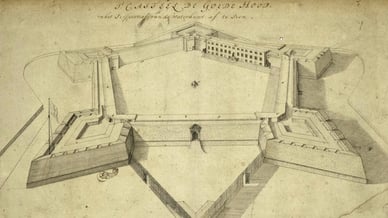
Castle of Good Hope (1680)
Hundreds of enslaved people, sailors, soldiers and members of the Khoi people were involved in its construction. The fortress became the administrative, military and political centre of the Cape Colony. In the centuries that followed, it was used for various purposes, including as a residence for the colony’s leaders, a military installation and a prison.
Despite its imposing walls and artillery positions, the Castle of Good Hope was never attacked. During the British military campaigns for control of the Cape, battles took place outside the fortress: in 1795 at Muizenberg, and in 1806 at Blaauwberg.
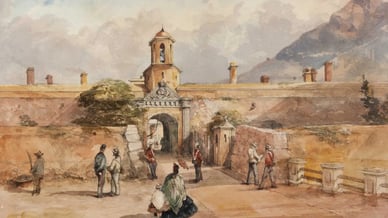
Castle of Good Hope (Thomas William Bowler, 1864)
The Castle of Good Hope was organised as a small, self-contained town. The grounds included a church, a bakery, warehouses, workshops, shops, barracks and prison cells.
In 1936, the building was granted the status of a national monument. In 2016, it was awarded the higher status of a National Heritage Site. Today, it is considered one of the most important sites of South Africa’s colonial heritage.
Architecture
The Castle of Good Hope is built in the shape of a pentagon. At its corners are five projecting bastions, named after the titles of William III of Orange-Nassau: Leerdam, Buuren, Katzenellenbogen, Nassau and Oranje. This design was typical of 17th-century European defensive structures. It allowed artillery to be positioned so that the defenders could fire upon the approaches to the fortress from various directions.
Stone was used in its construction, and the walls were built thick and sturdy. A moat ran around the fortress, which was originally filled with water from a local stream. Inside were barracks, storerooms, workshops, a bakery, a church, living quarters and prison cells. The Castle of Good Hope was not merely a defensive structure, but a self-contained complex capable of supporting the garrison’s daily life.
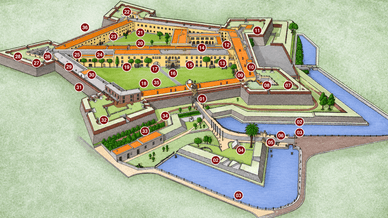
Castle of Good Hope – Layout plan
- Main Entrance & Bell Tower
- Ravelin
- Moat
- Arsenal
- Outer Entrance with Lion Posts
- English 18-Pounder
- Leerdam Bastion
- Restitution Garden
- Vertical Sundial
- Captain's Tower
- Oranje Bastion
- Krotoa Memorial
- Lady Anne Barnard Banquet Hall
- Het Backhuys & Dolphin Pool
- Governer's Quarters & Council Chambers
- Kat Balcony & Kings of the Castle
- Inner Archway
- Front Courtyard
- Slaves Quarters
- Back Courtyard
- Torture Chamber & Dark Hole
- Nassau Bastion
- Centre for Memory, Healing & Learning
- Secunde's Hall
- Ammunition Room in Dungeon
- Jail
- Hotchkiss Signalling Guns' Mounts
- Katzenellenbogen Bastion
- King Cethawayo Detention Area
- Military Museum
- Waterpoort (Original Main Entrance)
- Buuren Bastion
- Garden
- Cape Khoi Kraal Exhibition
- Restaurant
- Sally Port Entrance (Sea Facing)
The distinctive yellow colour of the exterior walls also has a historical explanation: it is believed that this colour was chosen to reduce the impact of the sun’s heat.
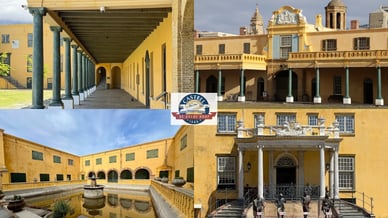
Castle of Good Hope – Facades
Contemporary Use and Tourism
The Castle of Good Hope is now a historic monument, a museum complex and an active cultural venue. Once inside the grounds, visitors can explore the inner courtyards at their leisure, visit exhibitions and take a guided tour.
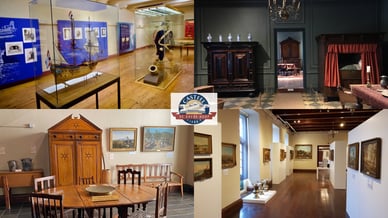
Castle of Good Hope – Exhibition halls
The fortress houses several museum and exhibition spaces:
- Castle Military Museum – an exhibition dedicated to military history and the fortress’s role in the defence of the Cape Colony.
- William Fehr Collection – a collection of paintings, furniture and decorative art associated with the history of the Cape.
- Cape Heritage Museum – exhibitions dedicated to the region’s cultural heritage.
- Camissa Museum – an exhibition telling the story of Camissa’s history and heritage.
- Koena Art Institute – an art space.
Other points of interest include the Krotoa Memorial, dedicated to a Khoi woman, and the former prison quarters. Also worth noting are the Governor’s Quarters, the Council Chambers and the historic casemates.
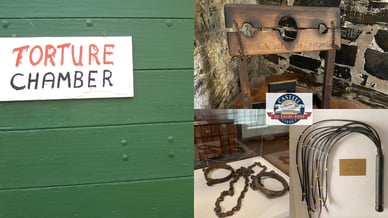
Castle of Good Hope – Torture chamber
Guided tours are available for visitors seven days a week. The programme also includes traditional ceremonies, such as the Key Ceremony – the symbolic opening of the fortress gates – and a signal cannon salute. The holding of these ceremonies depends on weather conditions. It is advisable to check the schedule before your visit.
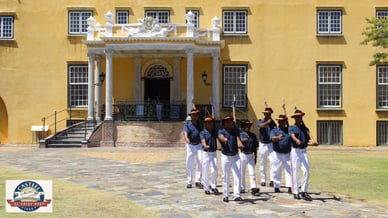
Castle of Good Hope – Key Ceremony
The fortress is also used to host exhibitions, cultural events, community gatherings and workshops. It is not just a museum, but also a venue for experiencing Cape Town’s contemporary culture.
Opening hours
The Castle of Good Hope is open to visitors daily from 09:00 to 16:00. The last tickets are sold at 15:15. The castle is closed to visitors on 25 December and 1 January; on all other days, it is open 363 days a year.
The last ticket can be purchased until 15:15. If you plan to explore the museum collections, the interior and the bastions, it is best to arrive in the morning.
Tickets
Tickets for the Castle of Good Hope are reasonably priced:
Category | Price |
|---|---|
Adults | R50,00 |
Pensioners and children (5 – 17 years) | R25,00 |
Booked school groups (per learner) | R8,00 |
Children under 5 | Free |
Admission prices and conditions for attending special events may vary. We recommend checking the official visitors’ page for information on tickets and guided tours.
Contact details and location
The Castle of Good Hope is situated in the centre of Cape Town, at the junction of Castle Street and Darling Street. Originally, the castle stood on the shore of Table Bay, but due to subsequent urban expansion and land reclamation, it now lies some distance from the coast.
You can reach the attraction on foot from the city centre or by taxi. For motorists, there is a dedicated Castle of Good Hope car park. The entrance is on Darling Street, opposite the CCMA building. The management asks that you do not park on Grand Parade and that you use the designated car park instead.
Address: Corner of Castle and Darling Streets, Cape Town, 8001, South Africa
Telephone: +27 (0) 21 461 4673, +27 (0) 21 461 4676
Email: [email protected]
Social media


FAQ
Where is the Castle of Good Hope?
The castle is situated in the centre of Cape Town, South Africa, at the junction of Castle Street and Darling Street. It is not far from the Grand Parade.
How much does it cost to visit the Castle of Good Hope?
An adult ticket costs R50,00, and a child’s ticket costs R25,00. The admission fee for South African pensioners is R25,00, and for school groups it is R8,00.
What are the opening hours of the Castle of Good Hope?
The fortress is open daily from 09:00 to 16:00. The last tickets are sold at 15:15. It is closed on Christmas Day and New Year’s Day.