Which is the largest stadium in London?
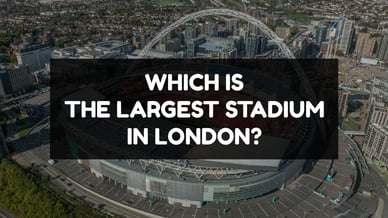
London is considered one of the world’s football capitals – the city is home to clubs from the Premier League, the Championship and the lower divisions, and hosts cup finals, England national team matches and major European tournaments. In terms of the number of famous stadiums, London is hard to compare with any other city: it is home to Wembley Stadium, Emirates Stadium, Tottenham Hotspur Stadium, London Stadium, Stamford Bridge and other major venues.
The answer to the question of which is the largest stadium in London is clear – Wembley Stadium. It is the largest stadium in Great Britain and one of the largest football stadiums in Europe.
Stadium | Capacity | Main use / club | Opened |
|---|---|---|---|
Wembley Stadium | 90,000 | England national team, FA Cup finals, major matches and concerts | 2007 |
Twickenham Stadium (Allianz Stadium) | 82,000 | England national rugby union team | 1909 |
Tottenham Hotspur Stadium | 62,850 | Tottenham Hotspur | 2019 |
London Stadium | 62,500 | West Ham United, football, athletics competitions, concerts | 2011 |
Emirates Stadium | 60,704 | Arsenal | 2006 |
Stamford Bridge | 40,341 | Chelsea | 1877 |
London’s largest stadium – Wembley Stadium
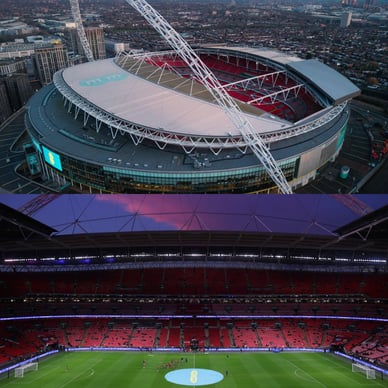
Largest Stadium in UK - Wembley Stadium
Wembley Stadium is the capital of Great Britain’s premier sports venue. It is not merely the largest stadium, but a true symbol of English football. Wembley Stadium hosts:
- England’s home matches;
- FA Cup finals;
- UEFA Champions League finals;
- concerts by global stars;
- NFL London Games.
The stadium has a capacity of 90,000. It is worth noting that the old Wembley was also a record-breaker: before its redevelopment, it held over 100,000 people, and the attendance record in 1923 exceeded 126,000 spectators.
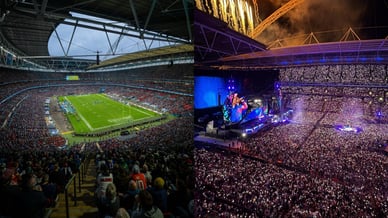
Wembley Stadium Capacity
The modern Wembley opened in 2007 on the site of the old legendary stadium, which had stood since 1923. The new project was so ambitious that the stadium immediately became one of the most recognisable sports venues in Europe.
It is not only the largest stadium in the United Kingdom, but also the second-largest football stadium on the European continent after Camp Nou. It is one of the largest stadiums in the world designed specifically for football.The architects sought to create not just a football stadium, but a national symbol. The stadium was designed with decades ahead in mind: vast stands, state-of-the-art acoustics, a retractable roof and infrastructure capable of hosting events of any scale.
The stadium’s most recognisable feature is the giant steel arch above the roof. It stands around 133 metres high and is approximately 315 metres long. This structure serves two purposes:
- it supports part of the roof;
- it is an architectural symbol of Wembley and of London as a whole.
At night, the arch is illuminated and can be seen from many kilometres away. For fans, it is as closely associated with English football as the red buses are with London itself.

Wembley Stadium Tour - The Home of England Football
Wembley is the official home stadium of the England national team. It hosts:
- qualifying matches;
- UEFA Nations League matches;
- friendly matches;
- major international tournaments.
In addition, Wembley traditionally hosts:
- the FA Cup final;
- the EFL Cup final;
- FA Community Shield matches;
- semi-finals and finals of major UEFA tournaments.
The stadium hosted the UEFA Champions League finals in 2011 and 2013, as well as matches at UEFA Euro 2020, including the Italy v England final. However, the arena is not just about sport, but also cultural events. It is a multi-purpose stadium. Over the years, it has hosted performances by Taylor Swift, Coldplay, Beyoncé, Ed Sheeran, Harry Styles, BTS and many other artists.

Bad Blood - Taylor Swift Live At The Eras Tour Wembley
In addition to music events, Wembley hosts:
- NFL London Games;
- boxing nights;
- wrestling tournaments;
- charity shows and major ceremonies.
Wembley is a hive of activity practically all year round, not just during the football season. England has many famous stadiums, but this one is considered the main one.
Other major stadiums in London
Let’s take a look at some of London’s other major stadiums. We’ll tell you about their history, capacity and the events held there.
Tottenham Hotspur Stadium
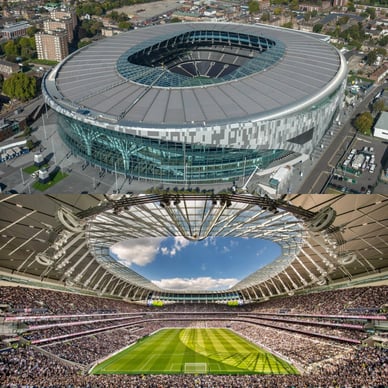
Tottenham Hotspur Stadium Photo
Tottenham Hotspur Stadium is one of the most modern and technologically advanced stadiums not only in London but in Europe as a whole. It opened in 2019 following the demolition of the old White Hart Lane, where Tottenham Hotspur used to play.
In terms of capacity, it ranks among the top three largest stadiums in London, with 62,850 seats. But what makes this arena special is not just its size. It was originally built as a multi-purpose venue:
- the pitch can be ‘extended’ and reconfigured;
- an NFL pitch with artificial turf is hidden beneath the football turf;
- the stands are positioned as close as possible to the pitch, so the sound there is truly deafening.
It is one of the few stadiums in the world that regularly hosts not only football but also NFL matches. To achieve this, it has a separate retractable pitch system — a rather rare and expensive solution.

Inside Tottenham’s £1BN SUPER Hotspur Stadium
Construction costs amounted to approximately £1 billion, making it one of the most expensive stadiums in sporting history. Tottenham Hotspur Stadium is used for:
- Tottenham Hotspur home matches;
- NFL London Games;
- boxing matches;
- concerts by major artists.
In terms of atmosphere, it often rivals Wembley, but in terms of status, it remains a club stadium rather than a national arena.
Emirates Stadium
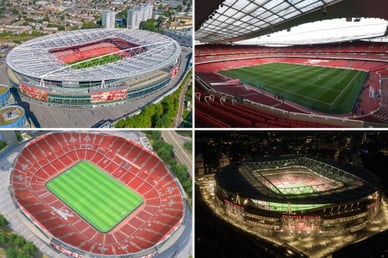
Emirates Stadium
Emirates Stadium is Arsenal’s home ground, which opened in 2006 after the club moved from the legendary Highbury. It has a capacity of approximately 60,704 spectators, making it the fourth-largest football stadium in London after Wembley Stadium, Tottenham Hotspur Stadium and the London Stadium.
The stadium is very modern in every respect; its key features include:
- good viewing angles from every stand;
- well-designed acoustics (although it is noisier than older stadiums);
- convenient facilities for fans.

THE LOUDEST NORTH LONDON FOREVER! | ARSENAL VS REAL MADRID
The construction of the Emirates Stadium cost approximately £390–400 million. At the time of its opening, it was one of the most expensive stadiums in Europe. The Emirates Stadium hosts:
- Arsenal’s home matches in the Premier League;
- UEFA Champions League matches and other European tournaments;
- occasionally, England matches at youth and women’s national team level;
- commercial events and concerts (though football takes precedence).
The atmosphere at the stadium deserves a special mention. After the move from Highbury, fans argued for a long time that the arena lacked ‘soul’. But over time, the Emirates Stadium has nonetheless become a recognisable part of London and one of the city’s most visited football venues.
London Stadium
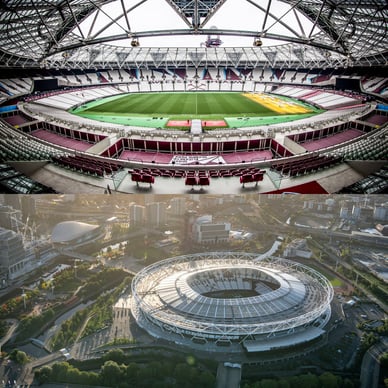
London Olympic Stadium
London Stadium is a stadium with an unusual history. It was built for the 2012 London Olympic Games, and after the Games it was converted for football use. It is now the home ground of West Ham United.
The stadium has a capacity of around 62,500 spectators (for football matches; this may vary depending on the configuration). It is important to understand that this is not a ‘classic football stadium’, but a transformable venue. Its stands can be partially moved and reconfigured.

London 2012 Olympic Park
The pitch is set back from the stands, which is why the atmosphere is sometimes criticised by fans. Other notable features of the London Stadium include:
- movable structural elements for different sports;
- a modern pitch transformation system;
- infrastructure designed to accommodate several types of events at once (football, athletics, concerts).
This is one of London’s most versatile stadiums, but not the one with the strongest ‘football spirit’.
Stamford Bridge
Stamford Bridge is one of London’s oldest and most atmospheric stadiums. It opened in 1877 and has been home to Chelsea since the late 19th century. The stadium has a capacity of 40,341.
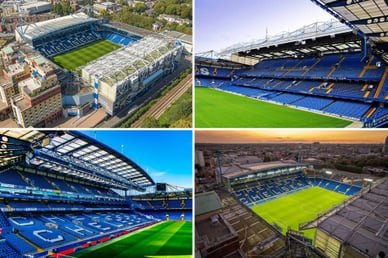
Stamford Bridge - Chelsea’s home ground
This stadium is situated right in the heart of the city, surrounded by streets, houses and a railway line. Due to its specific location, it is almost impossible to expand the stadium. The main features of Stamford Bridge:
- very compact architecture — the stands are close to the pitch;
- a ‘tight-knit’ atmosphere during matches;
- one of the most ‘urban’ stadiums in the Premier League.
The stadium has been rebuilt many times, particularly in the 1990s and 2000s. Despite its age, the interior is quite modern. Chelsea’s management is constantly discussing plans for a complete refurbishment or a move due to restrictions on expansion.
Stamford Bridge is a stadium steeped in history and character. It is not the largest or the most modern, but in terms of atmosphere, it is often ranked alongside the most ‘lively’ arenas in England.
Interesting facts
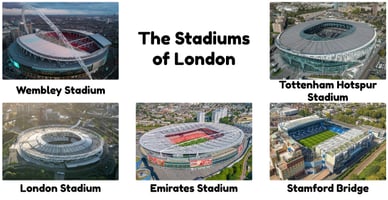
Stadiums in London
If you were to bring all of London’s stadiums together in a single picture, it would immediately become clear that this is not just a collection of venues, but an entire sporting ecosystem, where each venue has a life of its own and plays its own role.
Let’s start with the most famous one — Wembley Stadium. It remains the largest stadium in the United Kingdom, with a capacity of 90,000 spectators. By European standards, it ranks among the largest football arenas, second only to Camp Nou in Barcelona, but ahead of most stadiums in Europe.
We’ll mention the NFL in London separately. For American football, this is no longer a one-off event but an established tradition. NFL International Series games are regularly held at Wembley Stadium and Tottenham Hotspur Stadium. In fact, Tottenham Hotspur Stadium was designed specifically with this in mind: it features a retractable pitch that allows for a quick changeover between football and NFL without ‘damaging’ the turf.
When it comes to concerts, Wembley Stadium and the London Stadium have long been among Europe’s leading concert venues. Artists of the calibre of Ed Sheeran, Beyoncé, Coldplay and Taylor Swift perform at these arenas, and often it’s not just a single concert but several shows in a row. For many musicians, Wembley is a must-visit venue on a world tour.
There is another point that often surprises people: the cost of football stadiums in England. The record-holders here are:
- Tottenham Hotspur Stadium cost around £1 billion and is considered one of the most expensive stadiums in Europe.
- Wembley Stadium cost around £798 million following its refurbishment.
- Emirates Stadium cost approximately £390–400 million.
In a single city, arenas that host UEFA finals, NFL matches, Olympic events and world-class concerts coexist seamlessly. In this sense, London is not just a football city, but a place where stadiums operate almost non-stop, used all year round.

The Stadiums of London!
Conclusion
Wembley Stadium in London holds a special place. Despite the city having plenty of modern arenas such as Tottenham Hotspur Stadium or Emirates Stadium, it is Wembley that remains the main landmark. It is not just a club stadium, but England’s national stage.
It seats around 90,000 spectators and hosts events that typically transcend the scope of a single club. It is the venue for FA Cup finals, England national team matches, decisive UEFA tournament fixtures, major concerts and world-class shows. If a truly major event is planned in London, there is a high probability it will be organised at Wembley Stadium.
At the same time, every stadium in London plays its own part in the city’s overall picture. These are not just sports venues; they are part of city life. Wembley Stadium is all about scale and national finals. Tottenham Hotspur Stadium embodies technology and versatility. Emirates Stadium symbolises modern comfort and club identity. London Stadium is a legacy of the Olympics and stands out for its versatility. Stamford Bridge symbolises the history and atmosphere of old footballing London.
In the capital of Great Britain, the stadiums do not duplicate one another, but complement each other. Each has its own character, history and audience.
Frequently asked questions
How many football stadiums in London?
The exact number depends on which grounds are classified as professional. If we consider only the stadiums of Premier League clubs, English Football League clubs and major teams, there are more than 20 in London and the surrounding area. Among the most famous are: Wembley Stadium; Emirates Stadium; Tottenham Hotspur Stadium; Stamford Bridge; London Stadium; Craven Cottage; Selhurst Park; The Den; Loftus Road and others.
How many cricket stadiums are there in London?
There are several major cricket grounds in London, but there are two main international venues: Lord’s Cricket Ground and The Oval. It is these grounds that host England’s Test matches, international tournaments and national competition finals. Lord’s is often referred to as the ‘home of cricket’. This stadium opened in the 19th century and is considered one of the world’s most famous sporting venues.
What is the biggest stadium in the world?
In terms of capacity alone, the world’s largest stadium is the Rungrado 1st of May Stadium in Pyongyang, North Korea. Its capacity is estimated at approximately 114,000 spectators. The stadium is used for football matches, mass shows and state events.
What is the biggest stadium in the UK?
The largest stadium in the United Kingdom is Wembley Stadium in London. Its official capacity is 90,000 seats. In second place is Twickenham Stadium — the country’s largest rugby arena, with a capacity of around 82,000 spectators.
What stadium has the biggest capacity?
If we consider active sports stadiums worldwide, Rungrado 1st of May Stadium leads in terms of official capacity. But much depends on how you count: for American football, Michigan Stadium is considered the largest, with over 107,000 seats. Among cricket stadiums, the record holder is the Narendra Modi Stadium in India, with a capacity of around 132,000. Among football stadiums in Europe, the largest is Camp Nou in Barcelona.