Etihad Stadium
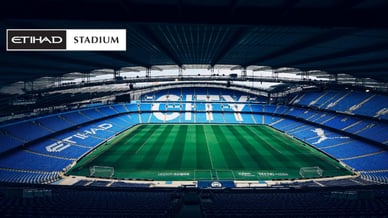
Etihad Stadium is known as Manchester's main sporting venue. It is also referred to as the home ground of Manchester City Football Club (Man City). This modern stadium combines architectural aesthetics, convenient seating and high capacity, making it the centre of sporting and cultural events in the city.
Name | Etihad Stadium (formerly City of Manchester Stadium) |
Country | United Kingdom |
City, address | Manchester, Ashton New Road, M11 3FF |
Year founded | 2002 |
Owner | Manchester City Football Club |
Team | Manchester City (Man City) |
Capacity | Approximately 53,400 |
Record attendance | 54,693 (match against Leicester City, 2016) |
Area | Approximately 47 acres |
Postal code | M11 3FF |
Sponsor | Etihad Airways |
Expansion | Project to 60,000 seats, completion planned for 2026 |
History of Etihad Stadium
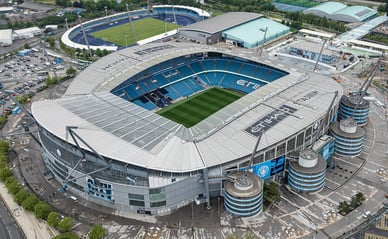
Etihad Stadium Manchester
The stadium was built for the 2002 Commonwealth Games and was originally designed as an athletics arena. After the games, the stadium underwent reconstruction and was adapted for football. In 2003, Manchester City, which had moved from Maine Road, played its first match here. Since then, the arena has become not only a venue for football matches, but also a concert venue for world stars. Over the years, it has hosted major international matches and events, and the stadium itself continues to expand to meet growing demand.
Where is Etihad Stadium located?
Etihad Stadium is located in the eastern part of Manchester, in the Sportcity area, which is considered the sporting centre of the region. The area was specially developed for major events during the 2002 Commonwealth Games. Today, this area is not just a stadium, but an entire sports cluster, including the following areas:
- training bases;
- a cricket arena;
- a velodrome;
- green areas;
- a park for walking.
The stadium fits conveniently into the city's infrastructure, as it is located near Ashton New Road, which connects the centre of Manchester with the eastern districts. The city centre is only a few kilometres away, and the main transport hub, Piccadilly Station, is about 2.5 km away. This allows fans to easily get to matches and events on foot or by public transport.
The area around the stadium is also well developed, with shops, bars, restaurants and hotels nearby where visitors can stay overnight. The presence of green spaces and parks makes visiting the stadium convenient not only for football fans but also for tourists wishing to take a tour of the sports complex.
Today, Etihad Stadium is perceived not only as a football arena for Man City matches, but also as an important cultural and public place, a symbol of modern Manchester.
Etihad Stadium seating plan
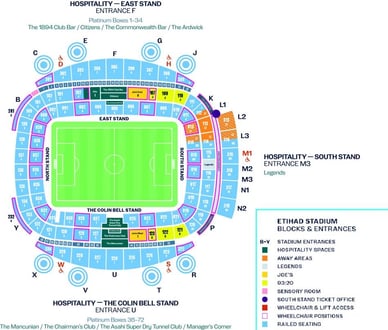
Etihad Stadium seating plan
The arena is designed with maximum comfort and safety in mind. The stadium plan is divided into four main stands:
- East Stand.
- Colin Bell Stand.
- South Stand.
- North Stand.
Each stand is divided into blocks, which makes navigation easier. There are sections for family fans, VIP boxes, and areas for away fans. A convenient seating map helps spectators choose seats with the best view of the pitch in advance. The stands have areas with the best views for live broadcasts and corporate events.
Etihad Stadium capacity
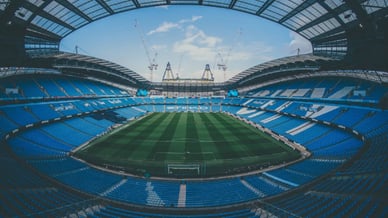
Etihad Stadium capacity
Etihad Stadium currently has a capacity of around 53,400, making it one of the largest football stadiums in England. However, an expansion project is already underway, which will increase the number of seats to 60,000. This will allow for even more large-scale matches and concerts to be held, as well as international tournaments. During the design process, special attention was paid to comfortable seating, wide aisles and modern security systems. As a result, Etihad Stadium is one of the arenas that offers spectators the best live sports experience.
Etihad Stadium Events

Manchester City vs Real Madrid Etihad Stadium
Etihad Stadium is not only Manchester City's home ground, but also a venue for Premier League, Champions League and FA Cup matches. It is a multi-purpose facility that regularly hosts a wide variety of events. Every football match turns into a spectacular show. Thousands of fans gather in the stands, and millions of fans around the world watch live broadcasts. The atmosphere at the stadium during Man City games is unique. It has everything from mass fan chants to spectacular pre-match shows with fireworks and light effects.
But football is not the only type of event for which the stadium is used. It also hosts major concerts by world stars. Artists such as Coldplay, Beyoncé, Ed Sheeran, Taylor Swift and many others have performed in the stands and on the pitch at Etihad Stadium over the years.

Coldplay - Etihad Stadium
The arena's capacity and convenient seating plan allow the space to be transformed for different types of shows, from intimate concerts to grand world tours. Concerts at the stadium are often the main events of the summer in Manchester and attract tens of thousands of spectators.
In addition to football and music, the Etihad Stadium is used for corporate events, sports shows and charity events. Here you can:
- book a stadium tour;
- visit the club museum to learn about its rich history and see its main attractions;
- see the players' changing rooms;
- walk through the tunnel that the players use to enter the pitch;
- guided tours are available for fans and tourists, allowing them to see restricted areas and experience the atmosphere of a real match.
The stadium also plays an important role in the life of the city, as festivals, street fairs, sporting events and cultural events are held nearby. Thanks to its convenient transport links and parking facilities, many Manchester residents and tourists choose this place for leisure and meetings. Etihad Stadium is rightly considered an arena that combines sport, music and culture. Every new event here becomes an occasion that is talked about in Manchester and far beyond.
How to get to Etihad Stadium?
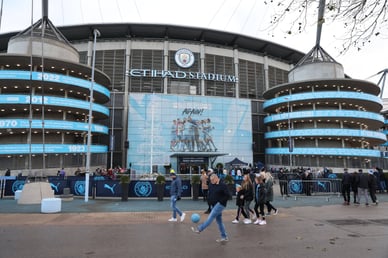
Manchester Etihad Stadium
The stadium is located in the Sportcity area and is connected to Manchester city centre by convenient transport routes. There are various ways to get there.
By train (nearest railway stations)
Manchester Piccadilly is the city's main railway station, located approximately 2.5 km from the stadium. It is a 25-30 minute walk from the stadium, or you can take a bus or tram. Trains depart from Piccadilly to destinations throughout the region and to other cities in the UK, making this the most convenient route for visitors. In addition, Ashburys station is located closer to the arena, but it has fewer connections than Piccadilly.
By underground
Manchester does not have a traditional underground system, but its function is partially fulfilled by the Metrolink tram system, which connects the city centre to the stadium. Visitors often use a combination of train and tram, which allows them to quickly get from the railway station to the arena.
By tram
This is the most popular way to get to the stadium on match or concert days. The Metrolink line runs from the city centre, and the Etihad Campus terminus is located right at the main entrance to the arena. The journey from Piccadilly Station takes about 10 minutes. On days when there are big matches and events, the frequency of trams increases to cope with the flow of fans.
By bus
Buses No. 216 and No. 231 run regularly from Manchester city centre (including Piccadilly Station) and stop at Etihad Stadium. The city's bus network is well developed, so you can also use other routes that pass near the arena if you wish.
By car
For those who prefer to travel by car, there is official parking next to the stadium. There are also private car parks in the surrounding area. Traffic can be heavy on match days, so it is advisable to arrive early. There are signs on site to help you find your way around and locate available parking spaces.
Information for visitors
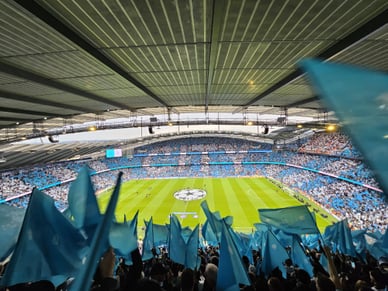
Etihad Stadium seat view
Etihad Stadium is not only a venue for matches, but also a modern, comfortable complex that is open to visitors all year round. Here you can take a tour of the stadium, buy tickets, visit the club shop or stay at one of the nearby hotels.
Opening hours
The schedule depends on matches and events. Stadium tours are usually held daily from morning to evening, but are cancelled on match days. The shop is open almost every day, including weekends.
Shop
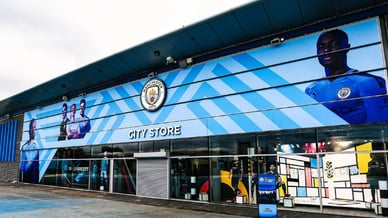
Etihad Stadium shop
The Manchester City brand store is located next to the stadium and offers a wide range of products, from football kits and accessories to souvenirs. Here you can purchase official match tickets, food and drinks during events, as well as unique gifts for fans.
Hotels nearby
There are several hotels of various standards within walking and transport distance of the stadium:
- Holiday Inn Express Manchester City Centre.
- Hotel Football.
- Small boutique hotels.
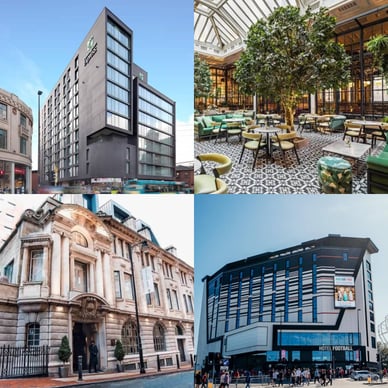
Etihad Stadium hotels nearby
Many hotels offer special packages for fans, including match tickets or transfers to the stadium. Thanks to its proximity to the centre of Manchester, guests can find hotels with rooms to suit any budget.
Parking
The stadium's official car park can accommodate thousands of vehicles. In addition, there are additional private car parks and temporary parking areas around the arena, which open during major events. Parking costs vary depending on location and time. For the convenience of visitors, there is a system for booking parking spaces in advance.
Contact details and postcode
Address: Ashton New Road, Manchester, M11 3FF.
Postcode: M11 3FF.
Contact information, including telephone numbers and email addresses, is available on the official Manchester City website. Here you can also find the latest club news, match and tour schedules, and book tickets.


Frequently asked questions
When was Etihad Stadium built?
In 2002.
Who owns the Etihad Stadium?
The stadium is owned by the City of Manchester and operated by Manchester City Football Club.
How much do man city pay for the Etihad Stadium?
The club leases the stadium from the city council for approximately £3 million per year.
What was the Etihad Stadium called before?
City of Manchester Stadium.
When will Etihad Stadium expansion be finished?
It is planned for 2026.
How big is the Etihad Stadium?
Approximately 47 acres.
How many seats in Etihad Stadium?
The capacity was 53,400 seats, and after the expansion it reached 60,000.