Barbican Hall
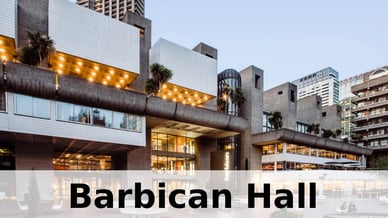
Barbican Hall is a concert hall in the Barbican Centre, where classical and contemporary music concerts are held. The London Symphony Orchestra and the BBC Symphony Orchestra are based in this cultural complex. In this article, we will tell you about the history of this famous hall, how to get there, and where to stay nearby.
Name | Barbican Hall |
Country | Great Britain |
Year founded | 1971 |
Address | Silk Street, London EC2Y 8DS |
Attendance | Approximately 1 million people per year |
Capacity | Concert Hall: 1,943 seats |
Notable events | Barbican International Film Festival, London Symphony Orchestra concerts, Contemporary Arts Exhibitions, Barbican Jazz & Classical Series |
Architects | Peter Chamberlain, Geoffrey Powell, and Christophe Bon |
History
Barbican London is part of the residential complex of the same name, which was built in the 1960s and 1970s on a site that was heavily bombed during the Second World War. The name of the concert hall is linked to the history of the ancient world: on the site of the modern London neighbourhood, the Romans built barbicans — tower-like fortifications designed to protect the Roman “colony” from attack.
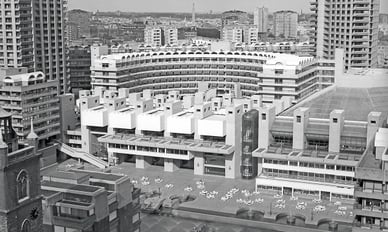
Barbican Hall 1982
The concert hall project was approved in 1971. Architects Peter Chamberlain, Geoffrey Powell, and Christophe Bon worked on it. Construction began on the site of the Barbican residential neighbourhood.
The centre was officially opened to the public on 3 March 1982. Queen Elizabeth attended the ceremony. The Barbican Centre was originally conceived as a ‘gift from the city to the nation.’ Its construction cost £161 million.
The concert hall hosts classical and contemporary music concerts. It serves as a concert and rehearsal base for two of the most famous national orchestras.
In 2013, the centre once again became the London venue for the Royal Shakespeare Company after its departure in 2001. The concert complex building is designed in the brutalist style. This style was characteristic of English architecture in the post-war period. The concert hall is distinguished by its deliberately squat, ‘sprawling’ multi-level structure with floors extending not only upwards but also downwards. In 2001, the complex was awarded Grade II listed status.
The Barbican Concert Hall regularly hosts The Nutcracker ballet. The largest cultural complex in London invites renowned ballet companies, including the English National Ballet, to perform the legendary ballet production, which is especially popular during the Christmas holidays. The audience enjoys attending the performances, and the Barbican provides professional assistance for successful shows.
Where is the Barbican Centre located?
The Barbican Centre is located in the centre of the United Kingdom's capital, in the City of London. Address: Silk Street, London EC2Y 8DS, United Kingdom.
Europe's largest cultural centre, including a concert hall, theatres, exhibition spaces, a cinema and a library, is located next to Moorgate and Barbican underground stations, providing easy access by public transport. The complex is located in the modern residential area of Barbican Estate, known for its brutalist architecture.
Seating plan at the Barbican Hall
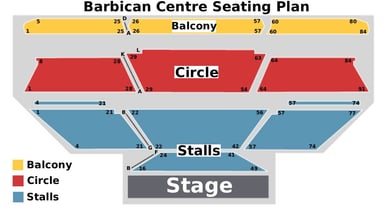
Barbican Hall Seating Plan
Barbican London has several main halls, each with its own seating plan:
Barbican Hall has a larger capacity of 1943 seats. Seats are grouped into Stalls, Circle and Balcony. The seating plan includes rows with central and side sections for viewing classical music performances, orchestras and concerts.
Barbican Centre capacity
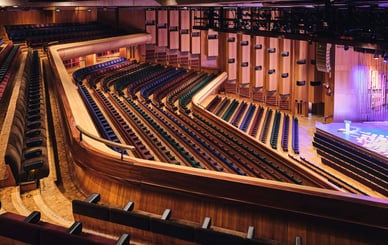
Barbican Hall capacity
The Barbican's capacity varies depending on the venue. The Barbican Theatre can seat between 1,154 and 1,156 people. It is the main theatre venue, designed for drama productions and shows.
The Barbican Hall, designed for orchestral and classical music concerts, has 1,943 seats. The Pit Theatre is a small multi-purpose hall for chamber productions and experimental performances with only 200 seats. Cinemas and other spaces designed for film screenings, lectures and masterclasses have between 150 and 300 seats.
How to get to the Barbican Centre?
You can get to the Barbican Centre by tube, bus or car.
Nearest tube stations
The closest tube stations to the concert hall are:
- Barbican (Circle, Hammersmith & City, Metropolitan) – 2 minutes' walk.
- Farringdon (Circle, Hammersmith & City, Metropolitan, Thameslink) – 5 minutes on foot.
- Moorgate (Northern, Circle, Hammersmith & City, Metropolitan) – 7 minutes on foot.
By bus
The nearest bus stops to the cultural centre are a 2-5 minute walk away. Routes 4, 56, 153, 214, 242, and 521 run in this direction. Walking distance to the centre is 2-5 minutes.
By car
You can also get to the concert hall by car. Parking is usually not a problem, especially if you use the early booking option.
Barbican Hall events
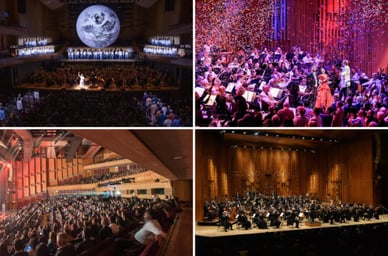
Barbican Hall events
Over the years, the Barbican Centre has hosted concerts by world-famous stars, as well as exhibitions and theatre performances:
- Dirty Looks: Desire and Decay in Fashion — an exhibition that reimagined the usual standards in the world of fashion. In September 2025, the Barbican Centre presented an exhibition in which dirt, stains, scuffs and traces of time acted as an artistic language. In this unusual way, the designers expressed their protest, philosophy and environmental stance. The exhibition was housed in twelve rooms, each of which was an autonomous space.
- Encounters: Giacometti x Huma Bhabha — an exhibition featuring sculptures by Bhabha and Giacometti, spanning almost 100 years of art.
- Performances by the London Symphony Orchestra and Antonio Pappano — December 2025.
- Concerts by the BBC Symphony Orchestra — in December 2025.
- Performances by the Royal Shakespeare Company: Les Miserables and Trevor Nunn's Henry IV, Parts I and
The Barbican Cinema regularly hosts film screenings. In December 2025, the films Die My Love, Animalia and Pillion were presented.

Stephane Grappelli. 80th Birthday Concert. Barbican Hall, London. 1988
Information for visitors
Before visiting the Barbican Centre, it is advisable to find out what restaurants are nearby, where you can stay overnight and what the parking situation is like.
Hotels near the Barbican Hall
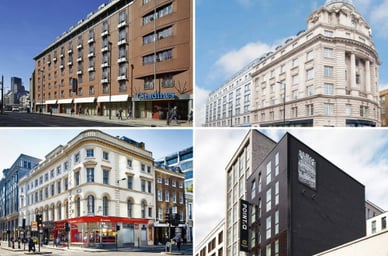
Hotels near the Barbican Hall
There are several good hotels close to the Barbican Centre:
- Citadines Apart'hotel Barbican London — an aparthotel in the Barbican area.
- Malmaison London — a stylish hotel with excellent guest reviews.
- Premier Inn London Farringdon (Smithfield) — a good option in terms of value for money.
- Travelodge London Central City Road — an affordable hotel near the underground station and within walking distance of the concert hall.
- The Moorgate by Cove — apartments that are perfect for families and long-term stays.
- Fox & Anchor (Hotel) — a cosy hotel-pub in close proximity to Barbican.
- Point A London, Shoreditch — a budget option in the Barbican/Old Street area.
Restaurants near the Barbican Hall
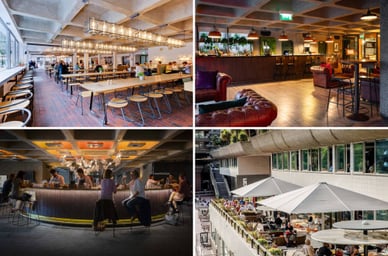
Restaurants at Barbican Centre
There are also plenty of places to eat near the Barbican Centre, among the most popular are:
- Barbican Kitchen — a café offering simple dishes and quick snacks.
- Barbican Bar & Grill — a restaurant specialising in contemporary British cuisine with a view of the lake.
- Martini Bar — a bar with a large selection of drinks and light snacks before or after an event.
A few minutes' walk from the centre is the modern Indian restaurant Mayura Barbican, Côte Barbican — a French bistro restaurant with good reviews, and St. John — a well-known British restaurant serving traditional cuisine.
Parking
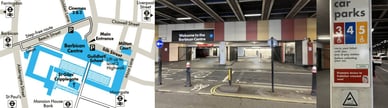
Barbican Hall parking
You can park your car directly under the Barbican Centre. There are entrances from Silk Street and Beech Street (via the tunnel). The height restriction is 1.85 m. You can book a space online and pay on arrival.
Barbican Car Park - Beech Street is a car park within the Barbican complex with access via Beech Street. There are also alternative car parks nearby, such as CitiPark London Barbican, located about a 5-10 minute walk away.
Other options include City of London Corporation - Car and Bike Parking (London Wall Car Park), a large underground car park near Barbican, and Bunyan Court Car Park, a small private car park within the district (which can be used if the main car parks are full).
Approximate parking prices:
- up to 1 hour – £7;
- up to 2 hours – £10.5;
- up to 3 hours – £14;
- 24 hours – £40-46.
The evening rate after 4 p.m. until 6 a.m. is around £13. For early entry (from 5:30 a.m. to 9:30 a.m.), there are offers for £12 for 12 hours.
Contact details and postcode
Address: Silk Street, London, EC2Y 8DS, United Kingdom. Main postcode EC2Y 8DS.
Main number: +44 20 7870 2500
Information telephone number: +44 20 7638 8891
Ticket booking: +44 20 7101 1188


Frequently asked questions
When was the Barbican Centre built?
Construction of the Barbican Centre took place between 1971 and 1982.
Who designed the Barbican Centre?
The architects of the Barbican Centre are Peter Chamberlain, Geoffrey Powell, and Christophe Bon. The project was developed on the basis of the large Barbican Estate cultural complex, which includes residential buildings, gardens, and cultural spaces.
What to do near the Barbican Centre?
Near the Barbican Centre are the Museum of London (about a 10-minute walk), the Guildhall Art Gallery with its impressive collection of artworks, and the Roman Amphitheatre. Inside the complex itself is the Barbican Conservatory, and a 5-minute walk away is Postman's Park, both ideal places for a stroll. The Thames embankment is a 15-minute walk away.
What is at the Barbican Centre?
The Barbican Centre has a theatre, a concert hall, a small chamber hall for experimental and small theatre productions, a cinema, exhibition galleries, a library, public spaces, cafés and restaurants.