George Carey
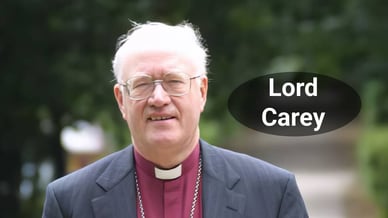
George Carey is a former Archbishop of Canterbury, theologian and public figure. He headed the Church of England from 1991 to 2002, during a period when Anglicanism underwent significant changes. Lord Carey of Clifton, born in 1935, implemented one of the major church reforms, namely the ordination of women. This radically changed the Anglican Communion. Lord Carey is one of the most prominent and controversial Archbishops of Canterbury of the late 20th century.
He combined conservative theological views with attempts to change the church and make it more modern and open to addressing social issues. His name is associated with significant initiatives, not only in England but throughout the world. It is also associated with high-profile scandals surrounding George Carey, when the church hierarchy responded to allegations of abuse within the clergy.
This article is dedicated to a man whose activities clearly reflect the drama of the entire Anglican Church at the end of the 20th century. The desire for reform led to a clash between tradition and new realities, along with painful questions of responsibility that continue to influence church life in England today.
Full name | George Leonard Carey |
Title | Lord Carey of Clifton |
Date of birth | 13 November 1935 |
Place of birth | London, England |
Education | King’s College London (studied theology) |
Key initiatives | Modernisation of church life, ordination of women as priests, balance between tradition and reform |
Positions held | Priest in various parishes; vicar; chaplain; Bishop of Bath and Wells (1987–1991), Archbishop of Canterbury (1991–2002) |
Wife | Eileen Harmsworth Hood |
Children | Four – two sons and two daughters |
Parents | George Thomas Carey (father), May Carey (mother) |
Personal life and character
George Carey is not only a clergyman, but also a family man. The former archbishop has a wife and children. His relatives and colleagues note his personal kindness and sense of humour. This man combines gentleness in communication with firmness in principles.
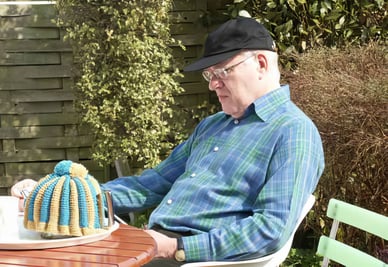
George Carey's hobbies deserve a special mention. The former archbishop loves to read, especially religious and historical literature. His hobbies also include travelling: he often visited other countries as part of church and public trips. His interest in history helped him to better understand the development of the church and society.
Wife
George Carey's wife is called Eileen Harmsworth Hood. She is the daughter of Douglas Cunningham Hood. Eileen Harmsworth Hood graduated from South East County Technical College in Bark-Essex.
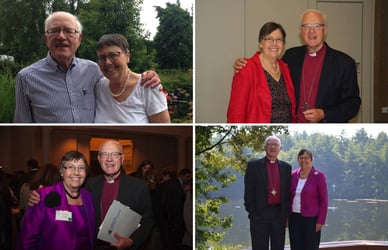
George Carey's wife is qualified in childcare and has a nursing degree (SRN). She worked at West London Hospital and then in the radiotherapy department at Mount Vernon Hospital (Northwood).
Eileen and George Carey were married in 1960. The couple have four children and several grandchildren (about 12).
Note: In 1998, Eileen and her son co-authored the book The Bishop and I, a publication dedicated to the spouses of bishops in the Anglican world.
Eileen has always actively supported her husband in his work. As the wife of an archbishop, she took an interest in issues related to church life and ministry.
Children
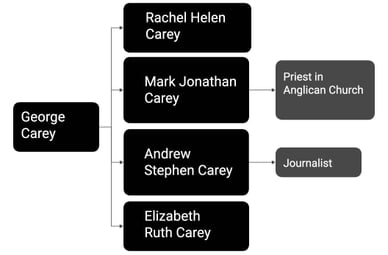
George Carey has four children: two sons and two daughters. His firstborn, Rachel Helen Carey, was born on 30 May 1963.
His son Mark Jonathan Carey was born on 28 February 1965. Another son, Andrew Stephen Carey, was born on 18 February 1966. His youngest daughter, Elizabeth Ruth Carey, was born on 26 October 1971.
One of George Carey's sons, Mark, became a priest in the Anglican Church. The second, Andrew, chose a career in journalism (he was deputy editor of the Church of England Newspaper) and worked as a freelance journalist.
Early years and family
Carey of Clifton was born into a working-class family in East London on 13 November 1935. He lived with his parents in fairly modest circumstances. The future archbishop was not ‘born into the establishment’; his rise to the top of the church hierarchy was gradual.
In the environment where Carey of Clifton grew up, no one belonged to the elite. His life revolved around simple labour and modest opportunities. Carey of Clifton's parents and surroundings had no connections that would open the way to the highest ecclesiastical circles.
The future archbishop's father was named George Thomas Carey. His mother, Ruby Catherine Gurney, came from a working-class but relatively well-off family, but her childhood was difficult, and she had to struggle to survive.
Note: The Gurney family has historical ties to the city of Canterbury in the county of Kent. Over time, Ruby Catherine Gurney's ancestors moved to East London, where she was born.
George Carey attended a regular local school, and after graduating at a very young age, he began working: he worked as a clerk, helped his family, and led a rather mundane working life. In 1954, at the age of 19, he joined the Royal Air Force. Army discipline had a strong influence on his character, as did the responsibility and necessity of interacting with people from different walks of life. This made him composed and independent, as well as attentive to people's stories.
After completing his military service and converting to Christianity, he became a student at King's College London. Thus began his journey in the church environment. Carey was never seen as someone who was ‘born’ for the establishment. Everything he achieved, from his status as a parish priest to his position as Archbishop of Canterbury, was accomplished step by step. George Carey came a long way through hard work, teaching and personal conviction.
His early biography shows that he is a rare example of a leader of the Church of England who rose from the very bottom and had no privileges at the beginning of his career. This arouses great public interest in George Carey as a person and gives an understanding of how he managed to become the head of the Anglican world.
The path to faith and education
George Carey came to a conscious realisation while still a teenager. He “caught up” on his education: he studied at King's College London, then went on to obtain further degrees in theology, and over time developed an academic interest in theology.
Education became a way for him to escape his simple surroundings and enter intellectual church circles.
George Carey's path to faith was not a sudden conversion, but rather a slow inner awakening. As a teenager, he began to seriously consider the idea that faith could be more than just a familiar village or family ritual, but the true meaning of life. He was greatly impressed by communities where he observed ordinary people sincerely living their faith. George Carey began to gravitate towards it, and after the army he decided to become a clergyman, which required appropriate education. The future archbishop realised that without thorough preparation, he would not be able to enter the intellectual world of the church. Enrolment at King's College London became a stepping stone for him to climb the social ladder. During his studies, he made up for what wealthy Anglican families teach their children from an early age. During that period, he received a classical education, mastered the culture of theological discussion, and significantly broadened his horizons.
As a student at King's College, George Carey immersed himself thoroughly in theology, not as a future practitioner, but as a researcher. He later obtained theological degrees and engaged in scholarly work, writing research papers. His studies opened the doors to the academic world and, at the same time, to the higher echelons of the church hierarchy.
For Carey, education became more than just a degree; it became a way out of the simple, working-class environment in which he grew up, a way into the world of ideas, where meanings are born and decisions are made. For this reason, he always viewed theology not as an abstract science, but as a vital support that had once changed his own destiny.
First steps in church ministry
Archbishop George Carey's first steps in church ministry were devoid of any pomp and circumstance. After graduating from college, he was ordained first as a deacon and then as a priest.
He worked in ordinary parishes, where his task was not to pronounce the correct theological formulations, but simply to be close to people. During those years, George Carey worked with a wide variety of parishioners, from young people to the elderly and families. He often had to deal with everyday problems rather than abstract spiritual issues.
It was then that he learned to understand what life was like for parishioners who attended church not for ideas, but for spiritual support. George Carey became a priest who was able to listen, engage in dialogue, and explain religious tenets.
George Carey formed the image of a clergyman who was close to ordinary people, understood their needs, and focused on practical faith rather than just academic discussions.
In parallel with his pastoral work, he taught at theological colleges. At first, as a young teacher, he was not far removed from his students. Later, he became a more experienced mentor. For George Carey, this dual ministry became natural. He combined academic theology with living practice, without resorting to pure scholarship or simple parish routine.
George Carey shaped the image of a clergyman who was close to ordinary people, understood their needs, and focused on practical faith rather than just academic discussions. He always strove to make the message of faith understandable to ordinary people, avoiding arrogant theological snobbery and preferring to discuss Christianity as something important rather than complicated. It was during this period that he developed a unique style of ministry, which later played a key role in his advancement in the church hierarchy, combining openness, simplicity, and the ability to combine intellect and love for one's neighbour.
Bishop of Bath and Wells
In 1987, George Carey was appointed Bishop of Bath and Wells, which was a big step forward for him. From being a respected pastor and theological teacher, he became a prominent figure on the national stage.
This diocese is one of the oldest and most important in England. Entrusting it to a man without ‘aristocratic’ roots was a bold move. Carey became bishop because of his lively style of ministry, his ability to talk to people and his ability to work with contemporary challenges, not because of his background or connections.
The key areas of George Carey's work as Bishop of Bath and Wells were:
- pastoral care;
- diocese management;
- participation in national church discussions.
In this role, he did what he always did best: pastoral care and involvement in the life of local communities. He regularly visited parishes, took an interest in their real needs and tried to make the diocese more open and less bureaucratic. At the same time, the position required management skills. Over time, Carey learned this too, became a leader, worked with the clergy, dealt with financial issues and organisational processes. Every day, he bore a huge responsibility.
At the same time, he took an active part in national church discussions. His voice was increasingly heard at synods, in interviews, and in theological debates. He was not afraid to speak his mind, and as a result, he quickly gained a reputation as a man who combined Gospel convictions with a willingness to discuss reform.
It was this stage that paved the way for his appointment as Archbishop of Canterbury. George Carey proved that he was capable of managing a large church structure and knew how to unite people without losing touch with everyday church life. He was not just a pastor or a scholar, but a true leader who could become the head of the Churches of England.
Appointment as Archbishop of Canterbury
In 1991, George Leonard Carey was appointed Archbishop of Canterbury and remained in this position until 2002. This period coincided with the first half of the 1990s, when British society was undergoing major changes. Those years saw the rise of secularisation and growing debate about women's rights, ecumenism, and moral and social issues.

Carey's appointment to such a prestigious position was a step towards pragmatic and manageable leadership in the Churches of England. The public expected him to be able to combine Anglican traditions with modern challenges, as well as to represent the Church as an authoritative and influential institution in society.
The Archbishop of Canterbury is not only the spiritual leader of the Anglican Church, but also a socially and politically significant figure, the symbolic leader of the Anglican community worldwide. He participates in state ceremonies and influences social and moral debates in England. Carey's appointment to this position was both a church and a socio-political event: he came to the Church at a time of transformation and had to find a balance between preserving traditions and responding to new challenges.
Major reforms and initiatives
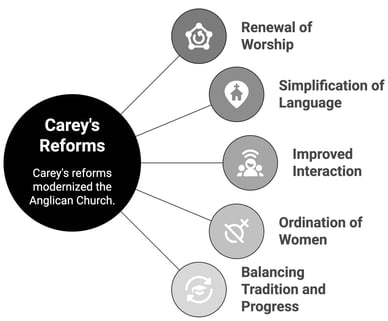
Carey was keen to bring about change in the life of the Church, to make it more understandable and accessible to modern society. He advocated for the renewal of worship, the simplification of church language, and improved interaction with parishioners.
The ordination of women as priests became one of the main initiatives of his archbishopric. In 1992–1994, with his assistance, the Church decided to admit women to the priesthood. This decision met with great resistance from conservative circles, especially among English people who adhered to the traditional understanding of the priesthood.
At the same time, Carey was able to gain broad support from progressive reformers who saw this as a step towards equality and the adaptation of the church to modern realities. As a result, Carey came to be seen as a moderate reformer. He never radically broke with tradition, but actively promoted innovations that would make the church more open, modern and socially relevant.
These steps strengthened his image as a leader, able to balance tradition and progress. Archbishop George Carey left a significant mark on the development of the Anglican Church in the late 20th and early 21st centuries.
Attitude towards women priests
Bishop George Carey advocated for the ordination of women as priests, arguing that it was based on the principles of equality and a modern understanding of ministry. He believed that if the Church wanted to remain relevant and attractive to parishioners, it had to make use of all talents, including those of women, and reflect social changes in public life. This decision was an important step for the Church of England, as it enabled it to move with the times and respond to society's demand for equality between men and women in spiritual ministry. It provoked heated debate: conservative members of the clergy and some lay people opposed it, believing that the priesthood should remain exclusively male in accordance with long-standing tradition. Supporters of the reforms saw this step as a long-awaited renewal and restoration of justice.
Carey played an important role in preventing a schism in the church, finding a compromise between opponents and supporters, ensuring dialogue and the gradual introduction of reforms in order to preserve the unity of the Anglican Church. His skilful actions prevented conflict between traditionalists and progressive members. This position reinforced Carey's image as a moderate reformer who combined a desire for innovation with a concern for church stability.
Conservative views on sexual ethics
When it came to homosexuality and same-sex relationships, George Carey took a conservative stance. He always reminded society of the biblical norms and church traditions that should form the basis of moral teaching.

In 1998, the Lambeth Conference was held, during which issues of sexual morality and the role of homosexual priests in the Anglican Church were discussed. Carey spoke in favour of strict restrictions on the ordination and appointment of priests who openly express their homosexuality, citing the need to uphold traditional values and the unity of the church. His position provoked criticism from the liberal section of society and progressive members of the church. They argued that such a line excludes and demeans people on the basis of sexual orientation, failing to meet modern social standards.
Adherents of the conservative position, including Carey himself, argued that following tradition would protect the church from schism and help preserve its spiritual identity. His approach once again demonstrated a compromise between conservatism and an attempt to maintain the unity of the church, while at the same time highlighting internal contradictions. It also underscored the tension between traditionalists and the liberal wing of the Anglican Church.
Activities after the archbishopric
After stepping down as Archbishop of Canterbury in 2002, George Carey continued to be actively involved in the public and religious life of the country, but no longer as the official head of the Church of England. He regularly spoke in the House of Lords, participating in debates on issues of morality, human rights and the role of Christianity in society, as well as migration and social justice.
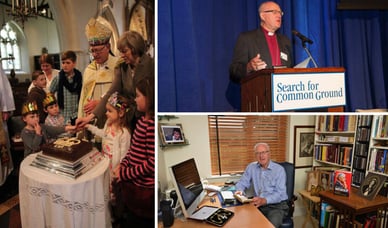
George Carey published articles and books, and also spoke out, analysing the modern church and society, continuing to advocate for the promotion of ideas of moderate reformism, social responsibility and the need for dialogue between the traditional way of life and the modern one. He continued to defend his position on women's equality in the priesthood, a conservative line on sexual ethics and the modernisation of church life. At times, George Carey rethought and refined his beliefs, taking into account and adapting to social and cultural contexts. No longer Archbishop of Canterbury, he continued to be an influential figure in society and the church, his opinion was listened to, and he played the role of a wise former leader.
Relations with the British royal family
George Carey has no direct family ties to the British royal family, but as Archbishop of Canterbury, he was closely associated with the monarchy, served on the Privy Council, and participated in key state and church ceremonies. His position automatically made him one of the crown's chief spiritual advisers.
George Carey's contacts with members of the royal family deserve special attention. He often interacted with them at official events, attended public and private church services, and periodically provided advice on matters of spiritual support and church initiatives.
His role at these meetings emphasised the unique nature of the Church of England, showing that it was not just a religious organisation, but an institution closely intertwined with the state and the monarchy. The Archbishop of Canterbury became the link between the spiritual leadership and the political and social influence of the Crown.
Through such interactions, George Carey demonstrated the joint work of the church and the monarchy to preserve traditions and respond to the challenges of society.
Official functions at court and ceremonies
The archbishop participated in coronations, national thanksgiving services and important state religious services. Carey performed these functions for Queen Elizabeth II and was her spiritual advisor within the scope of his status. He attended official services at Westminster Abbey and St James's Palace, blessed national initiatives and represented the church at state celebrations.
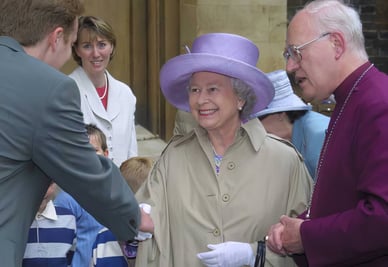
Her Majesty the Queen greets members of the Carey family at the Lambeth Palace Garden Party 2001
Here are some examples of his participation:
- the opening ceremony of the next session of Parliament;
- national thanksgiving services (for example, on the occasion of the Queen's jubilees);
- official services during state visits and commemorative dates.
Important! His presence at these events emphasised the close connection between the Church of England and the British crown and the role of the archbishop as the spiritual leader of the nation.
Participation in significant events of the royal family
George Carey participated in many ceremonies related to the royal family, such as:
- the funeral of Princess Diana, Princess of Wales (he conducted the service at the princess's funeral);
- the funeral of the Queen Mother;
- anniversary services.

Through these events, most people outside the church community became aware of him. The tone of his speeches always combined respect for tradition with an appeal to the feelings of ordinary citizens.
Social and political activity after retirement
After retiring, George Carey remained active: he wrote articles, appeared in the media, and participated in social campaigns. He influenced debates on topics such as migration, national identity, and the role of Christianity in modern Britain. He remained a prominent voice in public life.
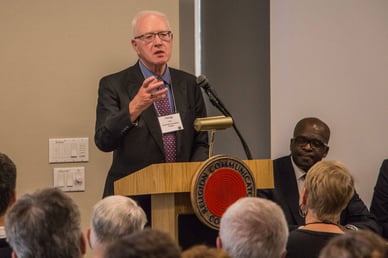
Lord Carey speaking at the Religion Communicators Council. March 2016
Migration, identity and Christianity in public life
George Carey advocated so-called controlled migration, convincing the public that an overly rapid influx of people could lead to a weakening of the country's cultural and religious identity. He linked these issues to the role of Christianity in society and emphasised the need to preserve common values. His position was criticised for being overly harsh. However, George Carey had not only opponents but also supporters who considered his position pragmatic and cautious.
Discussions about euthanasia and human rights
Over time, George Carey changed his position on voluntary euthanasia, supporting the right to ‘assisted dying,’ but only in strictly limited cases. This sparked heated debate within the religious community, as the archbishop remained a prominent figure even after his resignation. For him, the theme of compassion and personal choice in hopeless situations was important.
Scandals and investigations related to abuse
In later years, George Carey's reputation was severely damaged by cases of sexual abuse by clergy in the Anglican Church during his leadership. These were not direct accusations against him personally, but rather about how he responded to complaints and appeals filed by victims.
The case of Bishop Peter Ball

Peter Ball held the position of bishop in the Anglican Church. He was accused of sexual harassment and abuse of teenagers. George Carey was archbishop at the time and was criticised for not fully reporting the information to the police and for attempting to mitigate the consequences for Ball. These conclusions were reached as a result of independent investigations. Carey's reputation was partially undermined.
Other episodes and criticism
Investigations and reports raised questions about other cases of abuse where Carey's decisions were perceived as too lenient. He faced criticism from victims, public organisations and, to some extent, church leadership. These episodes shaped the image of a man who did not defend victims decisively enough and was too slow to respond to complaints. Despite his good intentions, he did not always effectively protect vulnerable people in the Church of England.
Apologies and consequences for Carey himself
George Carey publicly apologised to the victims and acknowledged mistakes in management. For this reason, the Church limited his ministry by revoking his licence to serve and relieving him of some honorary positions. This created an internal conflict between his attempts to explain his decisions and the public's demands for stricter accountability.
Books and theological works
In his books and theological works, George Carey raises important topics: the personal path to faith, reflections on God and man. He is not only an administrator and church politician, but also an author who shapes theological thought.
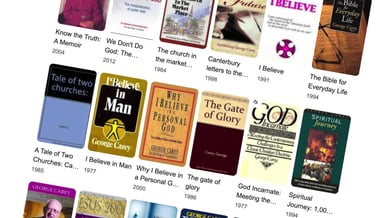
He has written numerous books and theological articles, including memoirs in which George Carey recounts in detail his journey to faith and ministry. In them, he touches on topics such as:
- personal spiritual experience;
- the role of the Church in modern society;
- questions of morality and the relationship between God and man;
- the challenges facing Christianity in the 21st century.
Several works by George Carey:
- Know the Truth: A Memoir — an autobiography in which he recounts his life journey, from his childhood and service in the Air Force to his appointment as bishop and archbishop.
- The Church in the Marketplace — a book reflecting his view of the role of the Church in the daily lives of ordinary people and the relationship between church ministry and secular society.
- The Gate of Glory — one of his theological works, addressing issues of faith, theology and the relationship between man and God.
- Why I Believe in a Personal God: The Credibility of Faith in a Doubting Culture is a book devoted to reflections on faith in God, its validity and significance for people living in today's sceptical society.
In his books and articles, Carey repeatedly returned to the themes of religious doubt, spiritual search, morality, the decision to devote one's life to service, the Church's closeness to people, helping them, and its connection to the realities of life.
Conclusion
George Carey plays an important role in the history of the Anglican Church and British society. His life is full of contradictions: the son of a working-class man from the East End became Archbishop of Canterbury. He made a name for himself as a reformer of women priests and at the same time a conservative on other issues. In modern society, George Carey is perceived as a minister of the church and a figure associated with high-profile scandals. The assessment of his role will continue to be a subject of debate for a long time to come.