Shamrock Rovers F.C.
Shamrock Rovers are a football team originally from Ringsend, Dublin. There is still some debate about when the club truly began — 1899 is the earliest known reference, but 1901 is generally regarded as the year the club properly took shape. Since their founding, they’ve won a record number of League of Ireland titles, taking the top spot 21 times. That makes Shamrock Rovers F.C. the most successful club in Irish football, and that’s without their 25 victories in Ireland’s FAI Cup.
As you can see, the team has come a long way over the past 125 years, making notable appearances in European competition via the Conference League and later moving to their new home at Tallaght Stadium, South Dublin.
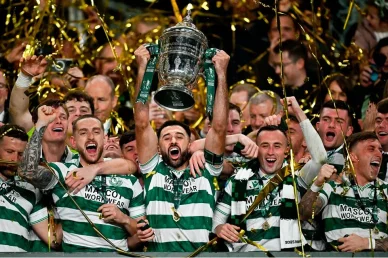
Roberto Lopes lifts the FAI Cup for Shamrock Rovers after defeating Cork City at the Aviva Stadium
Today, Shamrock Rovers are internationally recognised as the most famous Irish football club, and they’re still only just beginning. Let’s take a closer look at the team’s history and legacy.
The History of the Dublin Club
Early Years
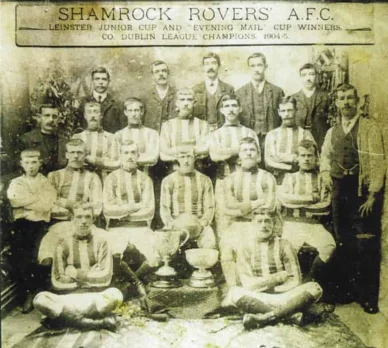
Shamrock rovers team (1904/1905)
When the club was first founded in Ringsend, Dublin, it secured some rooms on Shamrock Avenue, which is widely believed to have given the team its name. All these years later, few fans of the club know that their team is named after a street that would eventually go on to become Irishtown Road.
However, it took the team some time to establish itself, and it wasn’t until 16 years after their 1899 foundation that they overcame these early struggles to win the Irish Junior Cup, defeating Derry Celtic Swifts in the 1915 final.
It still wasn’t smooth sailing, though. Shamrock Rovers had disbanded a number of times, and it did so again after the cup win before springing back to life in 1921 as a more professional and more organised outfit.
Before long, they’d joined the League of Ireland and won their first league title, topping the table at the end of the 1922—1923 season with an impressive 73 goals. They were on their way to becoming the legendary club that we know and love today.
The Famous Four Fs Who Launched the Golden Era
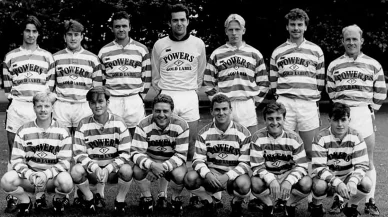
Historic team photo of Shamrock Rovers from the 1904-1905 season, when the club (then playing in stripes) won the County Dublin League and the Leinster Junior Cup.
For the next decade or so, Shamrock Rovers FC enjoyed a period of success, partly because of their Famous Four, the Four Fs. Comprising Bob Fullam, Jock Fagan, John Joe Farrell and Dinny Flood, this impressive forward line meant that they had arguably the strongest attacking squad in Irish league history.
In 1926, smack bang in the middle of this golden era, the team moved to Milltown ground, which served as its home for over 60 years until the site was sold for redevelopment in 1987. At around the same time, they also changed their kit to the iconic white and green hoops that they still wear today, and which gave the team the nickname ‘The Hoops’.
The new kit and stadium, combined with the Four Fs, gave the team the confidence they’d need to become regular league champions and cup specialists. Between 1929 and 1933, they won the FAI cup five times, establishing their reputation as the top club in Ireland and regularly drawing in crowds of over 30,000 people — all before today’s multi-million investments and globally televised matches.
The Club’s Recent History
Stephen Bradley Takes the Reigns
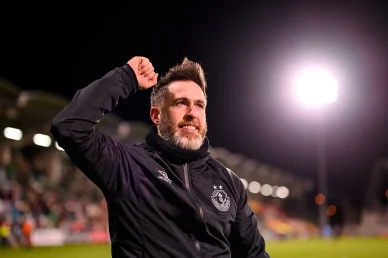
Stephen Bradley, head coach of Shamrock Rovers since 2016, who has led the club to multiple league titles and domestic trophies.
Shamrock Rovers FC continued to grow in prominence throughout the 20th century, adding title after title and cup after cup to the trophy room. By the turn of the millennium, they’d firmly cemented themselves as the most popular football team in the Irish leagues.
2016 saw Stephen Bradley taking the reins as the team’s manager, and it didn’t take him long to make an impact. His unique managerial style saw him continue to win big games while simultaneously placing an emphasis on the development of young players.
Bradley supplemented that with key signings like that of midfielder Jack Byrne, who’s scored 26 goals in over 140 appearances for the club. Byrne played in the FAI Cup 2019 final, which the Hoops won on penalties. That marked the end of a 32-year drought in the cup and signalled the start of a new modern success story.

Shamrock Rovers' Stephen Bradley RTÉ manager of the year 2025
The following year, in 2020, they were unbeaten in the league and won their first league title in nine years. They won for the next three years in a row, too. That meant that Shamrock Rovers had secured four consecutive titles and equalled their record from the 1980s.
The Move to Tallaght Stadium
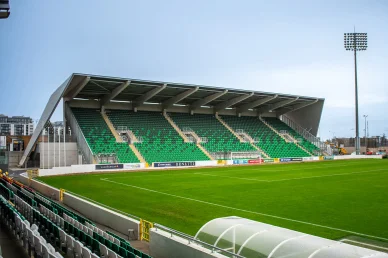
Tallaght Stadium, the 10,000-capacity home ground of Shamrock Rovers, located in Tallaght, South Dublin, which opened in March 2009.
In 2009, Shamrock Rovers completed the move from their smaller, more traditional grounds to the much more modern Tallaght Stadium. Located in South Dublin, the new stadium boasts better amenities and improved facilities that rival those of some of the biggest clubs in the world. It can house over 10,000 fans, which has led to improved attendances on match day and crowds of 6,000+ for average league games.
This growing attendance reflects how important the club has become to the local community, in part due to the work it does to engage the youth through outreach programmes and youth academies. It’s a shrewd move for the club, as recruiting a strong youth squad has become a key strategy for Bradley and his head coaches.
Inside the Current Squad
Club's Stars and Key Players
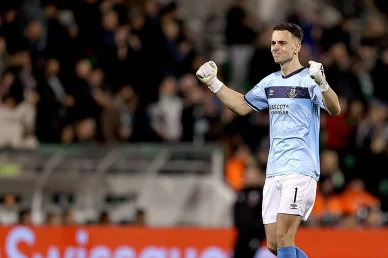
Leon Pohls, goalkeeper for Shamrock Rovers Football Club.
Today, fans are able to celebrate a strong team of Shamrock Rovers players, who are captained by iconic centre back Roberto Lopes. Lopes leads from the back, with Leon Pohls in goal. Pohls is one of the best in the game, and fans say he has the safest hands in the league.
And let’s not forget midfielders Dylan Watts and Darragh Nugent, both of whom are solid players who do a great job of maintaining possession and pressing forward. We might not have the iconic Shamrock Rovers players of the past like the Four Fs, but today’s team is more than capable of continuing the club’s iconic legacy.
Part of the team’s success is down to Stephen Bradley’s approach to squad development, which boils down to nurturing the youth team while backing them with experienced professionals, and making occasional transfers when he needs to augment the roster.
It’s no surprise, then, that the club has produced so many Irish internationals.
The Team’s Tactics and How They Play
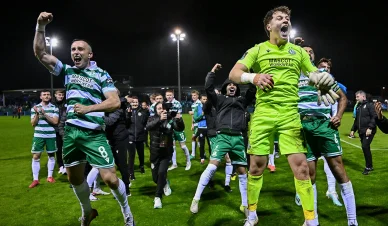
Shamrock Rovers players celebrate their victory on the pitch after winning the match
As you can probably tell from their solid midfielders, Shamrock Rovers players tend to focus on possession football, a tactical approach that allows them to grind their opponents down until they make mistakes that the team can pounce on.
Manager Stephen Bradley often uses a 3-5-2 or 3-4-3 formation, placing a heavy emphasis on his midfielders. He’s also drilled the squad to the point where their set-piece game strikes fear into the hearts of the rest of the league, but they also play with a fluid style that powered their European adaptation and allowed them to dominate even outside of the league.
This strategic versatility, combined with Bradley’s emphasis on home-grown talent and player development, has ensured that the Rovers are more than capable of holding their own against the teams of today while preparing to face the opponents that will come tomorrow.
The Rovers in Europe
European Firsts
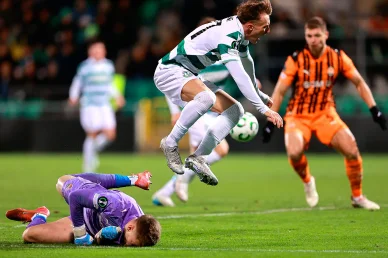
Shamrock Rovers’ Danny Grant gets past Shakhtar goalkeeper Kiril Fesiun.
Shamrock Rovers F.C. has a rich and storied history of success in Europe, going back as far as the European Cup 1957, when they were the first Irish club to play in the competition. The tie didn’t go the Rovers’ way, though—they lost 6-0 to Manchester United. And with United’s global legacy — shaped by icons like Cristiano Ronaldo — it’s a reminder of just how huge that stage was for an Irish club to step onto so early.
However, their presence in the European Cup was a sign of things to come, with the team continuing to compete at the top tier of European competition throughout the decades.
That includes an iconic campaign during the 2011 Europa League, when they made history by becoming the first Irish club to qualify for the group stages of the prestigious competition after beating Partizan Belgrade in the play-offs.
In more recent years, the team qualified for the UEFA Europa Conference League in 2022 and 2024, reaching the group stages in both years. And while it’s true that they haven’t yet won a major European title, if they continue along their current trajectory, it can only be a matter of time.
Success in the Conference League
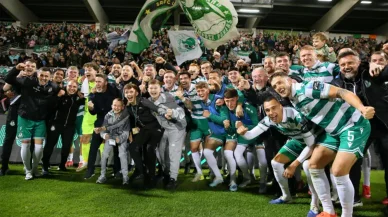
Shamrock Rovers players celebrate their victory together on the pitch after winning the match.
During the 2024 Conference League, Shamrock Rovers FC made history by reaching the knockout play-offs, signalling the team’s serious intent to be competitive above and beyond their success in the Irish leagues. Their campaign began with wins against Iceland’s Vikingur and Slovenia’s NK Celje, along with a string of group stage victories against Northern Ireland’s Larne FC, Wales’ New Saints and Bosnia and Herzegovina’s FK Borac Banja Luka.
These key wins signalled significant progress for Irish football on the international stage, showing how a club from Dublin could take on Europe. It also brought significant financial benefits in terms of ticket sales and merchandising rights, as well as boosting the club’s profile in Europe and beyond.
The Team’s Records and Achievements
As you’ve seen today, Shamrock Rovers have grown from its humble roots to become the top team in Irish football, scoring a huge number of record achievements and Irish firsts.
This includes an incredible 21 league titles and 25 FAI Cups, as well as more domestic cups and regional honours than we could list without doubling the length of this article. Shamrock Rovers F.C. have also supplied 64 internationals to the Irish national football team, which is more than any other club in the country.
All of these milestones and records show a clear continued ambition from the club to keep on putting Irish football on the map. In the years to come, you can expect to see further domestic dominance and a bigger push into Europe, especially if Stephen Bradley keeps up the good work. And at just 40 years old, he’s still got a lengthy career ahead of him.
It’s a good time to be a Hoops fan.