Ryanair vs Wizz Air
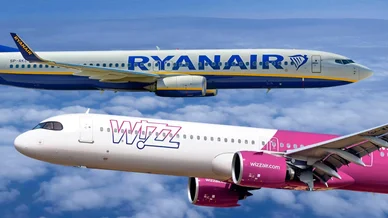
Ryanair is the largest low-cost carrier in Ireland. Wizz Air, a leading budget airline based in Budapest, Hungary, operates the most extensive fleet in the country. Both are popular, and both have their pros and cons that this article will examine — starting with a comparison of what customers can expect from these budget airlines.
Feature | Ryanair | Wizz Air |
Basic Flight Pricing | €15-€40 | €20 -€45 |
Routes | Over 240 destinations in 40+ countries across Europe | Over 200 destinations in 55 countries across Europe and the Middle East |
Baggage Polices | One free small personal bag | One small personal bag for free |
Customer Service | Chatbot for 24/7 support and a phone line | Virtual assistant, phone line, and an online claim form |
Value | Very low base fares; best for budget-conscious travelers who pack light | Competitive fares; extra savings with Wizz Discount Club or Multipass subscriptions |
This Ryanair vs Wizz Air table provides a quick overview of both airlines, but let’s take a closer look at how they compare in more detail.
Company Backgrounds
The Rise of Ryanair
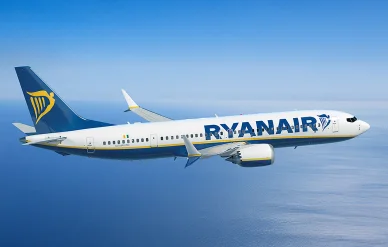
Ryanair Boeing 737 Ryanair Boeing 737 in flight, Europe's largest low-cost airline with its distinctive blue and yellow livery.
In 1984, Tony Ryan, Christopher Ryan, and Liam Lonergan founded Ryanair to create a no-frills airline model that was cheaper and simpler than their competitors
The airline only had one route from Waterford, Ireland, to London-Gatwick Airport, maintaining it for a year. They eventually moved to London Luton Airport and expanded their fleet with planes and passenger numbers.
In 1990, the airline began removing business class seats and onboard meals. Later in the 1990s, it focused on standardizing its fleet with Boeing 737-800 aircraft. The airline continues this practice today, operating a fleet of over 550+ Boeing aircraft and serving more than 200 destinations across Europe and North Africa.
Ryanair Ireland placed its first major order for Boeing 737-800s in 1998, valued at about $2 billion. That move, together with a focus on online bookings, helped the airline grow into Europe’s largest low-cost carrier.

Ryanair – Low fares, great care
Between 2017 and 2019, the airline established subsidiaries in Poland (Ryanair Sun, later Buzz), the UK (Ryanair UK), and Malta (Malta Air). Today, Ryanair remains Europe’s largest low-cost airline.
Wizz Air’s History Of Expansion
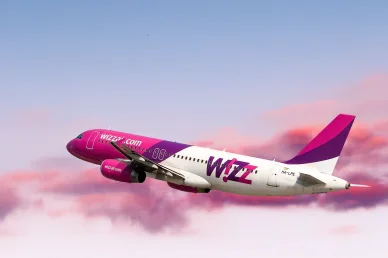
Wizz Air Airbus aircraft in flight displaying the airline's distinctive purple and pink livery.
Wizz Air was founded in 2003 by József Váradi, with its first flight a year later from Katowice International Airport to London Luton Airport. The company began expanding rapidly in 2015, ordering more than 300 Airbus A320-family aircraft between 2015 and 2021. Today, Wizz Airlines operates a fleet of over 200 Airbus A320 and A321 aircraft, serving more than 180 destinations across more than 50 countries.
The new plane orders coincided with the airline’s use of several secondary airports. The company established Wizz Air UK in 2017, Wizz Air Abu Dhabi in 2021, and Wizz Air Malta in 2022. This expansion allowed the airline to enter new markets in the Middle East and Central Asia.
However, the bulk of the company’s expansion focuses on Central and Eastern Europe due to the opportunities for growth there. The airline is also preparing to expand its fleet and market share in Western Europe, particularly in Italy and Spain, while slightly reducing operations in the Middle East.

Let's WIZZ
Today, Wizz Air’s focus on building a fleet of modern aircraft, as well as its efforts to keep passengers comfortable with a range of customizable options, sets it apart from competitors.
Where You Can Fly With Ryanair and Wizz Air
Ryanair’s Networks Across Europe and Beyond
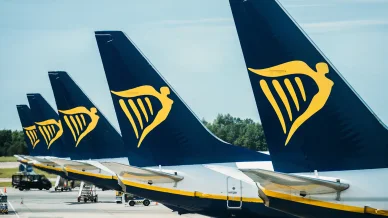
Multiple Ryanair Boeing 737 aircraft parked at airport apron with distinctive blue and yellow livery visible on the fleet.
The carrier has come a long way from operating a single route to serving hundreds of destinations across a vast European network. Unlike traditional airlines, Ryanair flights mainly connect smaller airports. At the same time, it operates from major hubs like London and Dublin, offering routes to Italy, Greece, Croatia, and Portugal.
Ryanair has built a strong presence across airports in Ireland, Spain, Germany, and the United Kingdom. Alongside its year-round network, regular travelers can also choose from a variety of seasonal flights. For instance, summer routes connect Dublin with sunny southern destinations such as Naples, Ibiza, and Santorini. Winter Ryanair flights take Irish holidaymakers to some of Europe’s most popular ski resorts in the Alps, including Salzburg and Turin, and Grenoble.
In the summer of 2026, the airline will open a new base in Tirana, offering flights to Dublin, Naples, Poznań, and Milan. It also continues to strengthen its airport partnerships, working with Dublin and Cork airports to expand capacity on high-demand routes. This includes increased frequencies on key Ryanair flights from Ireland to destinations such as London, Madrid, and Milan.
Wizz Air’s Routes: From Eastern Europe to the West
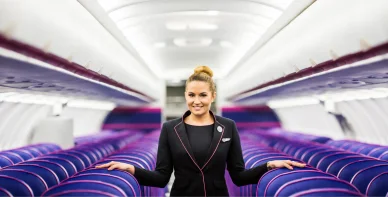
Wizz Air flight attendant in purple and pink uniform serving passengers inside aircraft cabin.
Wizz Air has built its network around Central and Eastern Europe, linking key markets such as Romania, Poland, and Hungary. Its main base locations are in Warsaw and Budapest.
In early 2026, the airline will open a new base in Podgorica, Montenegro, deploying two Airbus A321neo aircraft and launching 14 new routes. The carrier has also announced its largest expansion in Albania, adding destinations to Tenerife, Cologne/Bonn, Stockholm Arlanda, and Billund. As part of this plan, weekly flights from Tirana International Airport will increase on services to Milan Malpensa (from 16 to 21), Brussels Charleroi (11 to 14), Turin (9 to 11), and Berlin Brandenburg (7 to 9).
At the same time, the airline is expanding its presence in Western Europe—particularly in Italy and Spain—and introducing additional flights from Poland to Portugal and the Netherlands.
Like Ryanair, Wizz Air is increasing flight frequencies on key connections. Operating under an ultra-low-cost model and a young, fuel-efficient Airbus fleet, the airline keeps expenses and maintenance overheads low, allowing it to offer more daily departures at affordable fares.
Cost and Value Analysis
Wizz Air vs Ryanair: Fare Comparison
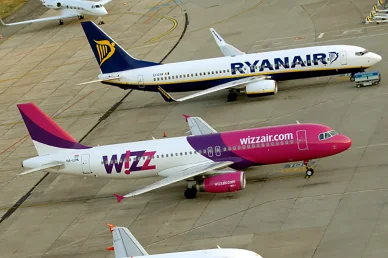
Two aircraft parked at airport - a Ryanair plane with blue and yellow livery next to a Wizz Air aircraft with purple and pink colors.
When comparing budget airlines, the biggest differences often appear beyond the base fare. Many extras come with additional fees, so the final price can vary more than you expect.
Feature | Ryanair | Wizz Air |
Base fare | Small under-seat bag 40×30×20 cm. Random seat included. Paid seat selection or included in Plus/Flexi Plus bundles | Small under-seat bag 40×30×20 cm. Random seat (seat selection paid or included in WIZZ Go/Plus bundles) |
Baggage fees | Depending on the route and dates. Priority & 2 Cabin Bags option for €6–€36 online. 10 kg checked bag €9.49–€44.99 | WIZZ Priority €5–€58 online. Checked bags (10 kg / 20 kg / 32 kg) – prices vary by route and season |
Priority boarding | Included in the Priority & 2 Cabin Bags option | Included in the WIZZ Priority option |
On-board meals | Buy-on-board. Meal Deal around €11 | Buy-on-board. Meal deals range from €8.50 to €11.50 |
Both airlines provide bundles and loyalty programmes with extra benefits. Ryanair offers Ryanair Prime, an annual membership for around €79 with access to exclusive flight deals, early sales, and other travel perks. Wizz Air runs the WIZZ Discount Club for €59.99 per year and the WIZZ Privilege Pass for €249 per year. These bundles feature flight and baggage discounts, free seat selection, and priority boarding.
Hidden Fees and Extra Options
With both airlines being low-cost, there are several ancillary revenue fees and hidden charges that can ambush customers if they aren’t careful. For Ryanair, the checked baggage fees vary based on how large the bag is. A 10 kg checked bag usually costs between €9.49 and €44.99 online, while a 20 kg bag ranges from about €18.99 to €59.99. Wizz Air also allows extra checked bags with costs ranging roughly from €12 to €70, depending on bag size, route, and booking time.
Wizz Air tends to have slightly higher additional fees than Ryanair, although the difference is relatively small, and both airlines still face criticism for limited price transparency. For the cheapest flights without a subscription plan, the Irish airline generally offers better value. However, for frequent travelers, a Wizz Air subscription provides better overall value through bundled discounts.
Overall Passenger Experience
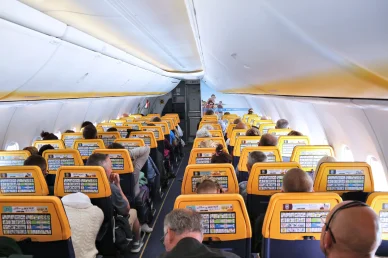
Interior cabin of Ryanair Boeing 737 aircraft with passengers seated in rows during flight.
Onboard Comfort
Ryanair’s seats are fairly basic on short-haul flights. They are narrow and non-reclining. You shouldn’t expect much in terms of seat comfort, adjustable headrests, or built-in entertainment. However, they work fine for short trips. “Extra legroom” seats are available for purchase in select rows.
Wizz Air offers a similar cabin experience, with seats that have little or no recline. Passengers can book a premium or extra-legroom seat for an additional fee.
For in-flight amenities, Ryanair doesn't provide free food, built-in entertainment, or onboard Wi-Fi. The carrier runs a “Getaway Café” service and an onboard retail catalogue available for pre-flight purchases. The Hungarian budget airline follows a similar model, with food and drinks available for purchase. It offers no built-in in-flight entertainment system or onboard Wi-Fi.
Ryanair’s fleet is largely made up of older Boeing 737-800 aircraft, which the company plans to replace with Boeing 737 MAX models. Meanwhile, Wizz Air operates a comparatively more modern fleet of Airbus A320-family aircraft, with a younger average age.
Service Quality
The customer service ratings for Ryanair are generally low. Many reviewers mention that Ryanair seems more interested in collecting extra fees, constantly adding costs for basic services. Passengers also mention that while the crew can be professional, they are not always friendly in complaint handling. According to comments, boarding at the gate and finding your seat can sometimes feel rushed and disorganized.
Wizz Air likewise receives mixed customer feedback. Many users report difficulties communicating with customer service by email or phone. Travellers also point out difficulties receiving refunds, problems with checked bags, and frequent upselling. However, the airline also receives positive reviews for its professional staff and smooth flight experience, which improves overall passenger satisfaction.
The mobile app for both airlines receives mixed feedback. For instance, Wizz Air’s dedicated app is praised for offering all necessary features for check-in, but it often has technical issues. At the same time, Ryanair’s app can be helpful, but some users report issues with luggage charges.
Ryanair vs Wizz Air: Travel Recommendations
When it comes to airline selection, the choice largely depends on your travel destination. Ryanair offers frequent low-cost flights across Europe, providing one of the most extensive networks on the continent, while Wizz Air focuses on Eastern European and Middle Eastern routes with a newer, more comfortable fleet.
If you travel frequently across Europe, the Irish low-cost carrier can help you save money, offering plenty of flight options to choose from. At the same time, you may benefit from Wizz Air’s subscription options, such as the Wizz Discount Club or MultiPass.
However, for both airlines, it’s important to book in advance and understand their rules to avoid extra charges or unnecessary add-ons. The more you plan ahead and think about route optimization, the smoother and less rushed your experience will be. After all, flying with a low-cost airline doesn’t have to be stressful — just a matter of smart planning.