Ireland
Welcome to the Emerald Isle. Known as a historic setting in Western Europe, Ireland is a beautiful island nation famous for its rich Celtic heritage. We’re all familiar with the Land of Saints and Scholars, but today we’re going to do a deep dive to discover that the great country of Ireland is far more than just its stunning landscapes and spirited modern culture.
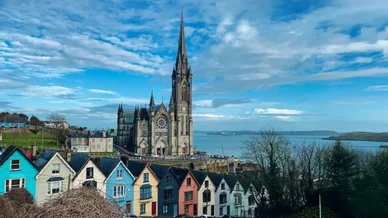
We’ll cover the who, the what, the why, and the where, and explore the most fascinating Irish facts that you never knew.
Ireland’s Geographic Identity
Where is Ireland?
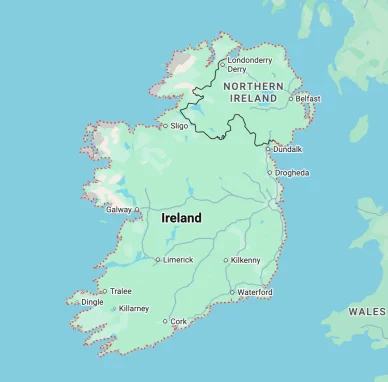
Geographical map of Ireland displaying the island's topography, regions, and major cities
Ireland occupies a coveted position as the westernmost country in the European Union. Because of its location, the island serves as a sort of strategic gateway to the Atlantic Ocean. In order to understand its rich and tumultuous history, it is surprisingly important to grasp the significance of where exactly Ireland is.
The island’s coordinates span from 51°30' to 55°30' North latitude, placing it firmly within the temperate zone and subjecting it to the moderating influences of the Atlantic’s currents and winds. It is bordered by the Atlantic Ocean on the west, south, and north. To the east, it is neighbored by the United Kingdom, from which it is separated only by the Irish Sea.
Geologically, Ireland’s formation is a story of ancient tectonic drama. Its bedrock was shaped during the Caledonian orogeny, a mountain-building period that occurred roughly 390-490 million years ago. The landscape that emerged from these processes is one of contrasts: low-lying central plains ringed by rugged mountains, extensive bogs, and a coastline indented by cliffs, bays, and peninsulas.
Measuring the Island of Ireland: Area, Length, and Coastline
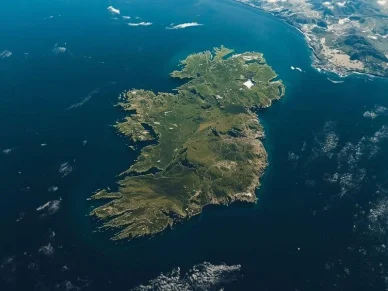
Satellite view of the island of Ireland from space
Ireland is Europe’s third-largest island, following Great Britain and Iceland. It comes in at a whopping total area of 84,421 km² (or 32,595 square miles), making it the 20th largest island in the entire world. The size of Ireland can be understood by the 486 km it spans from north to south as compared to its 275 km east to west.
Ireland’s size, however, falls short when it comes to international comparisons. The island does not rank among the world’s 100 largest landmasses, although it remains one of Europe’s more significant islands, standing as the third-largest in the region. Comparatively, Ireland is slightly larger than South Carolina in the United States and closely matches the size of Austria in Europe. Its landmass, though modest by global standards, encompasses a remarkable diversity of landscapes.
Ireland’s notoriously beautiful coastline stretches for 7,524 km, making it one of the longest coastlines in Europe. Dynamic and vulnerable, Ireland’s coastline features picturesque cliffs and peninsulas along its main island and the many smaller islands nearby.
The People of the Emerald Isle

Irish people wearing clothing in the national colors of green, white, and orange, celebrating their heritage
Population Statistics
As of April 2025, the Republic of Ireland’s population reached 5.458 million people, marking a significant increase driven by natural growth and sustained immigration. The Dublin metropolitan area is home to approximately 1.568 million people, accounting for nearly 29% of the national population. This underscores the capital’s role as the country’s primary urban and economic center.
The population of Ireland has a density of about 77 people per km², with higher concentrations in urban areas and along the eastern and southern coasts. The urbanization rate is estimated at 70%. Demographic indicators for 2025 include:
- Median age: 39 years, reflecting a gradually aging population but still below the EU average of 44 years.
- Age structure: 18.3% of the population is under 15, while 15.8% is aged 65 and over.
- Growth rate: Approximately 1.13% annually, sustained by positive net migration and a relatively high birth rate compared to other EU countries.
These growth statistics, among others, demonstrate a steadily growing population of Ireland. The numbers are even more intriguing when considered alongside the population of Northern Ireland.
Island of Ireland: Demographic Profile
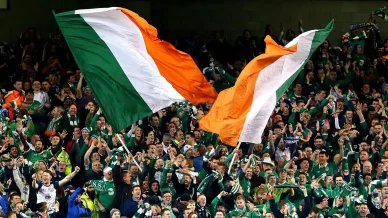
Irish supporters on the stands during a sporting event, dressed in national colors and cheering for their team.
The population of the island of Ireland, comprising both the Republic and Northern Ireland, surpassed 7 million people total in 2022 for the first time since the mid-19th century and has continued to grow since. The Republic accounts for about 78% of the total population with Northern Ireland making up the remaining 22%. This demographic distribution reflects historical and more recent patterns of growth.
The shared cultural heritage and strong economic ties between the two are far more significant today than the political divisions shaped by Ireland’s complicated history. Many families maintain connections on both sides of Ireland, and thousands commute daily across the border for work. Migration trends show more foreign-born residents in the Republic (20%) than in Northern Ireland (13%), but day-to-day contact across the island remains strong.
Projections to 2050 suggest continued growth for the island of Ireland’s population. The Republic’s population is expected to reach between 5.9 and 6.3 million. Depending on migration scenarios, the island’s total population could approach 7.5 million.
The Road to Independence
The Formation of Modern Ireland
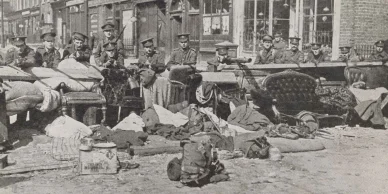
British soldiers holding a street in Dublin during the Easter Rising, 1916.
Determining how old Ireland is complicated. Technically, the modern Irish state has existed for 103 years. Yet although the Republic is now an independent nation, the island’s journey to freedom was marked by resilience, tragedy, and sacrifice. Modern Ireland traces its origins to the 1916 Easter Rising, a pivotal insurrection against British rule that, though initially unsuccessful, galvanizeв public support for self-determination.
The 1919-1921 War of Independence saw the Irish Republican Army wage a guerrilla campaign culminating in the Anglo-Irish Treaty of 1922. This treaty established the Irish Free State as a dominion within the British Commonwealth, while six northern counties remained under Unionist control as Northern Ireland.
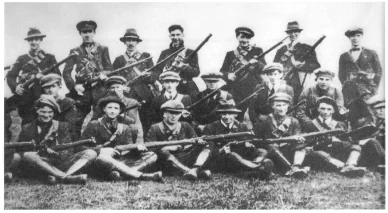
Members of Seán Hogan’s flying column of the 3rd Tipperary Brigade, IRA, during the Irish War of Independence.
The following years were shaped by the Irish Civil War (1922–1923), which ultimately laid the foundations for the island’s major political parties. Ireland’s constitutional development, in particular, gave the country its modern name and helped shape the nation we know today. In 1949, the Republic of Ireland Act formally declared the state a republic, severing the last constitutional ties to the British monarchy.
And when it comes to the question of how old Ireland is in the context of an independent country, the answer depends on perspective: as a state it is 103 years old (dating from 1922), while as a republic it has existed for 76 years since 1949.
Structure of Ireland’s Government
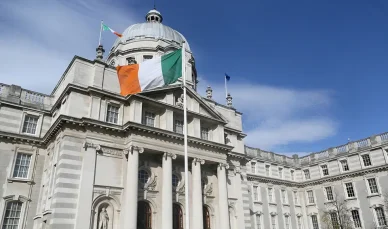
The main Government Buildings complex in Dublin, seat of key departments of the Irish state
The Republic of Ireland is a parliamentary democracy with a constitutional framework. The Oireachtas, or national parliament, consists of the President of Ireland and two houses: Dáil Éireann (the lower house) and Seanad Éireann (the upper house). The President, elected for a seven-year term (renewable once), serves as the ceremonial head of state, while the Taoiseach, or Prime Minister, leads the government and exercises executive authority.
The Dáil comprises 160 members (TDs) elected by proportional representation using the single transferable vote in multi-seat constituencies. The Seanad has 60 members, selected through a combination of university constituencies, vocational panels, and Taoiseach nominations.
Major political parties include:
- Fianna Fáil. Traditionally centrist and republican, with deep roots in the independence movement.
- Fine Gael. Center-right, pro-European, and historically associated with pro-Treaty forces.
- Sinn Féin. Left-wing, nationalist, and one of the largest parties in the Dáil, advocating for Irish unity.
- Labour, Green Party, Social Democrats, and others. They represent a spectrum of progressive, environmental, and social justice perspectives.
Today, Ireland maintains independent membership of the European Union, and its relationship with the EU remains central, with active participation in policymaking. It is committed to the single market and to dealing with the ongoing post-Brexit changes, especially when it comes to Northern Ireland.
Cultural and Historical Legacy
Celtic Beginnings
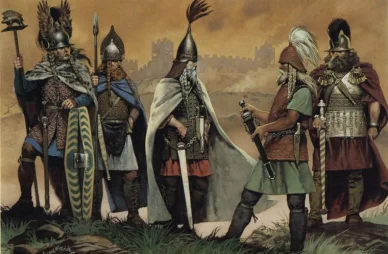
Illustration of ancient Celtic warriors, armed with spears and shields, wearing traditional armour and cloaks
Though Ireland’s relationship with the UK is perhaps more commonly known, its ancient Celtic civilization is the bedrock of its cultural identity.
Although archaeological evidence traces human settlement in Ireland back to the Mesolithic era, the arrival of the Celts around 500 BCE coincided with the Iron Age and laid the foundations of Gaelic society. a Tène culture shaped much of Ireland’s Iron Age material culture, including the warrior ethos later reflected in legendary figures like Cú Chulainn.
One of the most well-known Irish facts is that Ireland’s pre-Christian culture was guided by druids, its spiritual leaders. Their teachings were entirely oral, but Ireland’s early written tradition emerged later through Ogham inscriptions. They provide some of the earliest linguistic evidence of the Celtic world.
In 432 AD, Saint Patrick played a central role in spreading Christianity, forever altering Irish culture and society. Monasteries became cultural hubs that produced masterpieces like the Book of Kells. Despite these changes, Ireland has managed to maintain its Celtic traditions. From music and storytelling to festivals and language, these heritage elements continue to form the core of Ireland’s modern cultural revival.
Ireland’s Linguistic and Literary Legacy
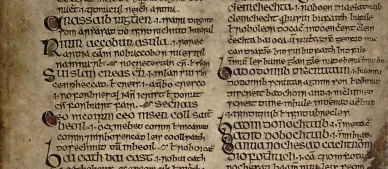
Page 12 of the medieval Irish manuscript Lebor na hUidre (‘Book of the Dun Cow’), MS 23 E 25, showing early Irish script and ornamentation.
Irish Gaelic is the first official language of the Republic. It is enshrined in the constitution and central to country's national identity. According to the 2022 census, 1.87 million people claim some ability to speak Irish, but only about 73,000 are native speakers. Most of them live in the “Gaeltacht regions”, where Irish is spoken as the community language. Although the number of daily speakers is declining, the government supports the language through various programmes.
Ireland's literary legacy is globally celebrated — an Irish fact that will surprise no one. W.B. Yeats, George Bernard Shaw, Samuel Beckett, and Seamus Heaney are Irish Nobel Prize winners who have all left a deep mark on world literature. Meanwhile, James Joyce is a national icon, a writer whose influence stretches far beyond Ireland. Dublin honours him each year on 16 June with Bloomsday, a festival inspired by his novel Ulysses.
Ireland’s Modern Economy
How Ireland Transformed Its Economy
Over the past century, the Irish economy has reshaped itself. For much of its history, Ireland was a predominantly agricultural country. That began to change in the late 20th century, when it opened up to free trade and foreign investment. It led to the “Celtic Tiger” boom of the 1990s and 2000s. Back then, everyday prices were still in the Irish pound (punt) before the country fully moved over to the euro — a shift that also reflected Ireland’s deeper integration with Europe.
Today, Ireland has a GDP per capita of €85,000 (2025), one of the highest in the EU. The Republic is a home to a world-class tech scene and major players in pharmaceuticals and financial services.
Here are some of the key factors driving the country’s economic growth:
- 12.5% corporate tax rate: One of the main reasons so many multinational corporations — especially US tech giants — choose to invest in the country.
- Tech sector:Google, Meta, Apple, Microsoft, Amazon, and other global companies have major European hubs in Dublin. They provide thousands of jobs and have helped turn the city into a tech hotspot.
- Pharmaceuticals and life sciences: Ireland is one of the world’s leading pharma exporters. Companies like Pfizer and Johnson & Johnson run large manufacturing sites here.
- Financial services: Dublin’s International Financial Services Centre (IFSC) hosts major global banks: Citi, JPMorgan, Barclays and HSBC. It stands as one of Europe’s key financial hubs.
- Tourism: Ireland welcomes around 11 million visitors each year, bringing in roughly €7 billion.
Despite global headwinds, Ireland’s economic outlook remains positive. GDP for 2025 came in at around 3.6% growth. It shows that the country has held its course through shifting trade and regulatory conditions.
Natural Resources and Agriculture
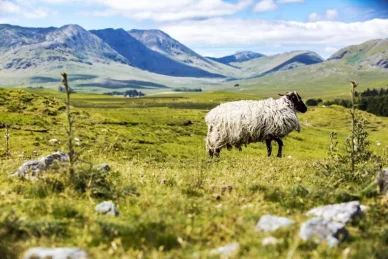
A sheep standing on the grassy slopes of the Irish countryside
Despite the country’s economic transformation, agriculture and food production remain central to Ireland’s economy. For example, companies like the Kerry Group and Glanbia have gone from traditional dairy cooperatives to leaders in global nutrition. The island’s mild, temperate climate makes it an ideal place for dairy, sheep, fishing industry and cattle farming.
Ireland now focuses on the sustainable use of its natural resources. The country is turning toward renewable energy, especially offshore wind, and the drop in peat extraction proves it. The Republic aims to achieve 80% renewable electricity by 2030 and net-zero emissions by 2050. Food security and export capacity are now key priorities as Ireland adapts to climate change, including the government’s Nature Restoration Plan and its push for biogenic methane accounting.
Ireland’s Landscapes Worth Seeing
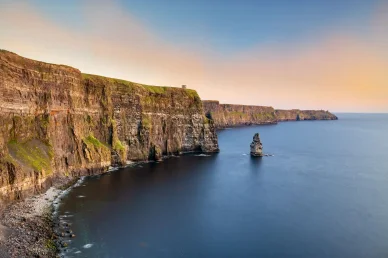
Scenic view of the Irish coastline, featuring rugged cliffs, green hills, and the blue waters of the surrounding sea
The island’s coastline features some of its best-known landmarks. The Cliffs of Moher, which rise 214 metres above the Atlantic and form part of a UNESCO Global Geopark, are among the most striking. The Ring of Kerry follows a circular route around the Iveragh Peninsula in the southwest of the island, famous for its dramatic coastal views. One of the interesting Irish facts is that Skellig Michael — a UNESCO World Heritage site off the Kerry coast — served as a Star Wars filming location because of its striking monastic setting.
Other major attractions include the Giant’s Causeway, noted for its unusual geology, and the Dingle Peninsula, where traditional Irish culture remains very much alive. Ireland’s “40 shades of green” (green landscapes), along with landmarks such as Bunratty and Ashford Castle, draw around 11 million visitors each year and bring in about €7 billion in tourism revenue.
Urban Centers
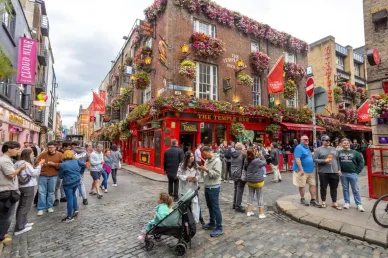
A typical street in Dublin city, lined with historic buildings and busy with everyday life
Dublin: Cultural Heartbeat
Dublin is not only Ireland’s capital but also its biggest city with a metro population of about 1.4–1.5 million. It’s home to Trinity College, founded in 1592, the Temple Bar cultural quarter with its pubs and small galleries, Dublin Castle, Christ Church Cathedral, dating back to the early 11th century, and Phoenix Park, one of the largest urban parks in Europe. Late-18th-century Georgian streets keep the spirit of that era alive, while pub culture keeps the city lively — from quiet neighbourhood pubs in Smithfield, Portobello, or Rathmines to modern gastropubs.
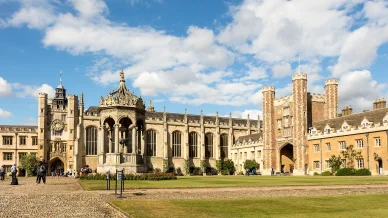
View of the Great Court at Trinity College Dublin, with its historic collegiate buildings surrounding the central square
Today, Dublin has a real tech-hub reputation, with global companies and plenty of start-ups set up here. At the same time, it stays one of Europe’s strongest cultural centres, with places like the National Gallery of Ireland, the Irish Museum of Modern Art (IMMA), National Concert Hall, or the Abbey Theatre.
Cities and Towns Across Ireland
Ireland isn’t all about Dublin. Other cities and towns offer plenty as well. For example, Cork is often called Ireland’s “second city” and the “capital of the south.” It’s known for great food and long-running local festivals with old maritime roots. Galway on the west coast is full of arts, music, and Irish-language life with a relaxed, slightly bohemian feel. Limerick is a center of education, sport, and innovation with a rich medieval history. Its big highlight is King John’s Castle, a 13th-century fortress right by the River Shannon. Waterford in the south-east is Ireland’s oldest city, founded by the Vikings. It has a long tradition of crystal-making and the Waterford Crystal name still carries weight.
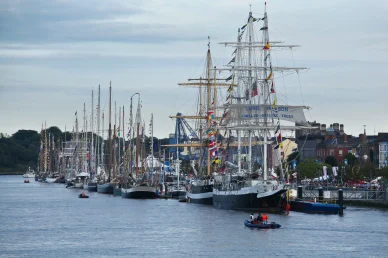
Tall ships lined up along the quays in Waterford for the maritime festival, with their masts and rigging dominating the waterfront skyline
Ireland’s population is spread across places with very different characters, and this regional diversity is easy to see from Cork to Galway, Limerick, and Waterford.
Environment and Climate
Ireland’s climate is temperate oceanic with mild winters of 4-7°C and summers usually sit around 14–16°C. Winter brings plenty of Atlantic storms, while summer gives you long, bright evenings. The North Atlantic Drift keeps Ireland milder than places on the same latitude.
It brings warmer water to the island’s shores, so the country never gets as cold as you’d expect. The island is known for its rain, especially in the west, with an average of about 1,200 millimetres a year. It might not be everyone’s favourite weather, but all that rain keeps the country so green — a bit of an Irish fact at this stage.
There’s concern that climate change could weaken the Gulf Stream influence on the island`s climate. So the government set a 2050 carbon neutrality goal and added new steps for rewilding and environmental conservation.
Home-Grown Irish Sports
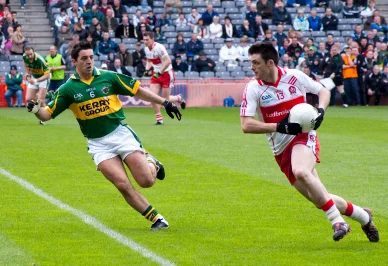
Action from a Gaelic football match in Ireland, with players battling for possession on the field
A lot of what people love about Ireland comes from its sports culture. The Gaelic Athletic Association (GAA) plays a massive role in that. So it’s no surprise that the Republic has no shortage of standout athletes, including world boxing champion Katie Taylor, former Manchester United captain Roy Keane, Sonia O’Sullivan, an Olympic medallist in athletics, legendary Irish rugby player Brian O’Driscoll, and Pádraig Harrington, a multiple major winner in golf.
Traditional sports like hurling and Gaelic football run at amateur level in almost every parish. Their roots go back many centuries. For example, hurling is mentioned in Irish sources as early as the 7th century. Early players were mostly young clansmen, and the game had no fixed rules, so it looked far wilder than the version played today. And here’s one more Irish fact you might not know: the All-Ireland Championships for these games pack more than 80,000 people into Croke Park each year.
How Ireland Learns and Innovates
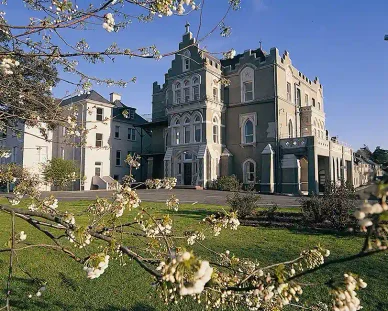
View of the University College Dublin (UCD) campus, showcasing its modern buildings and landscaped grounds
Ireland has a strong education system, with a high level of literacy (about 98%) and clear focus on STEM disciplines in schools. Trinity College Dublin and University College Dublin (UCD) are the two leading universities in the country. Their international programmes bring in students from many countries and this mix encourages real cultural exchange. Trinity College also holds 87th place in the 2025 QS World University Rankings. It runs Trinity Innovation & Enterprise and Trinity Research & Innovation programmes designed to help students and researchers turn ideas into real projects.
The EU supports Ireland’s research and development through programmes like Horizon Europe. This funding goes to university projects and laboratories and gives local startups a way to get started, most of which are based in Dublin. UCD also runs the Nexus Innovation Centre, an active incubator for young companies.
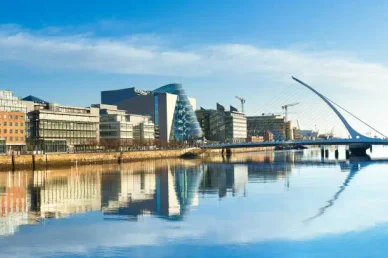
3,800+ Dublin Skyline Stock Photos
Ireland in the Coming Years
Today, the country faces a mix of issues and opportunities. One clear example is housing challenges, driven by limited supply and high costs. Meanwhile, an aging population and higher expectations put extra strain on the health system. These issues, along with climate change adaptation, are part of Ireland’s long-term plans to keep a strong position in Europe after Brexit.

For a deeper look into Ireland's history, check out this video
At the same time, the Republic of Ireland has as many opportunities as challenges. These include the growth of renewable energy, a fast-developing digital economy, and strong links with its global diaspora. Ireland continues to balance progress with the need to preserve its cultural identity and natural heritage, a balance that will shape its development in the years ahead.