Roy Keane
Roy Keane is one of the most notable figures of Irish football, a man with an impressive career and a legacy as a football icon that few other players can compare to. In his prime, the midfielder was known for the ferocity of his play and his impressive leadership as a team captain for both club and country.
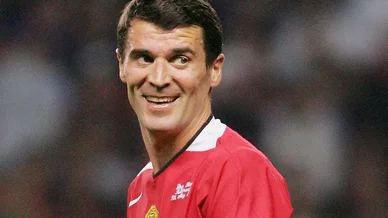
Back in the day, he was known for his elite standards and the high level of performance that he expected of the players he worked with. But what about today?
In this article, I’ll be sharing some key Roy Keane facts and covering his career from start to finish, along with his life off the pitch and what he’s been up to since his retirement from the beautiful game. Let’s kick things off!
Roy Keane’s Beginnings
Throughout his early career, Roy Keane was known for being a tough, working-class guy who took no nonsense from anyone, whether he was on the pitch or not. Growing up in the city of Cork, Keane played street football and pursued his passion with an intensity that left him struggling at school. It’s a story that’s as old as time.
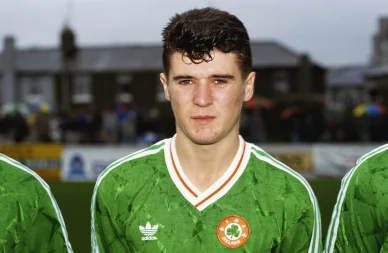
A young Roy Keane in 1991
For Keane, his breakthrough move came when he progressed from his schoolboy games to Cobh Ramblers, a League of Ireland team that he joined at the tender age of 17. Keane was such a strong player that it didn’t take long for him to catch the eye of talent scouts, and he was soon signed to Brian Clough’s Nottingham Forest in 1990.
The youth development programmes at Forest were far better than those at Cobh, which was good news for the young Keane. The team would eventually provide him with a gateway to the top tier of English football.
Keane at Nottingham Forest
Keane’s time at Nottingham Forest didn’t last long, but it’s arguably one of the most important periods of his entire career. At Forest, Keane continued to mature and improve, growing into the hard-tackling central midfielder that he would eventually become. In England, the matches were faster and the opponents were more experienced, requiring him to grow as a player and to learn to adapt on the fly.
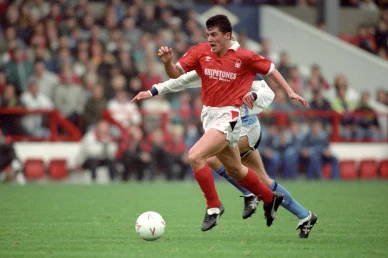
Roy Keane in Nottingham Forest
It was under Brian Clough’s guidance at Nottingham Forest that Keane’s mentality improved and he learned the vital skill of resilience. By the time that he left Forest and moved on to the next chapter in his career, he’d learned how to be the engine at the heart of a team. He’d also gained the confidence he’d need to take centre stage on the global arena. Manchester United was beckoning, and so was the FIFA World Cup.
The Move to Manchester United
1993 saw the Roy Keane Man Utd move, in which the midfielder moved to Manchester United for a then-record British transfer fee of £3.75 million. That might sound like a lot, but the current record is the £125 million transfer fee that Liverpool paid when purchasing Alexander Isak from Newcastle United.
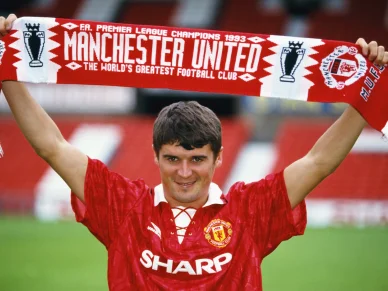
Roy Keane was the only player Alex Ferguson wanted to add to his league-winning squad in the summer of 1993
Keane was originally signed as a direct replacement for Bryan Robson, but it didn’t take him long to become a vital figure in the team and a dressing-room leader. With his typical intensity and his high standards, he soon showed promise as a potential leader thanks to his ability to control the tempo of the game and wear down the opposition.
In 1997, he became the team’s captain, and he helped to underline Ferguson’s commitment to relentless training by leading from the front. He was always a good player, but he was often at his best in his biggest matches, like when he spearheaded a comeback against Juventus in the 1999 Champions League semi-final. In fact, his leadership was so iconic that it’s still debated, admired and celebrated today. This article is a great example of that.
Title Wins and Major Games
Keane’s years at Manchester United were characterised by Premier League titles, Champions League matches and a trophy haul that brought in so much silverware that it would have been a good excuse for the club to build a bigger trophy room. In fact, Keane’s career was so successful that we’re not even going to try to cover everything here.

Roy Keane: All The Goals
With that said, his winning mentality and his reputation as a big-match player didn’t come out of nowhere. His ability to set the tone in the midfield meant that he was admired and feared in equal measure. United would have struggled to function without him.
During his time at Manchester United, Keane won the Premier League seven times and the FA Cup four times, as well as the Champions League in 1999. This latter win was also part of the Treble, a historic achievement that saw the team win all three major trophies.
Keane’s Republic of Ireland Career
Keane was a cracking club player, but it’s the Roy Keane Ireland career that cemented his legacy as a footballing icon. After debuting for the Republic of Ireland in 1991, Keane quickly became one of the most important members of the team, combining his strategic expertise with his hard-hitting tackles and domineering presence in midfield.
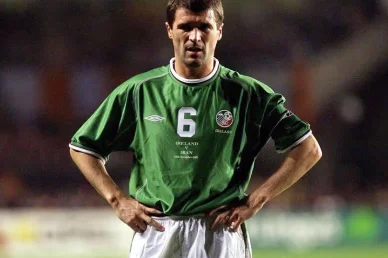
Roy Keane in action for Ireland
With that said, Keane’s captaincy divided opinion. For example, there’s the Saipan Incident, when Keane clashed with manager Mick McCarthy before the tournament and was sent home before the first kickoff. That wasn’t the only national team drama to centre around Keane, either. He was famous for having one training camp row after another, mostly because he held other players to his own high standards and was quick to complain if he felt that those standards weren’t being met.
That’s a great example of why Keane is such a polarising figure. For some, his high standards are what made the team great in the first place; for others, he pushed them too hard and it had a negative impact on their overall cohesion. And when he got sent home from Saipan, that was seen by many as abandoning his teammates.
The Move to Celtic and Keane’s Retirement
In 2005, Keane said goodbye to Manchester United and moved to Celtic, which would be the final chapter of his playing career, although he still had plenty left to give to football. Still, it acted as the perfect transition from being an elite captain to the next stage of his life and career.

Roy Keane Joined Celtic
At Celtic, Keane’s veteran presence allowed him to show some serious leadership for a new generation of players. He still had his trademark intensity, and there was no sign of the fire inside of him burning out, but he didn’t quite have the same fitness levels that he’d had as a younger man.
The Teams Keane Coached
After his retirement as an active player, Keane moved into management and began a successful coaching career. His management style was driven by his no-nonsense personality, and he continued to take no prisoners as a manager, just like he had on the pitch as a player.
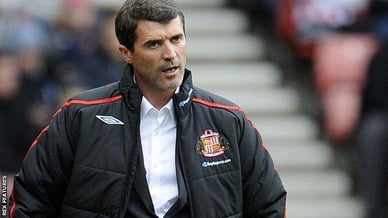
Roy Keane in Sunderland
The list of Roy Keane teams coached includes Sunderland (2006-2008), Ipswich Town (2009-2011), the Republic of Ireland (2013 and 2018), Aston Villa (2014) and Nottingham Forest (2019). His return to Forest is particularly interesting given that he’d started his career there as a player nearly 30 years earlier.
Keane was never known for being a diplomat, but that hasn’t stopped him from building a decent career as a manager. In fact, his no-nonsense man-management makes him the kind of boss that players either love or hate, which is pretty much the same as how people viewed his public identity back when he was a player. Either way, one thing is clear: Keane’s dedicated to success, both on the pitch and off.
Keane’s Life Off the Pitch
For a man like Roy Keane, there’s no such thing as retirement. Even off the pitch, he’s remained a prominent figure, especially amongst fans of the beautiful game. He’s written a few books, including an autobiography, and these are well worth reading if you’re looking to learn more about him.
He’s also built a reputation as an outspokenfootball pundit and the originator of a number of viral quotes thanks to his bluntness and no-nonsense reputation. You can often find him on air for Sky Sports, and he’s noted for the clarity and honesty of his analysis, although not everyone agrees with his directness.
Let’s take a look at some final facts about Roy Keane:
- Born: 10th August 1971, Cork, Ireland
- Games played: 676 senior club appearances with 87 goals (including 480 games and 51 goals for Manchester United)
- Silverware: Most notable wins include seven Premier League titles, four FA Cups and one Champions League title
- International Career: Captain of the Republic of Ireland team for several years, with 67 appearances between 1991 and 2005
- Managerial Highlight: Managing Sunderland to Premier League promotion
Why Roy Keane Still Matters
The impact that Roy Keane has had on the world of football can’t be overstated. His legacy goes far beyond a couple of key wins and the memorable goals that he scored. His high leadership standards and his run as an iconic captain for both Manchester United and the Republic of Ireland made him a household name and a key figure in popular culture.
In fact, there’s an argument to be made that Keane is an all-time great, thanks to his elite mentality and his insistence on discipline and professionalism even at the highest levels of English and international football. He’ll always be a controversial figure who inspires a huge amount of debate, but his accomplishments speak for themselves.
When we look back at Keane’s career, we don’t just remember the trophies, although there were plenty of those to talk about. Ultimately, it’s Keane’s dedication to the sport and the pursuit of excellence that sets him apart from his contemporaries. They don’t make players like him anymore.