The Irish Pound: The Punt, the Currency of Ireland and What it’s Worth Today
Known by locals as the punt, the Irish pound was the official currency of Ireland from 1928 until 2002, when it was replaced by the euro. The punt has a fascinating history that closely mirrors the history of the country itself, with it first being introduced after Ireland declared its independence.
Some punt coins have gone on to become highly sought after by coin collectors, which means that a lot of them are super valuable. And so with that in mind, let’s take a closer look at the punt.
The History of the Irish Pound/Punt: From 1928 Independence to the Euro
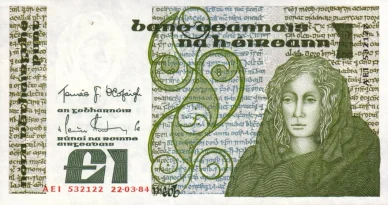
One Pound, Irish Banknote “B Series”
The Free State Creates the Punt in 1928
The story of the Irish pound begins when the struggle for independence led to Ireland breaking away from the British and establishing itself as the Irish Free State in 1922. At that point, the native Irish were still using the British pound sterling as the nation’s currency, but that didn’t sit well with those who’d worked so hard to break away from British rule.
That takes us up to 1928, when the country introduced the Free State pound, which is also known as the Saorstát punt. The punt was pegged at a 1:1 exchange rate with the British pound and was eventually renamed the Irish pound in 1938.
Ireland Joins the EMS and Separates from Sterling
In 1978, Ireland strengthened its national currency by joining the European Monetary System (EMS). Interestingly, the United Kingdom decided not to join, and it was this that led to the separation between the Irish pound (IEP) and the British pound sterling (GBP). After this point, the two of them no longer had a 1:1 exchange rate, with the parity breaking on March 30, 1979.

Irish Coins from before the Euro
This was the point at which an exchange rate between IEP and GBP was officially introduced, and it marked a further economic separation between Ireland and the UK at a time at which Irish independence was once again a hot topic. This was also when Ireland began to mint its own coins instead of relying on the British Royal Mint.
1999-2002: When the Irish Pound Changed to the Euro
The Transition to the Euro in 1999
If you’re wondering when the Irish pound changed to the euro, you’ve come to the right place. The simple answer is that Ireland agreed to the adoption of the euro in 1999, making the significant decision to adopt it while both the United Kingdom and Denmark declined. That led to an interesting period during which the country had to undergo a transition from one currency to another.
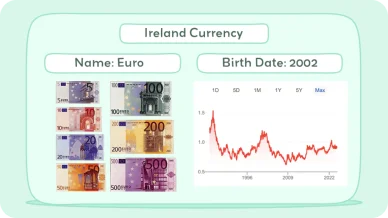
Ireland uses the euro as its official currency, which is also used by 18 other European Union countries
The euro became Ireland’s official currency on January 1, 1999 for electronic transactions, while physical notes and coins were introduced on January 1, 2002. The Irish pound was withdrawn from circulation on the same day, marking a full and immediate switch from the old to the new. It then ceased to be legal tender on February 9 of the same year.
2002: The Changeover Gains Public Support
The transition from pound to euro could easily have been controversial, but that turned out not to be the case. In fact, within just a week of the euro’s introduction, it was being used for 90% of all transactions, while over half of all cash was exchanged within the first couple of weeks.
This marked the fastest changeover in Europe, and the high levels of support could well be because the Irish pound still had historic links to the pound sterling. The rapid switch to the euro showed how the Irish public wanted to align themselves with Europe as opposed to the United Kingdom.
Irish Pound to EuroConversion Rate: 0.787564
The FixedIrish Pound to EuroConversion Factor of 1.26974
Of course, when you change from one currency to another, you need to be able to convert between them. On December 31, 1998, the Irish pound to euroconversion rate was fixed, with one euro equivalent to £0.787564 IEP. Looking at it from the other way round, that meant that an Irish pound was worth 1.26974 EUR.
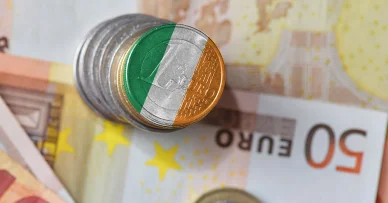
The euro (EUR) is the official currency of the Republic of Ireland
This made the Irish pound the only currency in the Eurozone that had a conversion factor of less than one, meaning that one unit in the initial currency was worth more than one euro. It’s also worth noting that the whole point of setting this conversion rate was to ensure that once it was fixed, it would never need to be changed.
Exchange Options for Redemption at the Central Bank
Knowing that you can convert the Irish pound to euro is one thing, but actually doing so is something else entirely. Fortunately, the process was made fairly simple, with all Irish pounds being redeemable at Dublin’s Central Bank at the fixed rate that we’ve just discussed. There was (and is) no fixed time limit for redemption, and those wishing to switch their currencies over could either mail their coins and notes in with ID or visit the bank in person.
Irish Pound Coins: Denominations and Designs
Decimal Coinage (Pounds and Pence)
Let’s take a closer look at the history of Irish pound coins, beginning with when the decimal system was introduced back on February 15, 1971. It’s worth noting that this took place on the same day as decimalisation was introduced to the UK, which makes sense considering that the two currencies were linked.
The decimal version of the Irish pound was available in the following denominations: 1/2p (halfpence or ha’penny), 1p, 2p, 5p, 10p, 20p, 50p and £1, although the ha’penny was withdrawn in 1987, three years after it was withdrawn in the United Kingdom.
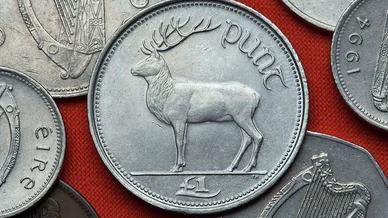
Collectors should look out for the distinctive Irish designs (e.g. animals and the harp), as well as for the commemorative £1 coins that were issued during special occasions. The wildlife designs by Percy Metcalfe tend to be particularly sought after.
Pre-Decimal Coinage: Shillings and Other Old Coins
Before the decimal system was launched, there was still an Irish pound coin; it was just worth something different and relied on you being able to understand the interactions between the pre-decimal coinage. This old system was less intuitive than the decimal system (which is why it was introduced in the first place), with the coins being worth the following:
- 12 pence = 1 shilling
- 20 shillings = 1 pound
There were also some “in-between” coins that coin collectors should be on the lookout for:
- 4 farthings = 1 penny
- 2 halfpennies = 1 penny
- 4 threepenny coins = 1 shilling
- 2 sixpences = 1 shilling
- 10 florins = 1 pound
- 8 half-crowns = 1 pound
- 4 crowns = 1 pound
These coins date back to 1928, and they were produced in the same size as the ones in Britain for convenience and ease of manufacturing. If you find coins that date back this far, they could be worth far more than their face value.
Irish Pound Coin Value Now: Collectible Coins and Redemption Options
Redeeming Coins for Face Value at the Central Bank
If you still have Irish coins (either pre- or post- decimal), it’s worth knowing that they can still be redeemed at the Central Bank of Ireland. The Irish pound coin value depends upon how you look at it. The Central Bank will give you their face value, but it’s always worth checking that they’re not worth more than that if you turn to the collectors’ market.
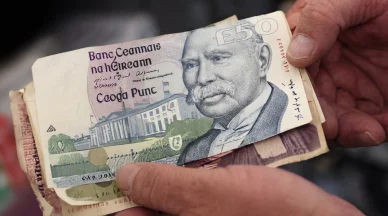
The Central Bank is still offering an exchange service for old Irish pound notes or coins as well as damaged euro notes and coins
The redemption process is pretty simple; as we mentioned earlier, you simply need to mail in your coins with proof of your identity or visit the Central Bank in person. In fact, they’ve put a lot of work into making the process as simple as possible.
Rare Coins’ Value to Collectors
As we’ve hinted at throughout this article, some rare coins are collectible and worth far more money if you sell them than they are if you simply redeem them for their face value. The trick is to do your research up front and to know the rare dates and the low mintage years, as well as when special coins were created. For example, collectors tend to go wild for the 1966 Easter Rising 10 shillings and the 1988 millennium £1.
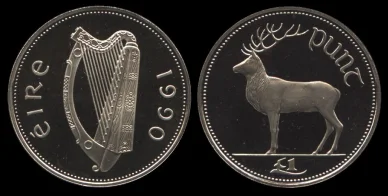
Irish Decimal Pound
It’s even better if you’re able to find a rare Irish pound coin that’s in uncirculated condition, meaning that it looks as new as it did when it left the mint. They tend to be particularly collectible, as do the proof sets from 1928 to 1937 and any error coins (i.e. those with mistakes on them).
Tips for Collecting and Preservation
So where exactly can you find Irish pound coins, and how can you start collecting and preserving them? Well, that’s a good question.
The coins are available from a variety of sources, from coin dealers in Ireland to online auctions on sites like eBay, as well as more specialised sites that are specifically designed with collectors in mind. Other options include coin fairs and estate sales. If you’re lucky, you can get your hands on a job lot of assorted coins for a bargain and find a rare treasure that the seller overlooked.
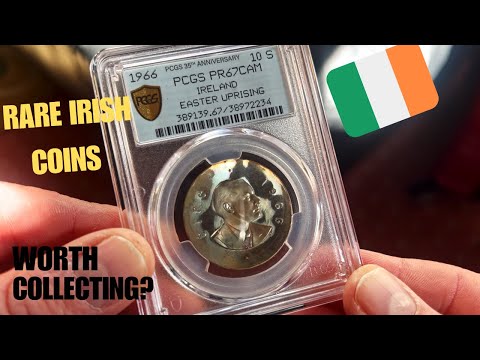
Rare Irish Coins You’ve Never Seen
Be sure to get your coins authenticated if they’re particularly valuable, and to spend some time learning how best to preserve them. Avoid cleaning them (because it reduces their value) and consider investing in protective capsules.
Legacy, Nostalgia and the Cultural Significance of the Irish Pound
The Pound as a Symbol of Irish Independence
We can’t stress enough how important the Irish pound is as a symbol of the country’s independence, from the days of the Irish Free State in 1922 to the country’s decision to adopt the euro while the Brits decided not to. The successful transition to the euro is also a reminder of how positively Ireland looks at the European Union.
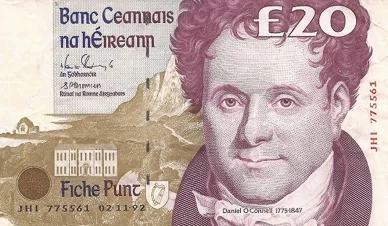
The Irish pound was introduced in 1928, six years after independence from the United Kingdom
There’s an argument to be made that the pound has a significance and a legacy that goes far beyond its monetary value and the things that it allowed people to buy. It’s had an impact on popular culture, is looked back fondly and with nostalgia by the older generations, and it’s seen as an important part of the country’s overall story.
Guidance on the Irish Pound
Let’s take a look at a few of the key facts that we’ve talked about in today’s guide. The best place to start is by answering the question of when did the Irish pound change to the euro? The simple answer is that after being used from 1928 to 2002, the Irish pound was replaced by the euro on January 1, 2002, with a conversion rate of 1 euro = £0.787564 IEP.
To convert IEP into euros, you can multiply the number of IEP by 1.26974. In other words:
- 100 euros = £78.76 IEP
- £100 IEP = 126.97 EUR
When it comes to redemption and collection, the summary is that all coins and notes are redeemable at Dublin’s Central Bank and will continue to be so indefinitely. However, before you trade your pounds into euros, you should check for rare dates, collectable coins, proof sets and uncirculated coins.
The good news is that there’s plenty of information out there online, and today’s article should have helped to give you a good idea of what you’re dealing with. So whether you’re collecting coins or selling the collectible coins you’ve got your hands on, good luck!